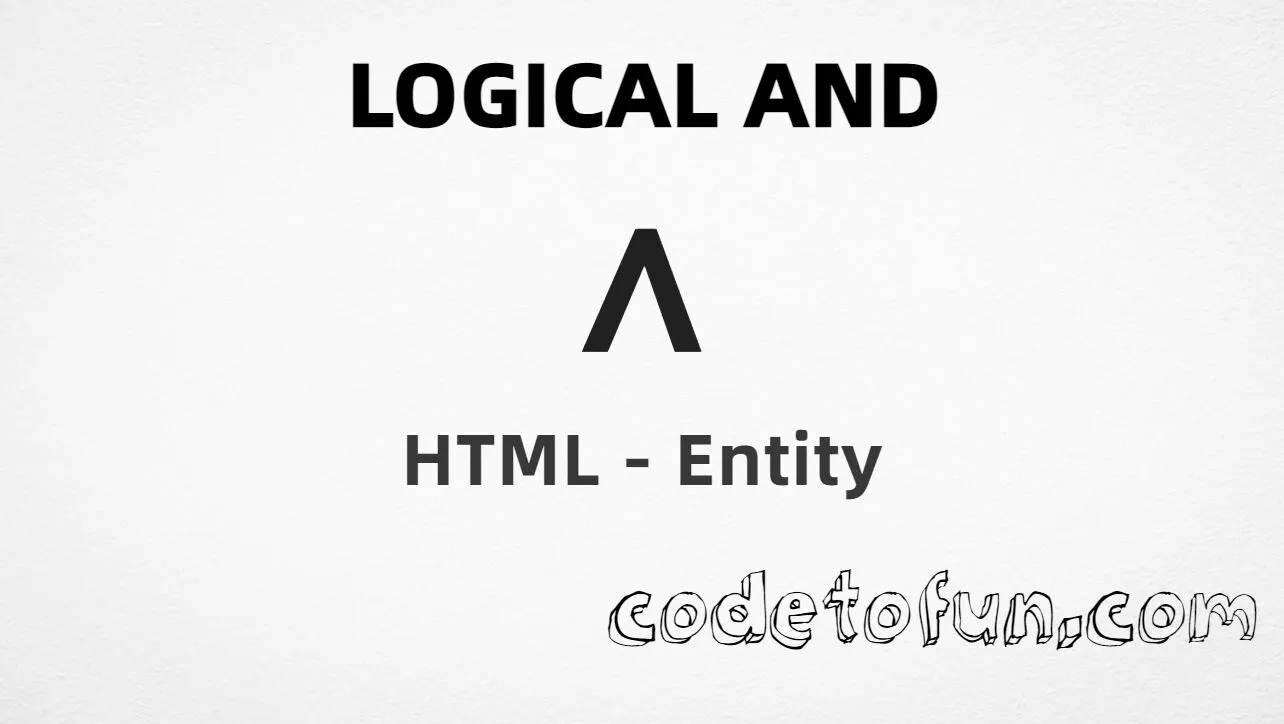
HTML Entity for Logical AND (∧)

What You'll Learn
How to display the Logical AND (∧) symbol in HTML using hexadecimal, decimal, named entity, and CSS escape methods. This character is U+2227 (LOGICAL AND) in the Mathematical Operators block (U+2200–U+22FF).
Render it with ∧, ∧, ∧, or CSS escape \2227. It denotes logical conjunction (“and”) in logic, mathematics, and programming. Related: Logical OR (∨, ∨) is disjunction, not the same as ∧.
⚡ Quick Reference — Logical AND
U+2227Mathematical Operators
∧Hexadecimal reference
∧Decimal reference
∧Most readable option
Name Value
──────────── ──────────
Unicode U+2227
Hex code ∧
HTML code ∧
Named entity ∧
CSS code \2227
Meaning Logical AND (conjunction)
Related U+2228 = OR (∨)
Block Mathematical Operators (U+2200–U+22FF)Complete HTML Example
A simple example showing the Logical AND symbol (∧) using hexadecimal code, decimal HTML code, the named entity, and a CSS content escape:
<!DOCTYPE html>
<html>
<head>
<style>
#point:after{
content: "\2227";
}
</style>
</head>
<body>
<p>Symbol (hex): ∧</p>
<p>Symbol (decimal): ∧</p>
<p>Symbol (named): ∧</p>
<p id="point">Symbol (CSS): </p>
</body>
</html>🌐 Browser Support
The Logical AND symbol (∧) is supported in modern browsers with a math-capable font:
👀 Live Preview
See the Logical AND symbol (∧) in logic and programming contexts:
🧠 How It Works
Hexadecimal Code
∧ uses the Unicode hexadecimal value 2227 to display the symbol.
Decimal HTML Code
∧ uses the decimal Unicode value 8743 to display the same character.
Named Entity
∧ is the semantic named entity for ∧—readable in source HTML and part of the HTML5 character set.
CSS Entity
\2227 is used in CSS stylesheets, particularly in the content property of pseudo-elements.
Same visual result
All four methods produce the glyph: ∧. Unicode U+2227 is in Mathematical Operators. Related: Curly Logical AND, Logical OR.
Use Cases
The Logical AND symbol (∧) is commonly used in:
Represent logical conjunction in formal logic (e.g., P ∧ Q).
Explain boolean AND operators and truth tables in educational content.
Formal definitions and proofs in mathematics and computer science.
Intersection and logical connectives in set notation discussions.
Circuit diagrams, AND gates, and digital logic explanations.
Show search syntax and filter logic in documentation.
Document logical operators in API docs and language references.
💡 Best Practices
Do
- Use
∧for readable source markup in logic content - Use math fonts (Cambria Math, Noto Sans Math) for reliable rendering
- Clarify that ∧ is logical AND, not exponentiation (^)
- Provide context when meaning matters (e.g. “P AND Q”)
- Serve pages with UTF-8 (
<meta charset="utf-8">)
Don’t
- Confuse
∧with the HTML<and>tag name in prose - Confuse ∧ (logical AND) with the caret
^used for exponentiation - Put CSS escape
\2227in HTML text nodes - Rely on the symbol alone for screen reader users
- Assume every system font renders Mathematical Operators clearly
Key Takeaways
Four HTML/CSS references all render ∧
∧ ∧ ∧For CSS stylesheets, use the escape in the content property
\2227Unicode U+2227 — LOGICAL AND
Prefer ∧ for readability; OR is ∨ (∨)
Previous: Lj (lj) Next: Logical OR (∨)
❓ Frequently Asked Questions
∧ (hex), ∧ (decimal), ∧ (named), or \2227 in CSS content. All produce ∧.U+2227 (LOGICAL AND). Mathematical Operators block (U+2200–U+22FF). Hex 2227, decimal 8743. Named entity: ∧.∧ is the named HTML entity for ∧. It is part of the HTML5 named character set and the most readable option in source markup.∧) is logical conjunction (AND). ∨ (∨) is logical disjunction (OR). They represent different boolean operations.Explore More HTML Entities!
Discover 1500+ HTML character references — logic operators, math symbols, and more.
8 people found this page helpful