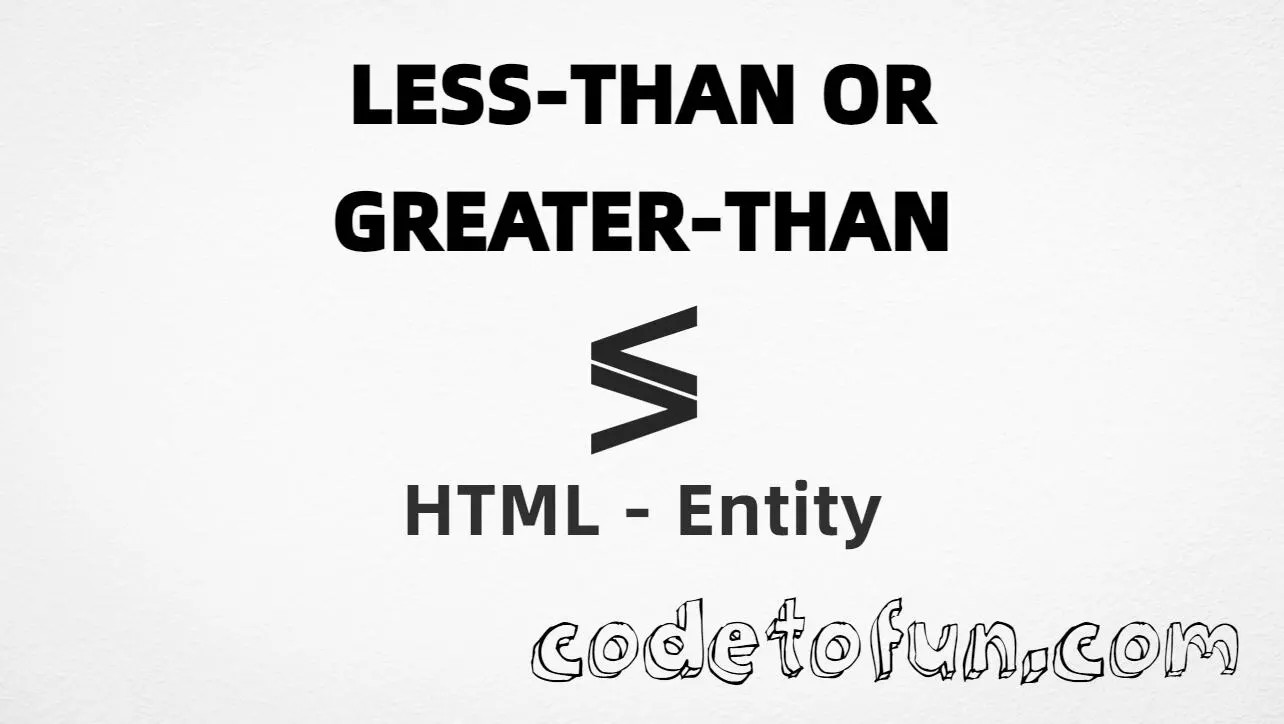
Less Than Or Greater Than (≶) is the Mathematical Operators character at Unicode U+2276 (LESS-THAN OR GREATER-THAN). It stacks less-than and greater-than in one relation glyph — without an equal bar.
Remember
Character     ≶
Unicode       U+2276
Named entity  ≶  or  ≶
Hex entity    ≶
Decimal       ≶
CSS escape    \2276
Not the same  ⋚ (⋚) · ≷ (≷) · ≠ (≠)
Prefer ≶ or ≶ in HTML. Alternatives: ≶ or ≶. Add the equal bar with ⋚ when you need less-than equal to or greater-than.
Using Named: ≶
Using Alias: ≶
Using Hex Code: ≶
Using HTML Code: ≶
Using CSS Entity: ≶
a ≶ b
How It Works
1. Named:≶ and ≶ are HTML5 names for U+2276 → ≶. Prefer these for readable source.
2. Hex:U+2276 → ≶ in HTML. Same glyph as named.
3. Decimal: same code point as 8822 → ≶.
4. CSS: use \2276 in content (not an HTML entity). #point::after appends that ≶ after the paragraph text.
5. Look-alikes:⋚ adds an equal bar; ≷ flips the order to greater-than first.
Pitfalls & Tips
Common mistakes when working with Less Than Or Greater Than.
Look-alikes
≶ ≠ ⋚
⋚ (U+22DA) includes an equal bar. Use ≶ only when equality is not part of the relation.
Pair
Mirror is ≷
Greater-than or less-than is U+2277 — use ≷, not a CSS flip of this glyph.
Not ≠
Different from ≠
≠ means not equal. ≶ means less-than or greater-than as a stacked comparison glyph.
Fonts
Math glyph coverage
Most modern fonts include U+2276, but verify on target devices if the symbol is critical.
CSS vs HTML
Do not mix escapes
\2276 belongs in CSS. ≶ / ≶ / ≶ belong in HTML.
A11y
Add nearby words
Pair the glyph with label text (for example a ≶ b) or use aria-label when it stands alone.
Semicolon
End references
Always finish with ; — write ≶, not &lg.
Compatibility
Browser Support
Less Than Or Greater Than (U+2276) and its entity forms (≶, ≶, ≶, ≶, CSS \\2276) are supported in all modern browsers. Glyph coverage depends on the font.
✓ Universal encoding
Less Than Or Greater Than (≶)
Encode with named, hex, decimal, or CSS escape — or type ≶ directly in UTF-8 HTML.
100%Browser coverage
Google ChromeSupported
Yes
Microsoft EdgeSupported
Yes
Mozilla FirefoxSupported
Yes
Apple SafariSupported
Yes
OperaSupported
Yes
Internet ExplorerIE 9+
Yes*
U+2276Full support
Bottom line: Prefer ≶ or ≶ for readable HTML. Use \\2276 only inside CSS content.
Remember
Key Takeaways
Unicode: this symbol is U+2276 (decimal 8822).
HTML: prefer ≶ or ≶ — also ≶ / ≶.
Use ≶ or ≶ (named), ≶ (hex), ≶ (decimal), or the CSS escape \2276 in the content property. All render ≶ when the font supports Mathematical Operators.
U+2276 (LESS-THAN OR GREATER-THAN). Hex 2276, decimal 8822. It belongs to Mathematical Operators (U+2200–U+22FF).
Yes. HTML5 defines ≶, ≶, and ≶ for U+2276. Prefer ≶ or ≶ for readable math markup.
Use it when a value is either less than or greater than another (not equal) — the stacked </> style relation without an equal bar. Prefer named entities for readable source.
HTML entities (≶, ≶, ≶, or ≶) go in markup. The CSS escape \2276 is used in stylesheets (usually in the content property of ::before/::after). Both render ≶.
≶ (U+2276) is less-than or greater-than without an equal bar. ⋚ (U+22DA) adds the equal component. ≷ (U+2277) is the greater-than-first mirror.
🤔
Did you know?
Less Than Or Greater Than is Unicode U+2276 (decimal 8822) — LESS-THAN OR GREATER-THAN in Mathematical Operators. HTML5 named entities: ≶ and ≶ (also ≶). Mirror form: ≷ (U+2277). With an equal bar, use ⋚ (U+22DA) instead.