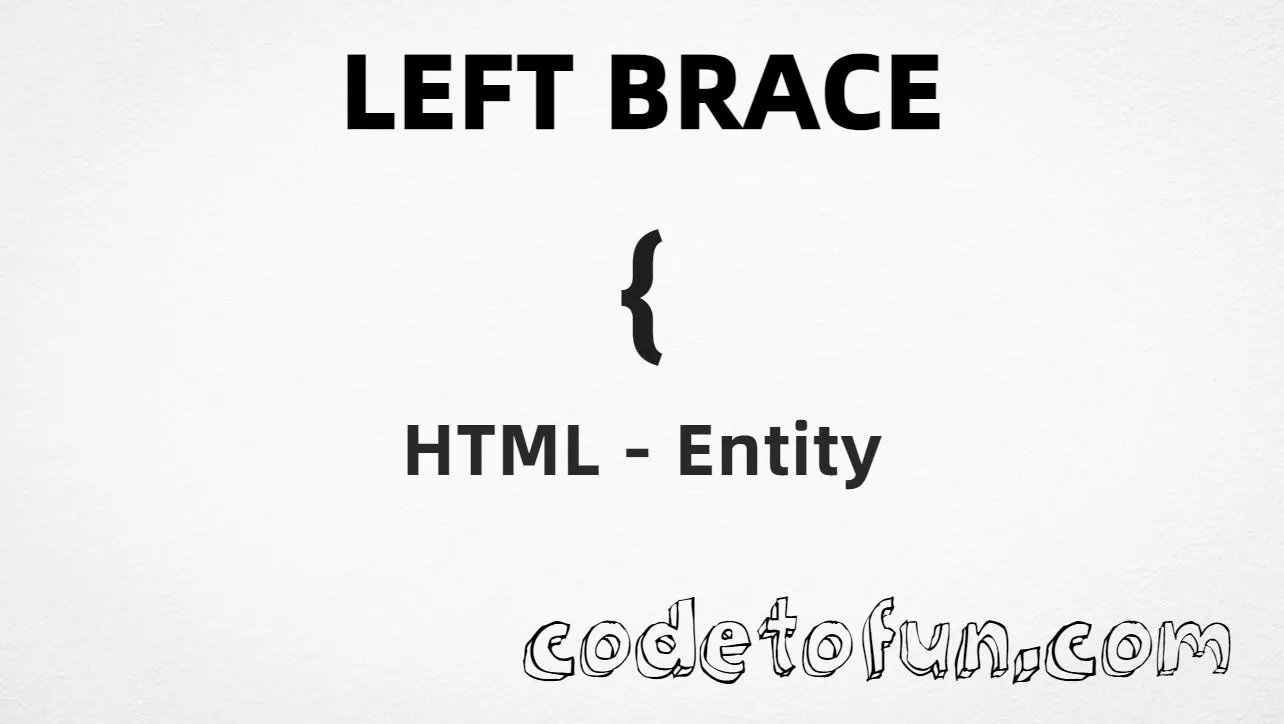
Left Brace ({) is the Basic Latin character at Unicode U+007B (LEFT CURLY BRACKET). It opens code blocks, JSON objects, and set notation — and pairs with }.
Remember
Character     {
Unicode       U+007B
Hex entity    {
Decimal       {
Named entity  {  (alias {)
CSS escape    \7B
Not the same  [ (bracket) · ( (parenthesis)
All of these produce the same glyph: {. Prefer { when you want an explicit entity; typing { directly is fine in normal UTF-8 HTML.
Use { (named), { (hex), { (decimal), or the CSS escape \7B in the content property. You can also type { directly in UTF-8 HTML.
U+007B (LEFT CURLY BRACKET). Hex 7B, decimal 123. It belongs to the Basic Latin (ASCII) block.
Yes. { is the primary HTML5 named entity. { is a supported alias. You can also use { or {.
Use it when documenting code, JSON, or math sets and you want an explicit entity. For normal body text, typing { directly is usually fine.
HTML entities ({, {, or {) go in markup. The CSS escape \7B is used in stylesheets (usually in the content property of ::before/::after). Both render {.
[ is Left Bracket (U+005B). ( is Left Parenthesis (U+0028). { is the left curly brace (U+007B).
🤔
Did you know?
Left Brace is Unicode U+007B (decimal 123) — LEFT CURLY BRACKET. HTML5 provides { (alias {). Prefer it for readable source, or use { / {. Pair it with } (U+007D) for matching braces.