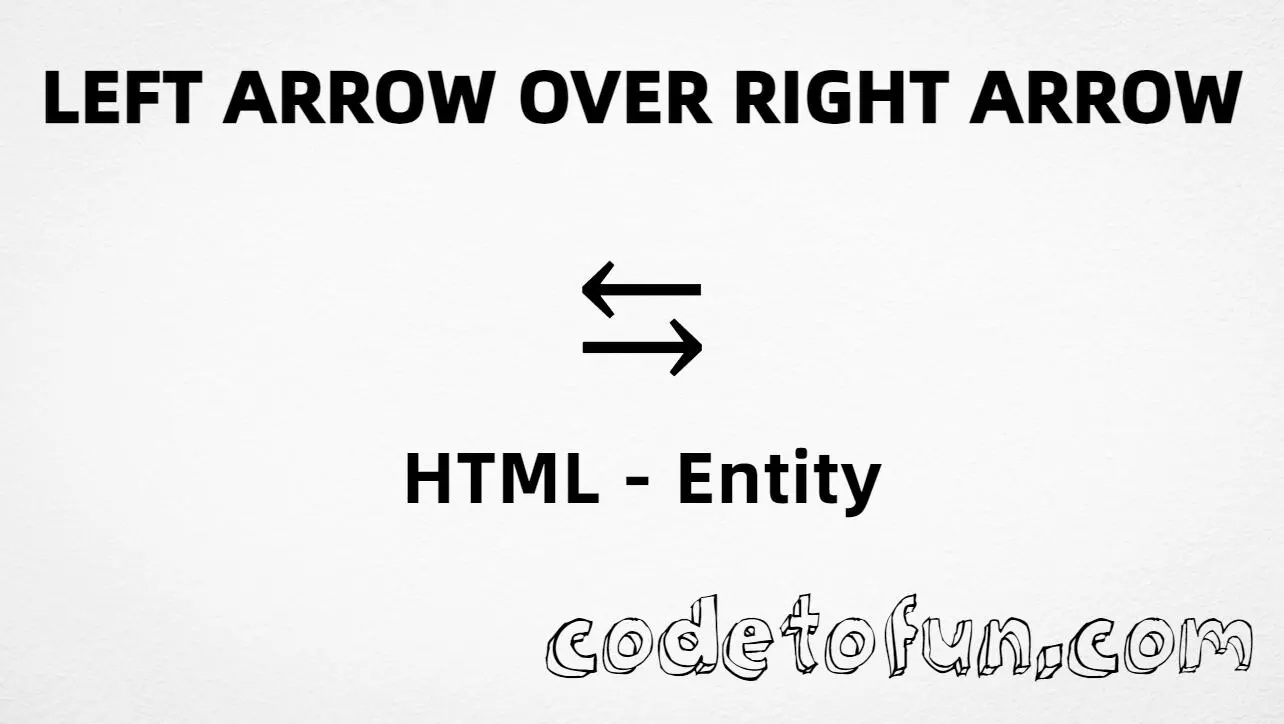
Left Arrow Over Right Arrow (⇆) is the Arrows character at Unicode U+21C6 (LEFTWARDS ARROW OVER RIGHTWARDS ARROW). It stacks a leftwards arrow above a rightwards arrow — useful for swap and bidirectional UI.
Remember
Character     ⇆
Unicode       U+21C6
Hex entity    ⇆
Decimal       ⇆
Named entity  ⇆
CSS escape    \21C6
Not the same  ⇄ (⇄) · ↔ (↔)
All of these produce the same glyph: ⇆ (when the font supports U+21C6). Prefer ⇆ in HTML source for clarity; use hex/decimal when generating entities, and CSS \21C6 only in content.
Using Hex Code: ⇆
Using HTML Code: ⇆
Using Named Entity: ⇆
Using CSS Entity: ⇆
⇆ Swap
How It Works
1. Hex:U+21C6 → ⇆ in HTML. The browser turns it into ⇆.
2. Decimal: same code point as 8646 → ⇆. Same result as hex.
3. Named:⇆ is the HTML5 name for this character.
4. CSS: use \21C6 in content (not an HTML entity). #point::after appends that ⇆ after the paragraph text.
Pitfalls & Tips
Common mistakes when working with Left Arrow Over Right Arrow.
Stacking
⇆ ≠ ⇄
Left-over-right is U+21C6. Right-over-left is U+21C4 (⇄). The letter order in the name matches the stack.
Look-alikes
Not single ↔
↔ (U+2194) is one left-right arrow — not two stacked arrows.
A11y
Label the action
Pair ⇆ with words like “Swap” or “Exchange”, or use aria-label.
CSS vs HTML
Do not mix escapes
\21C6 belongs in CSS. ⇆ / ⇆ / ⇆ belong in HTML.
Fonts
Arrows coverage
Most modern UI fonts include U+21C6. If a glyph is missing, try Segoe UI Symbol or Noto Sans Symbols.
Semicolon
End references
Always finish with ; — write ⇆, not &lrarr.
Compatibility
Browser Support
Left Arrow Over Right Arrow (U+21C6) and its entity forms (⇆, ⇆, ⇆, CSS \\21C6) are supported in modern browsers when the font includes the Arrows block.
✓ Universal support
Left Arrow Over Right Arrow (⇆)
Encode with named, hex, decimal, or CSS escape — same character when the font supports U+21C6.
100%Browser coverage
Google ChromeSupported
Yes
Microsoft EdgeSupported
Yes
Mozilla FirefoxSupported
Yes
Apple SafariSupported
Yes
OperaSupported
Yes
Internet ExplorerAll versions
Yes
U+21C6 / ⇆Full support
Bottom line: Prefer ⇆ in HTML. Use \\21C6 only inside CSS content. Do not confuse with ⇄ or ↔.
Use ⇆ (named), ⇆ (hex), ⇆ (decimal), or the CSS escape \21C6 in the content property. All render ⇆ when the font supports the Arrows block.
U+21C6 (LEFTWARDS ARROW OVER RIGHTWARDS ARROW). Hex 21C6, decimal 8646. It belongs to the Arrows block (U+2190–U+21FF).
Yes. ⇆ is the HTML5 named entity for U+21C6. You can also use ⇆ or ⇆.
Use it for swap/exchange UI, bidirectional diagrams, and technical notation that needs a leftwards arrow stacked over a rightwards arrow. Prefer ⇆ for readable HTML source.
HTML entities (⇆, ⇆, or ⇆) go in markup. The CSS escape \21C6 is used in stylesheets (usually in the content property of ::before/::after). Both render ⇆.
U+21C4 (⇄, ⇄) stacks a rightwards arrow over a leftwards arrow. U+2194 (↔, ↔) is a single left-right arrow. U+21C6 is left-over-right stacking.
🤔
Did you know?
Left Arrow Over Right Arrow is Unicode U+21C6 (decimal 8646) — LEFTWARDS ARROW OVER RIGHTWARDS ARROW. HTML5 provides the named entity ⇆. Prefer it for readable source, or use ⇆ / ⇆. Do not confuse it with the flipped stacking ⇄ (U+21C4, ⇄) or the single left-right arrow ↔ (U+2194).