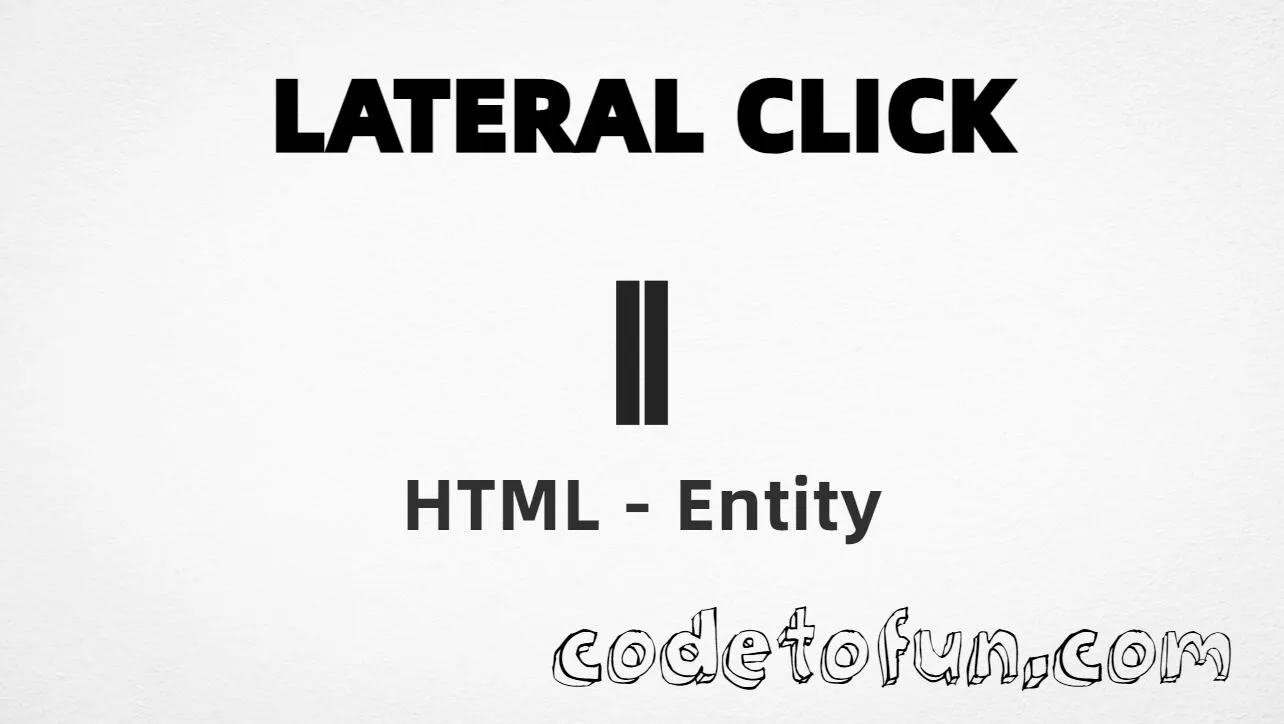
Lateral click (ǁ) is the Unicode character at U+01C1 in the Latin Extended-B block. Official name: LATIN LETTER LATERAL CLICK. It represents a lateral click sound in IPA and related orthographies.
Remember
Character     ǁ
Unicode       U+01C1
Hex entity    ǁ
Decimal       ǁ
CSS escape    \01C1
Named entity  (none)
Not the same  || (two ASCII pipes)
Prefer typing ǁ in UTF-8 HTML when your editor supports it; use ǁ or ǁ when you need an explicit entity.
Lateral click using Hex Code: ǁ
Lateral click using HTML Code: ǁ
Lateral click using CSS Entity: ǁ
Typed directly: ǁ
How It Works
1. Hex:U+01C1 → ǁ in HTML → ǁ.
2. Decimal: same code point as 449 → ǁ. Same result as hex.
3. CSS: use \01C1 in content (not an HTML entity). #point::after appends that ǁ after the paragraph text.
4. Typed: in a UTF-8 page you can paste ǁ directly. All four lines show the same glyph.
Pitfalls & Tips
Common mistakes when working with Lateral Click.
Named?
No named entity
HTML5 has no &…; name for U+01C1. Use ǁ or ǁ.
||
Not two ASCII pipes
ASCII || is two U+007C characters. Prefer ǁ for the lateral click letter so search and IPA tools treat it correctly.
Series
Other click letters
U+01C0–U+01C3 cover dental, lateral, alveolar, and retroflex clicks. Pick the code point that matches the sound.
CSS vs HTML
Do not mix escapes
\01C1 belongs in CSS strings. ǁ / ǁ belong in HTML.
Fonts
IPA font coverage
Some fonts omit U+01C1. Prefer Charis SIL, Noto Sans, or Segoe UI for reliable glyphs.
Semicolon
End references
Always finish with ; — write ǁ, not ǁ.
Compatibility
Browser Support
Lateral click (U+01C1) and its numeric entity forms (ǁ, ǁ, CSS \\01C1) are supported in all mainstream browsers. Visible glyphs depend on Latin Extended-B / IPA font coverage.
✓ Universal support
Lateral Click (ǁ)
Encode with hex, decimal, CSS escape, or type the character — same code point everywhere encoding is supported.
100%Browser coverage
Google ChromeSupported
Yes
Microsoft EdgeSupported
Yes
Mozilla FirefoxSupported
Yes
Apple SafariSupported
Yes
OperaSupported
Yes
Internet ExplorerAll versions
Yes
U+01C1 / entitiesFull support
Bottom line: Use ǁ or ǁ in HTML when you need this click letter, and \\01C1 only inside CSS content. Do not substitute ASCII ||.
Remember
Key Takeaways
Unicode: lateral click is U+01C1 (decimal 449) — glyph ǁ.
HTML: type ǁ, or use ǁ / ǁ (no named entity).
CSS: use \01C1 inside content for generated text.
Watch out:ǁ ≠ ASCII || — use the real click letter for IPA.
One line:U+01C1 → ǁ / ǁ / CSS \01C1 / type ǁ.
Frequently Asked Questions
Use ǁ (hex), ǁ (decimal), type ǁ directly in UTF-8, or the CSS escape \01C1 in content. There is no named HTML entity for U+01C1.
U+01C1 (LATIN LETTER LATERAL CLICK). Hex 01C1, decimal 449. It belongs to the Latin Extended-B block (U+0180–U+024F).
No. Use numeric references like ǁ or ǁ, or type the character ǁ in a UTF-8 document.
Use it for IPA phonetic transcription and orthographies that need the lateral click letter (for example in some Khoisan and Nguni language materials).
HTML entities (ǁ or ǁ) go in markup. The CSS escape \01C1 goes in stylesheet strings (usually content on ::before/::after).
ǁ (U+01C1) is a single Latin letter for the lateral click. Two ASCII pipes || are two U+007C characters. ‖ (U+2016) is DOUBLE VERTICAL LINE — a different symbol.
🤔
Did you know?
Lateral click is Unicode U+01C1 (decimal 449) — glyph ǁ in the Latin Extended-B block. Official name: LATIN LETTER LATERAL CLICK. HTML5 has no named entity. It is used in IPA and some African language orthographies. It is not two ASCII pipes || or double vertical line (U+2016).