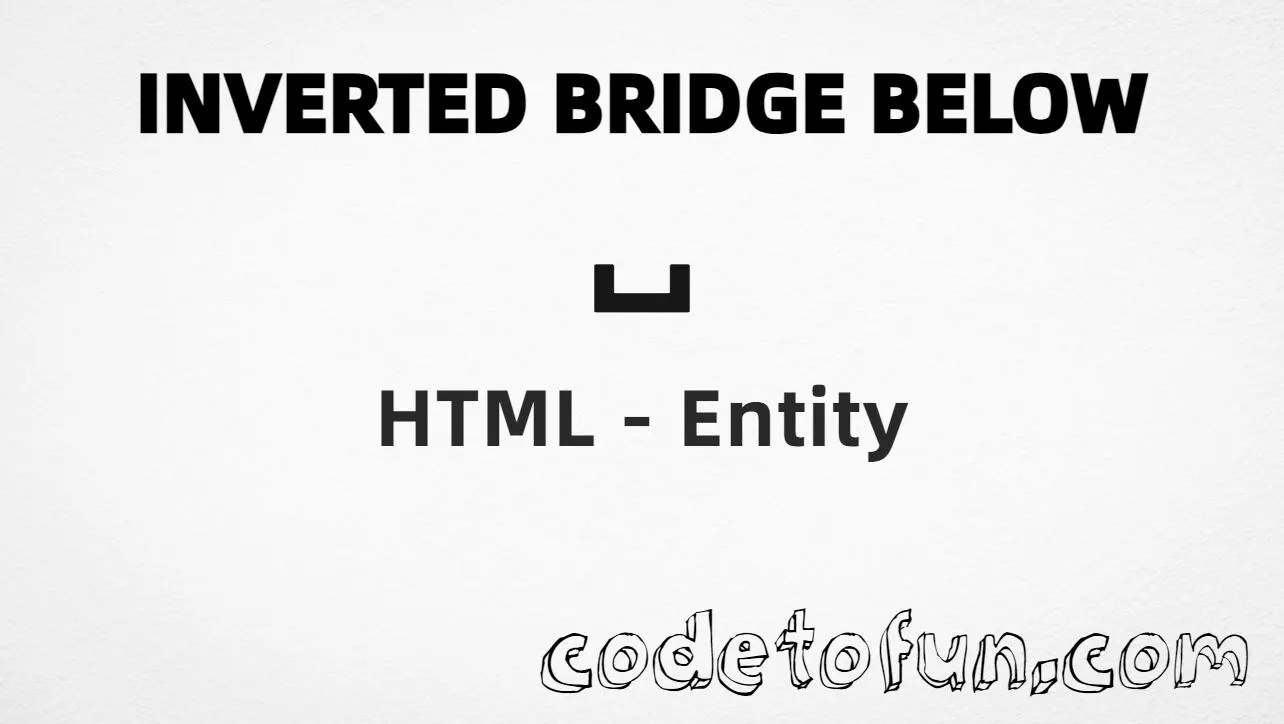
Inverted Bridge Below is the combining diacritic at Unicode U+033A (COMBINING INVERTED BRIDGE BELOW). It sits below a base letter — common in IPA for apical articulation (e.g. t̺).
Remember
Mark          combining inverted bridge below
Unicode       U+033A
Hex entity    ̺
Decimal       ̺
CSS escape    \033A
Named entity  (none)
Order         base letter + mark  →  t̺
Combining marks are not standalone letters. Write the base character first, then the entity (e.g. t̺ → t̺).
Reference
Quick Reference
One table for every form you will actually use.
Form
Code
Where it goes
Hex entity
̺
HTML after the base letter
Decimal entity
̺
HTML after the base letter
CSS escape
\033A
Stylesheet content (often ::after)
Direct character
base + U+033A
UTF-8 HTML text
Named entity
—
Not defined in HTML5
When to Use Which
Situation
Use
Need an entity in HTML source
t̺ or t̺
Generated mark via ::after
content: "\033A" on an element that ends with the base letter
Using Hex Code: t̺
Using HTML Code: t̺
Using CSS Entity: t̺
Typed directly: t̺
How It Works
1. Hex:U+033A → ̺ after the base letter. The browser combines them into t̺.
2. Decimal: same code point as 826 → ̺. Same result as hex.
3. CSS: use \033A in content (not an HTML entity). #point::after appends the mark below the letter t.
4. Typed: in UTF-8 you can type the base letter and the combining mark directly — same visual result.
Pitfalls & Tips
Common mistakes when working with combining Inverted Bridge Below.
Order
Base letter first
Write t̺, not ̺t. Combining marks follow the base.
Named?
No named entity
HTML5 does not define a named entity for U+033A. Use numeric forms.
CSS vs HTML
Do not mix escapes
\033A belongs in CSS. ̺ / ̺ belong in HTML.
Look-alikes
Not U+032A
U+032A is bridge below (often dental). U+033A is the inverted form (often apical).
Semicolon
End references
Always finish with ; — write ̺, not ̺.
Fonts
Diacritic support
Use fonts with good below-base combining support (e.g. Charis SIL, DejaVu Sans, Noto Sans).
Compatibility
Browser Support
Combining Inverted Bridge Below (U+033A) and its numeric entity forms (̺, ̺, CSS \\033A) are supported in all mainstream browsers when the font positions Combining Diacritical Marks correctly.
✓ Universal support
Inverted Bridge Below (U+033A)
Encode with hex, decimal, or CSS escape — attach after the base letter for correct combining below.
100%Browser coverage
Google ChromeSupported
Yes
Microsoft EdgeSupported
Yes
Mozilla FirefoxSupported
Yes
Apple SafariSupported
Yes
OperaSupported
Yes
Internet ExplorerAll versions
Yes
U+033A / entitiesFull support
Bottom line: Prefer base̺ or base̺ in HTML. Use \\033A only inside CSS content. Rendering quality depends on the font.
Remember
Key Takeaways
Unicode: combining inverted bridge below is U+033A (decimal 826).
HTML: use ̺ or ̺after the base letter.
CSS: use \033A inside content for generated marks.
Order: always base + mark — never the reverse.
One line:U+033A → t̺ / t̺ / CSS \033A.
Frequently Asked Questions
Use ̺ (hex), ̺ (decimal), or the CSS escape \033A in the content property. There is no named HTML entity. Place the mark immediately after the base letter (e.g. t̺).
U+033A (COMBINING INVERTED BRIDGE BELOW). Hex 033A, decimal 826. It belongs to the Combining Diacritical Marks block.
No. HTML5 does not define a named entity for this combining mark. Use numeric references like ̺ or ̺.
Use it in IPA and linguistics for apical articulation (e.g. t̺, n̺). Always write base letter first, then the combining mark.
HTML entities (̺ or ̺) go in markup after the base character. The CSS escape \033A is used in stylesheets (usually in the content property of ::after). Both apply the combining mark below the letter.
U+032A is COMBINING BRIDGE BELOW (often dental). U+033A is the inverted bridge below (often apical). U+032F is inverted breve below — a different shape used for non-syllabic vowels.
🤔
Did you know?
Inverted Bridge Below is Unicode U+033A (decimal 826) — COMBINING INVERTED BRIDGE BELOW. HTML5 has no named entity. Place it after the base letter (e.g. t̺). Used in IPA for apical articulation.