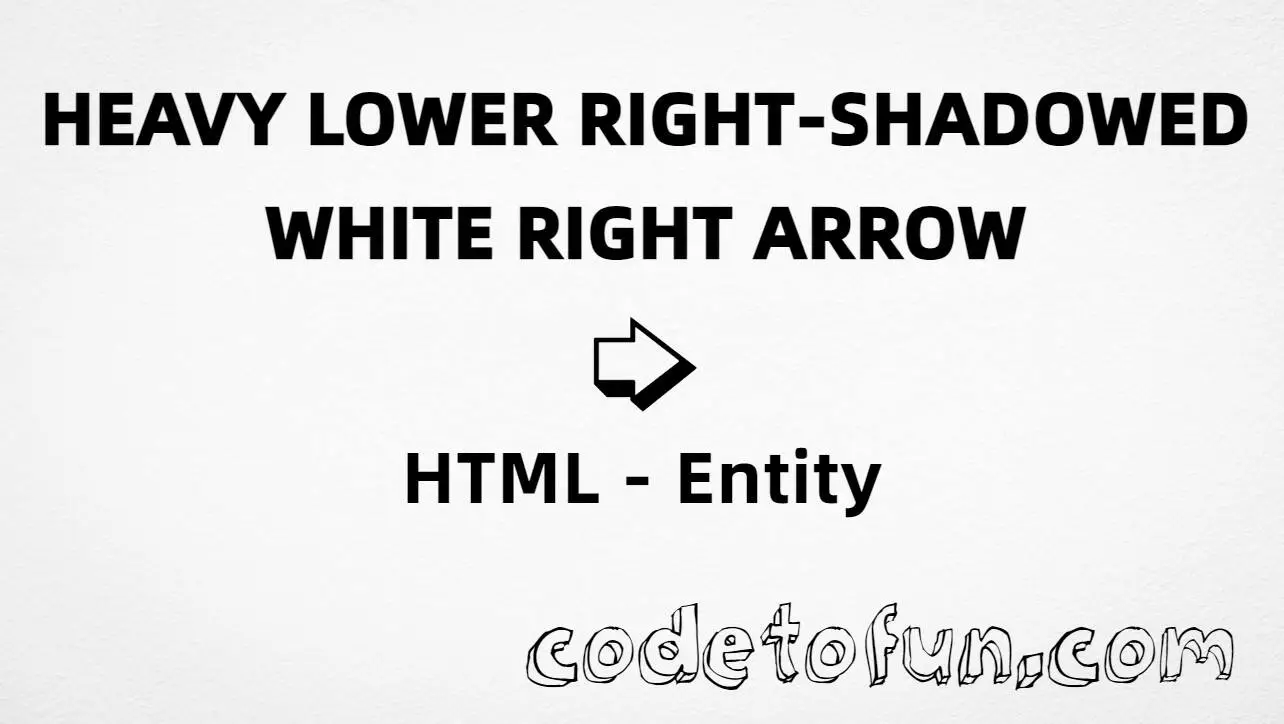
HTML Entity for Heavy Lower Right Shaded White Right Arrow (➭)
Beginner
5 min read
Updated: Sep 2026
1 example
Unicode U+27AD
Definition
What Is Heavy Lower Right Shaded White Right Arrow?
Heavy lower right shaded white right arrow (➭) is the Unicode character at U+27AD in Dingbats. Official name: HEAVY LOWER RIGHT-SHADOWED WHITE RIGHTWARDS ARROW. It is a bold white rightwards cue with a lower-right shadow, used for next, continue, and decorative navigation.
Remember
Character     ➭
Unicode       U+27AD
Hex entity    ➭
Decimal       ➭
CSS escape    \27AD
Named entity  (none)
Meaning       white right arrow, lower-right shadow
Not the same  ➮ · ➡ · → (→)
Prefer ➭ or ➭ in HTML (no named form). You can also type ➭ in a UTF-8 document. For a simple text arrow, prefer → (→).
Symbol alone, in a sample label, and next to related forms.
Glyph➭
Large glyph➭
SampleContinue ➭
Compared➭ ➮ ➡ →
With entitiesHex: ➭ | Decimal: ➭
Code
Complete HTML Example
One page that shows heavy lower right shaded white right arrow with hex, decimal, CSS escape, and a typed character. Use View Output or open the live editor.
Hex + Decimal + CSS + Typed
Four ways to display ➭ in HTML and CSS.
html
<!DOCTYPE html>
<html lang="en">
<head>
<meta charset="UTF-8">
<title>Heavy Lower Right Shaded White Right Arrow (U+27AD) in HTML</title>
<style>
#point::after {
content: "\27AD";
}
</style>
</head>
<body>
<p>Built with Hex: ➭</p>
<p>Built with Decimal: ➭</p>
<p id="point">Built with CSS: </p>
<p>Typed: ➭</p>
<p><span aria-label="Next">Continue ➭</span></p>
<p>Simple arrow: →</p>
</body>
</html>
Built with Hex: ➭
Built with Decimal: ➭
Built with CSS: ➭
Typed: ➭
Continue ➭
Simple arrow: →
How It Works
1. Hex:➭ inserts code point U+27AD → ➭.
2. Decimal: same code point as 10157 → ➭. Same visual as hex.
3. CSS: use \27AD in content (not an HTML entity). #point::after appends ➭.
4. Typed: paste ➭ in a UTF-8 document when you need this dingbat. Prefer aria-label or nearby prose such as “Next” so direction is clear to everyone.
Pitfalls & Tips
Common mistakes when working with heavy lower right shaded white right arrow.
Name
No named entity
There is no HTML5 named entity for U+27AD. Use ➭ or ➭. Do not invent &shadedrightarrow;.
→
Not →
→ is → (U+2192). Heavy lower right shaded white right arrow is ➭. Related direction — different weight and style.
➮
Not the upper-shadowed form
➮ (U+27AE) has an upper-right shadow. Use ➭ when you want the lower-right shaded white arrow.
Font
Font coverage
Some fonts omit Dingbats. If ➭ is missing, fall back to text (“Next”) or a font with U+27AD coverage.
CSS vs HTML
Do not mix escapes
\27AD belongs in CSS strings. ➭ / ➭ belong in HTML.
a11y
Add accessible text
Screen readers may not announce ➭ clearly. Prefer aria-label="Next" or nearby prose for navigation.
Semicolon
End references
Always finish entities with ; — write ➭, not ➭.
Compatibility
Browser Support
Heavy lower right shaded white right arrow (U+27AD) and its entity forms (➭, ➭, CSS \\27AD) are supported in all mainstream browsers. Visible glyphs depend on Dingbats font coverage.
✓ Universal support
Heavy Lower Right Shaded White Right Arrow (➭)
Encode with hex, decimal, CSS escape, or type the character — same code point everywhere encoding is supported.
100%Browser coverage
Google ChromeSupported
Yes
Microsoft EdgeSupported
Yes
Mozilla FirefoxSupported
Yes
Apple SafariSupported
Yes
OperaSupported
Yes
Internet ExplorerAll versions
Yes
U+27ADFull support
Bottom line: Prefer ➭ in HTML (no named form). Use ➭ when decimal form is required, and \\27AD only inside CSS content.
Remember
Key Takeaways
Unicode: heavy lower right shaded white right arrow is U+27AD (decimal 10157) — glyph ➭.
HTML: no named entity — use ➭ / ➭ / type ➭.
CSS: use \27AD inside content for generated text.
Meaning: ➭ ≠ → (→) — use for shaded white next/continue cues.
One line:U+27AD → ➭ / ➭ / CSS \27AD (no named form).
Frequently Asked Questions
Use ➭ (hex), ➭ (decimal), type ➭ directly in UTF-8, or the CSS escape \27AD in content. There is no named HTML entity for U+27AD.
U+27AD (HEAVY LOWER RIGHT-SHADOWED WHITE RIGHTWARDS ARROW). Hex 27AD, decimal 10157. It belongs to the Dingbats block (U+2700–U+27BF).
No. HTML5 does not define a named entity for this arrow. Prefer ➭ or ➭.
Use it for next/continue cues or decorative navigation that needs a white right arrow with a lower-right shadow. For an upper-shadowed twin, use U+27AE. For a simple right arrow, prefer →.
HTML numeric entities (➭ or ➭) go in markup. The CSS escape \27AD goes in stylesheet strings (usually content on ::before/::after).
No. Heavy lower right shaded white right arrow is U+27AD (➭). Heavy upper right shaded white right arrow is U+27AE (➮). Related dingbats — different shadow placement.
🤔
Did you know?
Heavy lower right-shadowed white rightwards arrow is Unicode U+27AD (decimal 10157) — glyph ➭ in Dingbats. There is no HTML5 named entity; use ➭ or ➭. Prefer nearby text or aria-label (for example “Next”). Do not confuse it with upper-shadowed ➮ (➮) or simple → (→).