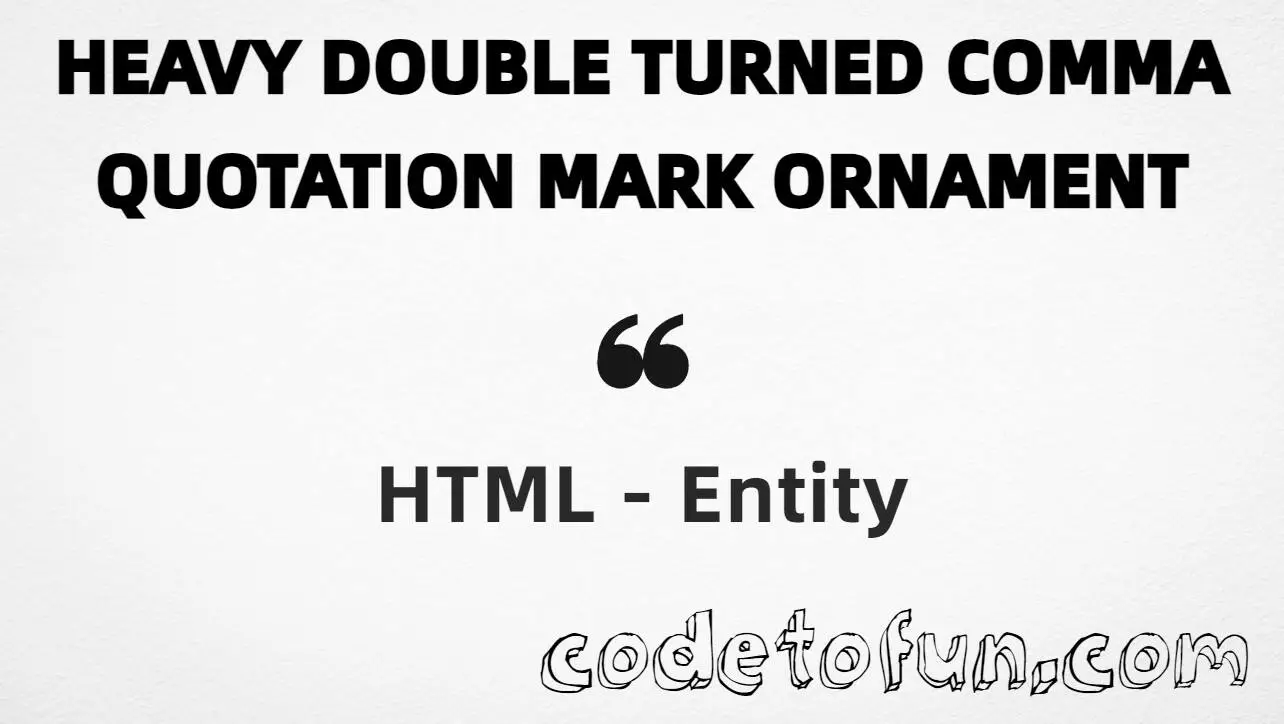
HTML Entity for Heavy Double Turned Comma Quotation Mark Ornament (❝)
Beginner
5 min read
Updated: Sep 2026
1 example
Unicode U+275D
Definition
What Is Heavy Double Turned Comma Quotation Mark Ornament?
Heavy double turned comma quotation mark ornament (❝) is the Unicode character at U+275D in Dingbats. Official name: HEAVY DOUBLE TURNED COMMA QUOTATION MARK ORNAMENT. It is a bold decorative opening quote used for pull quotes, testimonials, and ornamental typography.
Remember
Character     ❝
Unicode       U+275D
Hex entity    ❝
Decimal       ❝
CSS escape    \275D
Named entity  (none)
Meaning       decorative opening double quote
Not the same  ❞ · “ (“) · ❛
Prefer ❝ or ❝ in HTML (no named form). You can also type ❝ in a UTF-8 document. Pair with ❞ (❞) for the closing ornament; for prose quotes use “.
Symbol alone, in a sample label, and next to related forms.
Glyph❝
Large glyph❝
Sample❝ Keep learning ❞
Compared❝ ❞ “ ❛
With entitiesHex: ❝ | Decimal: ❝
Code
Complete HTML Example
One page that shows heavy double turned comma quotation mark ornament with hex, decimal, CSS escape, and a typed character. Use View Output or open the live editor.
Built with Hex: ❝
Built with Decimal: ❝
Built with CSS: ❝
Typed: ❝
❝ Keep learning ❞
Prose quote: “Hello”
How It Works
1. Hex:❝ inserts code point U+275D → ❝.
2. Decimal: same code point as 10077 → ❝. Same visual as hex.
3. CSS: use \275D in content (not an HTML entity). #point::after appends ❝.
4. Typed: paste ❝ in a UTF-8 document when you need this ornament. Prefer aria-label or nearby prose so decorative quotes stay clear to everyone.
Pitfalls & Tips
Common mistakes when working with heavy double turned comma quotation mark ornament.
Name
No named entity
There is no HTML5 named entity for U+275D. Use ❝ or ❝. Do not invent &heavyldquo;.
“
Not “
“ is “ (U+201C), the standard opening double quote. ❝ is a Dingbats ornament for decoration, not everyday prose.
❞
Opening vs closing
❞ (U+275E) is the heavy double comma (closing) ornament. ❝ is the opening turned form. Pair them for pull quotes.
Font
Font coverage
Some fonts omit Dingbats. If ❝ is missing, fall back to “ or a font with U+275D coverage.
CSS vs HTML
Do not mix escapes
\275D belongs in CSS strings. ❝ / ❝ belong in HTML.
a11y
Add accessible text
Screen readers may not announce ❝ clearly. Prefer nearby quote text or aria-label when the ornament carries meaning alone.
Semicolon
End references
Always finish entities with ; — write ❝, not ❝.
Compatibility
Browser Support
Heavy double turned comma quotation mark ornament (U+275D) and its entity forms (❝, ❝, CSS \\275D) are supported in all mainstream browsers. Visible glyphs depend on Dingbats font coverage.
✓ Universal support
Heavy Double Turned Comma Quotation Mark Ornament (❝)
Encode with hex, decimal, CSS escape, or type the character — same code point everywhere encoding is supported.
100%Browser coverage
Google ChromeSupported
Yes
Microsoft EdgeSupported
Yes
Mozilla FirefoxSupported
Yes
Apple SafariSupported
Yes
OperaSupported
Yes
Internet ExplorerAll versions
Yes
U+275DFull support
Bottom line: Prefer ❝ in HTML (no named form). Use ❝ when decimal form is required, and \\275D only inside CSS content.
Remember
Key Takeaways
Unicode: heavy double turned comma quotation mark ornament is U+275D (decimal 10077) — glyph ❝.
HTML: no named entity — use ❝ / ❝ / type ❝.
CSS: use \275D inside content for generated text.
Meaning: ❝ ≠ “ (“) — ornament for decoration; pair with ❞.
One line:U+275D → ❝ / ❝ / CSS \275D (no named form).
Frequently Asked Questions
Use ❝ (hex), ❝ (decimal), type ❝ directly in UTF-8, or the CSS escape \275D in content. There is no named HTML entity for U+275D.
U+275D (HEAVY DOUBLE TURNED COMMA QUOTATION MARK ORNAMENT). Hex 275D, decimal 10077. It belongs to the Dingbats block (U+2700–U+27BF).
No. HTML5 does not define a named entity for this ornament. Prefer ❝ or ❝.
Use it for decorative pull quotes, testimonials, or ornamental opening quotes. Pair with U+275E for the closing ornament. For semantic quotes in body text, prefer “ and ”.
HTML numeric entities (❝ or ❝) go in markup. The CSS escape \275D goes in stylesheet strings (usually content on ::before/::after).
No. Heavy double turned comma quotation mark ornament is U+275D (❝), a Dingbats decorative glyph. “ is U+201C (“), the standard opening double quotation mark.
🤔
Did you know?
Heavy double turned comma quotation mark ornament is Unicode U+275D (decimal 10077) — glyph ❝ in Dingbats. There is no HTML5 named entity; use ❝ or ❝. It is a decorative opening quote. Pair with ❞ (❞) for the closing ornament. For real quotation marks in prose, prefer “ / ”.