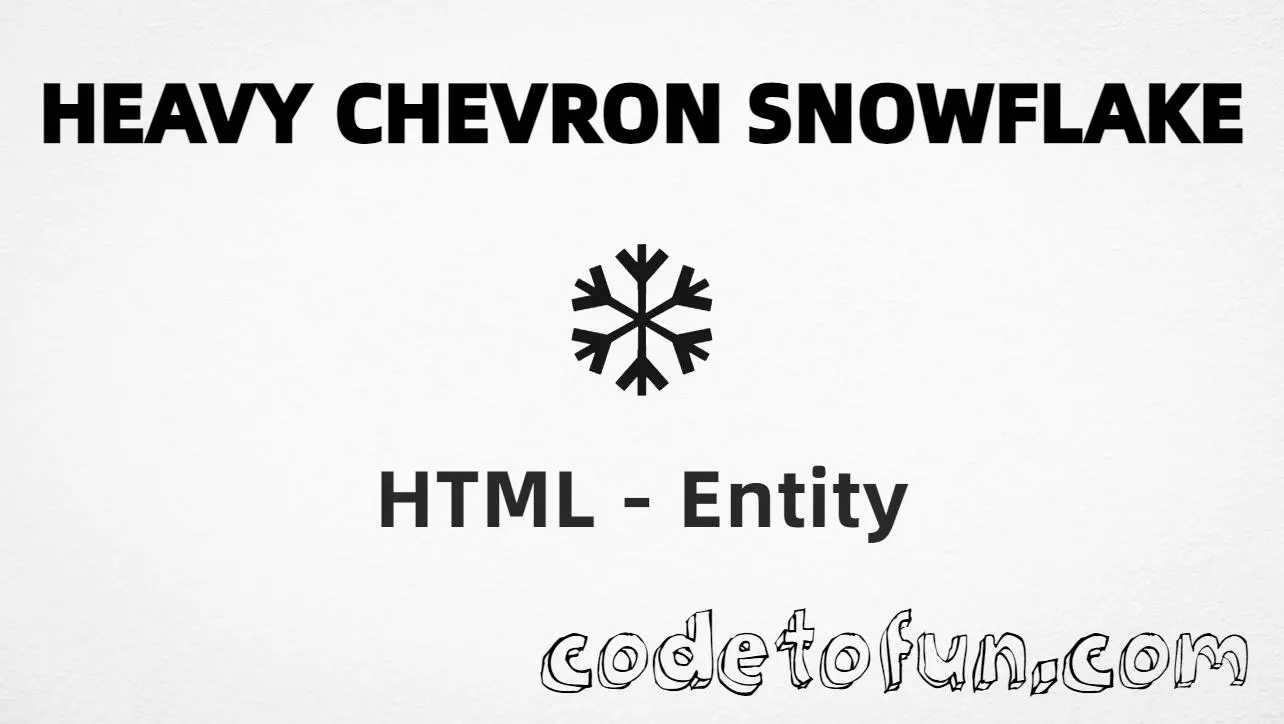
Heavy chevron snowflake (❆) is the Unicode character at U+2746 in Dingbats. Official name: HEAVY CHEVRON SNOWFLAKE. It is a bold snowflake used for winter themes, weather UI, and festive decoration.
Remember
Character     ❆
Unicode       U+2746
Hex entity    ❆
Decimal       ❆
CSS escape    \2746
Named entity  (none)
Meaning       heavy chevron snowflake
Not the same  ❄ · ❅ · ❇
Prefer ❆ or ❆ in HTML (no named form). You can also type ❆ in a UTF-8 document. Nearby snowflakes: ❄ (❄) and ❅ (❅).
Built with Hex: ❆
Built with Decimal: ❆
Built with CSS: ❆
Typed: ❆
❆ Snow likely tonight
Compare: ❄ ❅ ❆
How It Works
1. Hex:❆ inserts code point U+2746 → ❆.
2. Decimal: same code point as 10054 → ❆. Same visual as hex.
3. CSS: use \2746 in content (not an HTML entity). #point::after appends ❆.
4. Typed: paste ❆ in a UTF-8 document when you need the bold snowflake. Prefer aria-label or nearby prose such as “Snow” so meaning is clear to everyone.
Pitfalls & Tips
Common mistakes when working with heavy chevron snowflake.
Name
No named entity
There is no HTML5 named entity for U+2746. Use ❆ or ❆. Do not invent &heavysnowflake;.
❄
Not the same as ❄
Snowflake (U+2744) and tight trifoliate snowflake (U+2745) are related winter glyphs — different shapes from ❆.
❇
Not a sparkle
Sparkle (❇, U+2747) is a different dingbat. Use ❆ when you want a chevron-style snowflake.
Font
Font coverage
Some fonts omit Dingbats. If ❆ is missing, fall back to text (“Snow”) or a font with U+2746 coverage.
CSS vs HTML
Do not mix escapes
\2746 belongs in CSS strings. ❆ / ❆ belong in HTML.
a11y
Add accessible text
Screen readers may not announce ❆ clearly. Prefer aria-label="Snow" or nearby prose for weather or seasonal meaning.
Semicolon
End references
Always finish entities with ; — write ❆, not ❆.
Compatibility
Browser Support
Heavy chevron snowflake (U+2746) and its entity forms (❆, ❆, CSS \\2746) are supported in all mainstream browsers. Visible glyphs depend on Dingbats font coverage.
✓ Universal support
Heavy Chevron Snowflake (❆)
Encode with hex, decimal, CSS escape, or type the character — same code point everywhere encoding is supported.
100%Browser coverage
Google ChromeSupported
Yes
Microsoft EdgeSupported
Yes
Mozilla FirefoxSupported
Yes
Apple SafariSupported
Yes
OperaSupported
Yes
Internet ExplorerAll versions
Yes
U+2746Full support
Bottom line: Prefer ❆ in HTML (no named form). Use ❆ when decimal form is required, and \\2746 only inside CSS content.
Remember
Key Takeaways
Unicode: heavy chevron snowflake is U+2746 (decimal 10054) — glyph ❆.
HTML: no named entity — use ❆ / ❆ / type ❆.
CSS: use \2746 inside content for generated text.
Meaning: ❆ ≠ ❄ / ❅ — related winter dingbats, different shapes.
One line:U+2746 → ❆ / ❆ / CSS \2746 (no named form).
Frequently Asked Questions
Use ❆ (hex), ❆ (decimal), type ❆ directly in UTF-8, or the CSS escape \2746 in content. There is no named HTML entity for U+2746.
U+2746 (HEAVY CHEVRON SNOWFLAKE). Hex 2746, decimal 10054. It belongs to the Dingbats block (U+2700–U+27BF).
No. HTML5 does not define a named entity for U+2746. Prefer ❆ or ❆.
Use it for winter themes, weather UI, and festive decoration. For a lighter snowflake, try U+2744. For sparkle-style decoration, prefer U+2747 (sparkle) or heavy sparkle.
HTML numeric entities (❆ or ❆) go in markup. The CSS escape \2746 goes in stylesheet strings (usually content on ::before/::after).
No. Heavy chevron snowflake is U+2746 (❆). Snowflake is U+2744 (❄). Related winter dingbats — different shapes and code points.
🤔
Did you know?
Heavy chevron snowflake is Unicode U+2746 (decimal 10054) — glyph ❆ (HEAVY CHEVRON SNOWFLAKE) in Dingbats. There is no HTML5 named entity; use ❆ or ❆. Related snowflakes: ❄ (❄) and ❅ (❅). Prefer nearby text or aria-label (for example “Snow” or “Winter”) when the mark carries meaning.