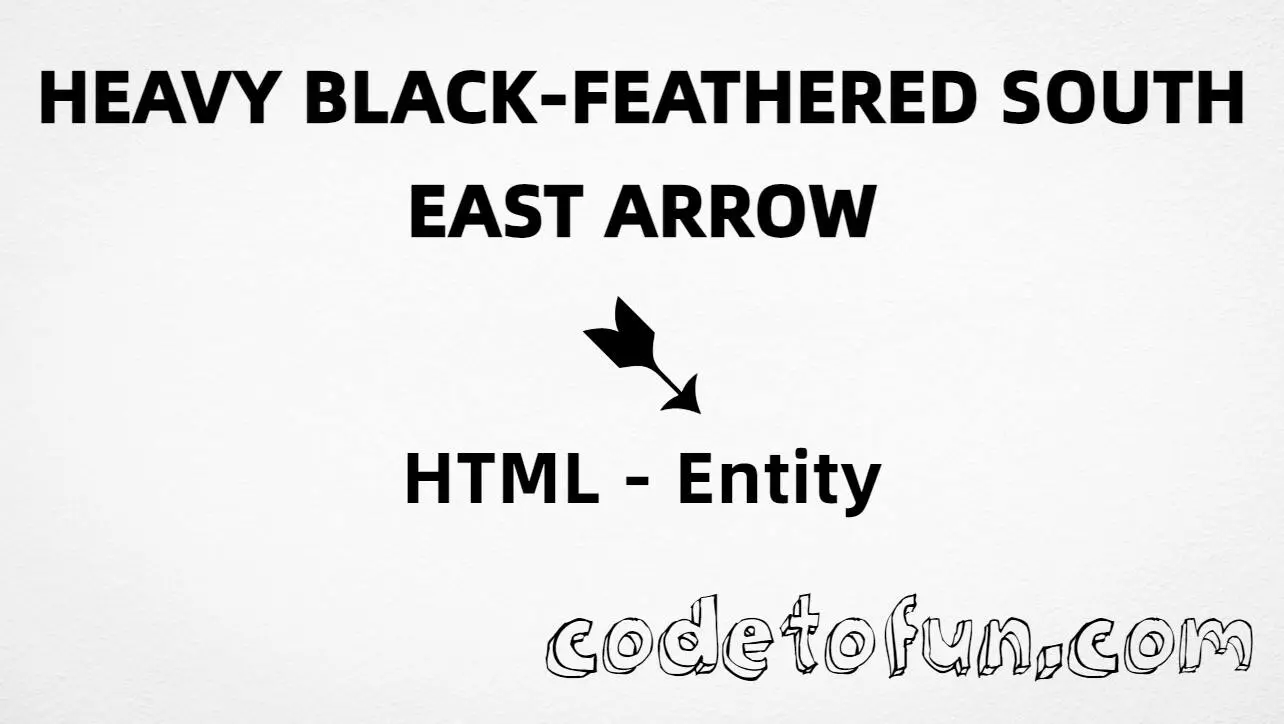
HTML Entity for Heavy Black Feathered South East Arrow (➷)
Beginner
5 min read
Updated: Sep 2026
1 example
Unicode U+27B7
Definition
What Is Heavy Black Feathered South East Arrow?
This arrow (➷) is the Unicode character at U+27B7 in Dingbats. Official name: HEAVY BLACK-FEATHERED SOUTH EAST ARROW. It is a bold feathered arrow pointing south-east (down and to the right) — useful for maps, drill-down cues, and directional UI.
Remember
Character     ➷
Unicode       U+27B7
Hex entity    ➷
Decimal       ➷
CSS escape    \27B7
Named entity  (none)
Meaning       feathered south-east (heavy)
Not the same  ➸ (feathered right) · ↘ (↘) · ➹
Prefer ➷ or ➷ in HTML (no named form). You can also type ➷ in a UTF-8 document. Pair the glyph with clear text so direction stays accessible.
Built with Hex: ➷
Built with Decimal: ➷
Built with CSS: ➷
Typed: ➷
Expand ➷
Feathered right: ➸
How It Works
1. Hex:➷ inserts code point U+27B7 → ➷.
2. Decimal: same code point as 10167 → ➷. Same visual as hex.
3. CSS: use \27B7 in content (not an HTML entity). #point::after appends ➷.
4. Typed: paste ➷ in a UTF-8 document when you need this dingbat arrow. Prefer aria-label or nearby prose such as “More details” so direction is clear to everyone.
Pitfalls & Tips
Common mistakes when working with this feathered arrow.
Name
No named entity
There is no HTML5 named entity for U+27B7. Use ➷ or ➷. Do not invent &featheredse;.
➸
Not feathered right
U+27B8 (➸) points right. U+27B7 points south-east. Related feathered dingbats — different directions.
↘
Not a plain south-east arrow
For a simple diagonal arrow, prefer ↘ (↘). U+27B7 is a heavy feathered dingbat.
Font
Font coverage
Some fonts omit Dingbats arrows. If ➷ is missing, fall back to text (“South-east”) or a font with U+27B7 coverage.
CSS vs HTML
Do not mix escapes
\27B7 belongs in CSS strings. ➷ / ➷ belong in HTML.
a11y
Add accessible text
Screen readers may not announce ➷ clearly. Prefer aria-label or nearby prose such as “More details”.
Semicolon
End references
Always finish entities with ; — write ➷, not ➷.
Compatibility
Browser Support
Heavy black feathered south-east arrow (U+27B7) and its entity forms (➷, ➷, CSS \\27B7) are supported in all mainstream browsers. Visible glyphs depend on Dingbats font coverage.
✓ Universal support
Feathered South East Arrow (➷)
Encode with hex, decimal, CSS escape, or type the character — same code point everywhere encoding is supported.
100%Browser coverage
Google ChromeSupported
Yes
Microsoft EdgeSupported
Yes
Mozilla FirefoxSupported
Yes
Apple SafariSupported
Yes
OperaSupported
Yes
Internet ExplorerAll versions
Yes
U+27B7Full support
Bottom line: Prefer ➷ in HTML (no named form). Use ➷ when decimal form is required, and \\27B7 only inside CSS content.
Remember
Key Takeaways
Unicode: this arrow is U+27B7 (decimal 10167) — glyph ➷.
HTML: no named entity — use ➷ / ➷ / type ➷.
CSS: use \27B7 inside content for generated text.
Meaning: ➷ ≠ ➸ — add accessible text for direction.
One line:U+27B7 → ➷ / ➷ / CSS \27B7 (no named form).
Frequently Asked Questions
Use ➷ (hex), ➷ (decimal), type ➷ directly in UTF-8, or the CSS escape \27B7 in content. There is no named HTML entity for U+27B7.
U+27B7 (HEAVY BLACK-FEATHERED SOUTH EAST ARROW). Hex 27B7, decimal 10167. It belongs to the Dingbats block (U+2700–U+27BF).
No. HTML5 does not define a named entity for this arrow. Prefer ➷ or ➷.
Use it for maps, drill-down cues, or decorative navigation that needs a bold feathered south-east arrow. For feathered right, use U+27B8. For a simple south-east arrow, prefer ↘.
HTML numeric entities (➷ or ➷) go in markup. The CSS escape \27B7 goes in stylesheet strings (usually content on ::before/::after).
No. U+27B7 points south-east (➷). U+27B8 points right (➸). Related feathered dingbats — different directions.
🤔
Did you know?
Heavy black-feathered south east arrow is Unicode U+27B7 (decimal 10167) — glyph ➷ in Dingbats. There is no HTML5 named entity; use ➷ or ➷. Prefer nearby text or aria-label (for example “South-east” or “More details”). Do not confuse it with U+27B8 (➸, feathered right) or ↘ (↘).