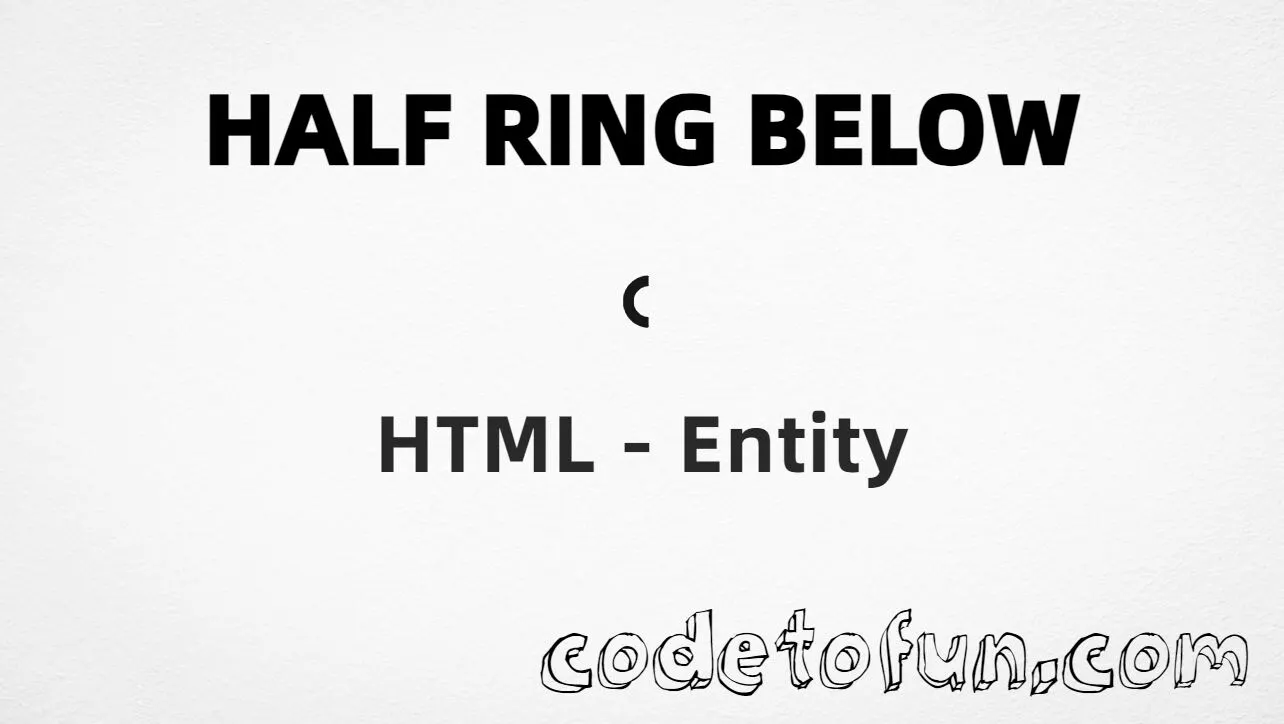
Combining half ring below is the Unicode character at U+0351 in Combining Diacritical Marks. Official name: COMBINING HALF RING BELOW. It sits under a base letter (for example a + U+0351 → a͑) and appears in IPA and other phonetic notation.
Remember
Character     ◌͑ (combining; needs a base letter)
Unicode       U+0351
Hex entity    ͑
Decimal       ͑
CSS escape    \0351
Named entity  (none)
Meaning       half ring under a base letter (IPA)
Not the same  a̜ (U+031C left half ring below) · ḁ (ring below)
Use ͑ or ͑after a letter (no named form). Alone, U+0351 has no letter shape — always pair it with a base character.
Built with Hex: a͑
Built with Decimal: a͑
Built with CSS (after a): a͑
Also: o͑   e͑
Left half ring (U+031C): a̜
How It Works
1. Hex: write a base letter, then ͑. Alone, U+0351 has no letter shape.
2. Decimal: same mark as 849 → ͑ after the letter.
3. CSS: use \0351 in content after a letter in the string (here the letter is in the HTML, the mark is appended). Prefer four hex digits so the escape does not swallow the next character.
4. Compare:U+031C is a different “left half ring below” mark — use it only when your chart requires that code point.
Pitfalls & Tips
Common mistakes when working with combining half ring below.
Base
Always use a base letter
U+0351 is combining. Write a͑, not a bare ͑, or the mark may look empty or misplaced.
Name
No named entity
There is no HTML5 named entity for U+0351. Use ͑ or ͑. Do not invent &halfringbelow;.
U+031C
Not left half ring below
U+031C is COMBINING LEFT HALF RING BELOW. Related IPA idea — different code point. Match your notation standard.
Font
Font coverage
Some fonts omit below-base combining marks. If a͑ looks wrong, try a font with solid Combining Diacritical Marks support.
CSS vs HTML
Do not mix escapes
\0351 belongs in CSS strings. ͑ / ͑ belong in HTML after the letter.
Order
Mark comes after the letter
In Unicode, combining marks follow the base: a then U+0351. Do not put the entity before the letter.
Semicolon
End references
Always finish entities with ; — write ͑, not ͑.
Compatibility
Browser Support
Combining half ring below (U+0351) and its entity forms (͑, ͑, CSS \\0351) are supported in all mainstream browsers. Visible stacking depends on font combining-mark support.
✓ Universal support
Half Ring Below (a͑)
Encode with hex, decimal, or CSS escape after a base letter — same code point everywhere encoding is supported.
100%Browser coverage
Google ChromeSupported
Yes
Microsoft EdgeSupported
Yes
Mozilla FirefoxSupported
Yes
Apple SafariSupported
Yes
OperaSupported
Yes
Internet ExplorerAll versions
Yes
U+0351Full support
Bottom line: Prefer ͑ after a base letter (no named form). Use ͑ when decimal form is required, and \\0351 only inside CSS content.
Remember
Key Takeaways
Unicode: half ring below is U+0351 (decimal 849) — combining; needs a base letter.
HTML: no named entity — use a͑ / a͑.
CSS: use \0351 inside content after a letter in the string.
Compare: U+0351 ≠ U+031C (left half ring below).
One line: base letter + U+0351 → a͑ / a͑ / CSS a\0351 (no named form).
Frequently Asked Questions
Place ͑ (hex) or ͑ (decimal) after a base letter, for example a͑. There is no named HTML entity for U+0351. You can also use CSS \0351 in content after a letter.
U+0351 (COMBINING HALF RING BELOW). Hex 0351, decimal 849. It belongs to Combining Diacritical Marks (U+0300–U+036F).
No. HTML5 does not define a named entity for combining half ring below. Prefer ͑ or ͑.
Use it in IPA and other phonetic notation that calls for a half ring below the base letter. Alone, U+0351 has no letter shape — always pair it with a base character.
HTML numeric entities (͑ or ͑) go in markup after a base letter. The CSS escape \0351 goes in stylesheet strings (usually content on ::before/::after).
No. U+0351 is COMBINING HALF RING BELOW. U+031C is COMBINING LEFT HALF RING BELOW. Related IPA marks, different code points — use the one your notation requires.
🤔
Did you know?
Combining half ring below is Unicode U+0351 (decimal 849) in Combining Diacritical Marks — a half-ring diacritic placed under a base letter. There is no HTML5 named entity; use ͑ or ͑after a letter (for example a͑ → a͑). Do not confuse it with U+031C (COMBINING LEFT HALF RING BELOW).