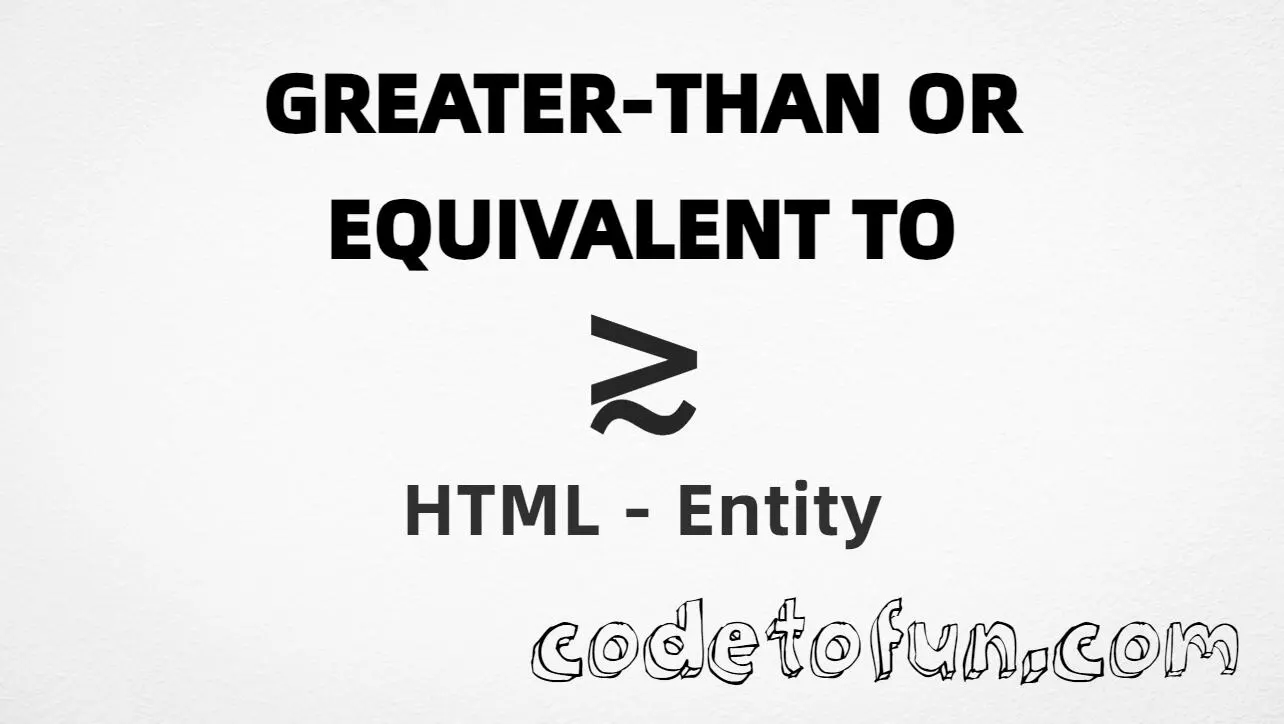
Greater-than or equivalent to (≳) is the Unicode character at U+2273 in Mathematical Operators. Official name: GREATER-THAN OR EQUIVALENT TO. It combines a greater-than sense with equivalence — different from everyday ≥ (≥).
Remember
Character     ≳
Unicode       U+2273
Named entity  ≳
Hex entity    ≳
Decimal       ≳
CSS escape    \2273
Meaning       greater than or equivalent
Not the same  ≥ (≥) · ≲ (≲) · ⋧ (⋧)
Prefer ≳ in HTML. Alternatives: ≳, ≳, or paste ≳ in a UTF-8 document.
Built with Named: ≳
Built with Hex: ≳
Built with Decimal: ≳
Built with CSS: ≳
Typed: ≳
Sample: a ≳ b
Everyday ≥ (different): ≥
How It Works
1. Named:≳ is the HTML5 name for U+2273 → ≳. Prefer this in markup.
2. Hex:≳ inserts the same code point. Same visual as named.
3. Decimal: same code point as 8819 → ≳.
4. CSS: use \2273 in content (not an HTML entity). Four hex digits are enough; keep a space or quote end after the escape if more digits follow.
5. Typed: paste ≳ in a UTF-8 document when your editor supports it. Compare with ≥ for everyday greater-or-equal.
Pitfalls & Tips
Common mistakes when working with greater-than or equivalent to.
Name
Prefer ≳
The named entity is clearer than numeric form and matches the single Unicode character.
vs ≥
Not the same as ≥
≥ means greater-than or equal. ≳ means greater-than or equivalent. Pick the relation you actually mean.
Negation
Not the same as ⋧
Greater-than but not equivalent is U+22E7. Do not use ≳ when you need the negated form.
Mirror
Mirror form exists
Less-than or equivalent is ≲ (U+2272) — a different character from U+2273.
Font
Check math font coverage
Some UI fonts omit Mathematical Operators. Prefer a math-capable font if the glyph shows as a box.
CSS vs HTML
Do not mix escapes
\2273 belongs in CSS strings. ≳ / ≳ / ≳ belong in HTML.
Semicolon
End references
Always finish entities with ; — write ≳, not &gsim.
Compatibility
Browser Support
Greater-than or equivalent to (U+2273) and its entity forms (≳, ≳, ≳, CSS \\2273) are supported in all mainstream browsers that implement Unicode and HTML entities. Glyph visibility depends on font coverage.
✓ Universal entity support
Greater Than Or Equivalent To (≳)
Encode with named, hex, decimal, CSS escape, or paste the character — same code point everywhere encoding is supported.
100%Entity support
Google ChromeSupported
Yes
Microsoft EdgeSupported
Yes
Mozilla FirefoxSupported
Yes
Apple SafariSupported
Yes
OperaSupported
Yes
Internet ExplorerIE 9+
Yes
U+2273Full support
Bottom line: Prefer ≳ in HTML. Use ≳ / ≳ when numeric form is required, and \\2273 only inside CSS content.
Prefer ≳ (named). You can also use ≳ (hex), ≳ (decimal), paste ≳ in a UTF-8 document, or the CSS escape \2273 in content.
U+2273 (GREATER-THAN OR EQUIVALENT TO). Hex 2273, decimal 8819. It belongs to Mathematical Operators.
Yes. HTML5 defines ≳ for U+2273. Prefer it when you want readable math markup.
Use ≳ when you mean greater-than or equivalent (similarity/equivalence). Use ≥ for everyday greater-than or equal. They are different relations.
HTML entities (≳, ≳, or ≳) go in markup. The CSS escape \2273 goes in stylesheet strings (usually content on ::before/::after).
No. ≳ is U+2273 (or equivalent). ⋧ is U+22E7 (but not equivalent) with entity ⋧.
🤔
Did you know?
Greater-than or equivalent to is Unicode U+2273 (decimal 8819) — glyph ≳ (GREATER-THAN OR EQUIVALENT TO) in Mathematical Operators. HTML5 named entity: ≳. Prefer ≳ in HTML. It is not the same as ≥ (≥) or greater-than but not equivalent (⋧).