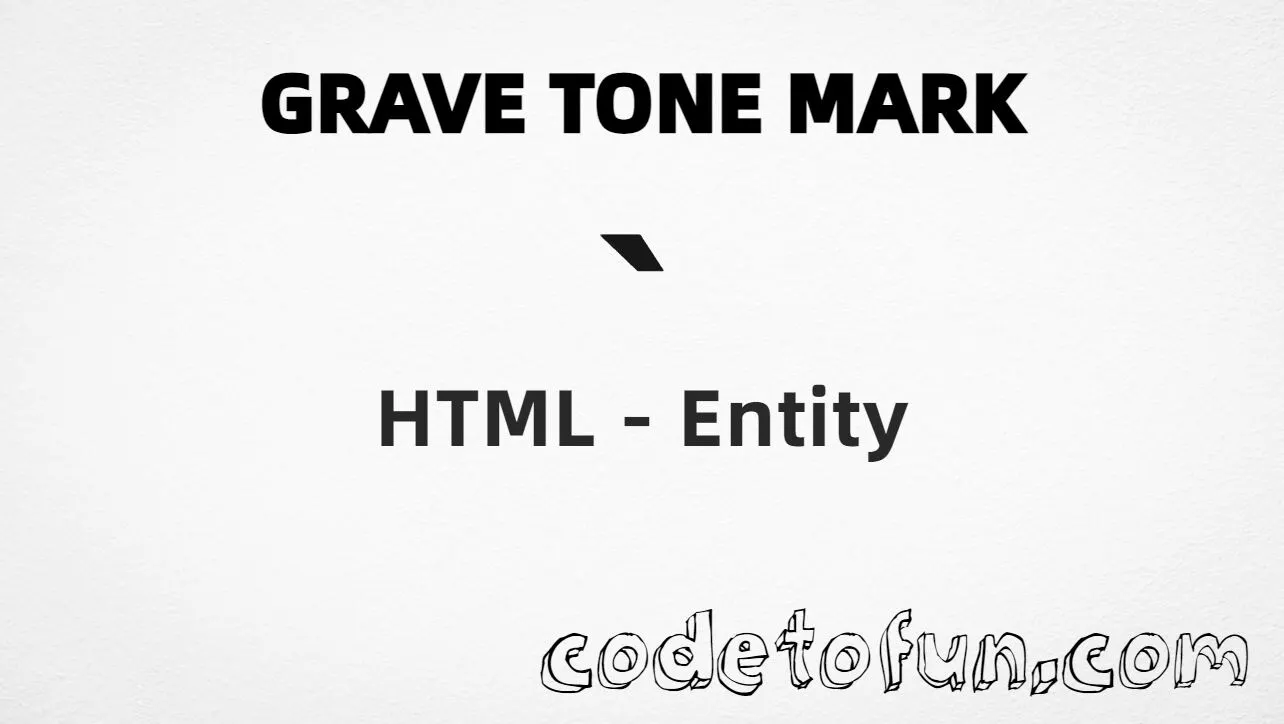
Combining grave tone mark is the Unicode character at U+0340 in Combining Diacritical Marks. Official name: COMBINING GRAVE TONE MARK. It must follow a base letter (for example a + U+0340 → à).
Remember
Character     ◌̀ (combining; needs a base letter)
Unicode       U+0340
Hex entity    ̀
Decimal       ̀
CSS escape    \0340
Named entity  (none)
Meaning       combining grave tone mark (phonetics / tone)
Not the same  à (grave accent) · ` (`) · acute tone mark
Prefer ̀ or ̀ after a letter (no named form). For everyday accents, prefer U+0300 or precomposed à.
Built with Hex: à
Built with Decimal: à
Built with CSS: à
Grave accent U+0300: à
Precomposed: à
How It Works
1. Hex:à places combining grave tone mark after a → à.
2. Decimal: same mark as 832 → à. Same visual as hex.
3. CSS: use \0340 with a base letter in content, for example "a\0340". Prefer four hex digits so the escape does not swallow the next character.
4. Compared:à is the usual combining grave. U+0340 looks the same and may normalize to U+0300 under NFC — prefer U+0300 unless you need this tone-mark code point.
Pitfalls & Tips
Common mistakes when working with grave tone mark.
Base
Always use a base letter
U+0340 alone may look like a floating mark or nothing useful. Write à, not a lone ̀.
NFC
Normalization may rewrite it
U+0340 is canonically equivalent to U+0300. After NFC, à may become à or even à. Keep this in mind for exact code-point matching.
Name
No named entity
There is no HTML5 named entity for U+0340. Use ̀ or ̀. Do not invent &gravetone;.
CSS
Pad the CSS escape
Prefer \0340. A short \340 can swallow the next hex digit if one follows immediately.
CSS vs HTML
Do not mix escapes
\0340 belongs in CSS strings. ̀ / ̀ belong in HTML.
Font
Font stacking matters
Some fonts render combining tone marks poorly. If à looks wrong, try a font with strong diacritic support.
Semicolon
End references
Always finish entities with ; — write ̀, not ̀.
Compatibility
Browser Support
Combining grave tone mark (U+0340) and its entity forms (̀, ̀, CSS \\0340) are supported in all mainstream browsers. Visible stacking depends on font support; normalization may map it to U+0300.
✓ Universal support
Grave Tone Mark (à)
Encode with hex or decimal after a base letter, or use CSS escape with a base in content — same code point everywhere encoding is supported.
100%Browser coverage
Google ChromeSupported
Yes
Microsoft EdgeSupported
Yes
Mozilla FirefoxSupported
Yes
Apple SafariSupported
Yes
OperaSupported
Yes
Internet ExplorerAll versions
Yes
U+0340Full support
Bottom line: Prefer à in HTML (no named form). Use ̀ when decimal form is required, and \\0340 only inside CSS content.
Remember
Key Takeaways
Unicode: grave tone mark is U+0340 (decimal 832) — needs a base letter.
HTML: no named entity — use à / à.
CSS: use \0340 with a base letter inside content.
Meaning: U+0340 ≈ U+0300 visually — NFC may rewrite the tone mark.
One line: base + U+0340 → à / à / CSS a\0340.
Frequently Asked Questions
Place ̀ (hex) or ̀ (decimal) after a base letter, for example à. There is no named HTML entity for U+0340. You can also use CSS \0340 in content.
U+0340 (COMBINING GRAVE TONE MARK). Hex 340, decimal 832. It belongs to Combining Diacritical Marks (U+0300–U+036F).
No. HTML5 does not define a named entity for combining grave tone mark. Prefer ̀ or ̀.
Use it for phonetic or tonal notation that specifically calls for the grave tone mark. For ordinary accented letters, prefer U+0300 or a precomposed character such as à.
HTML numeric entities (̀ or ̀) go in markup after a base letter. The CSS escape \0340 goes in stylesheet strings (usually content on ::before/::after).
They look the same and are canonically equivalent. Unicode NFC may convert U+0340 to U+0300. Prefer U+0300 unless you need the tone-mark code point explicitly.
🤔
Did you know?
Combining grave tone mark is Unicode U+0340 (decimal 832) — COMBINING GRAVE TONE MARK in Combining Diacritical Marks. There is no HTML5 named entity; use ̀ or ̀ after a base letter. It is canonically equivalent to combining grave accent (U+0300), so Unicode NFC may rewrite it. Prefer U+0300 for general accents unless you specifically need the tone-mark code point.