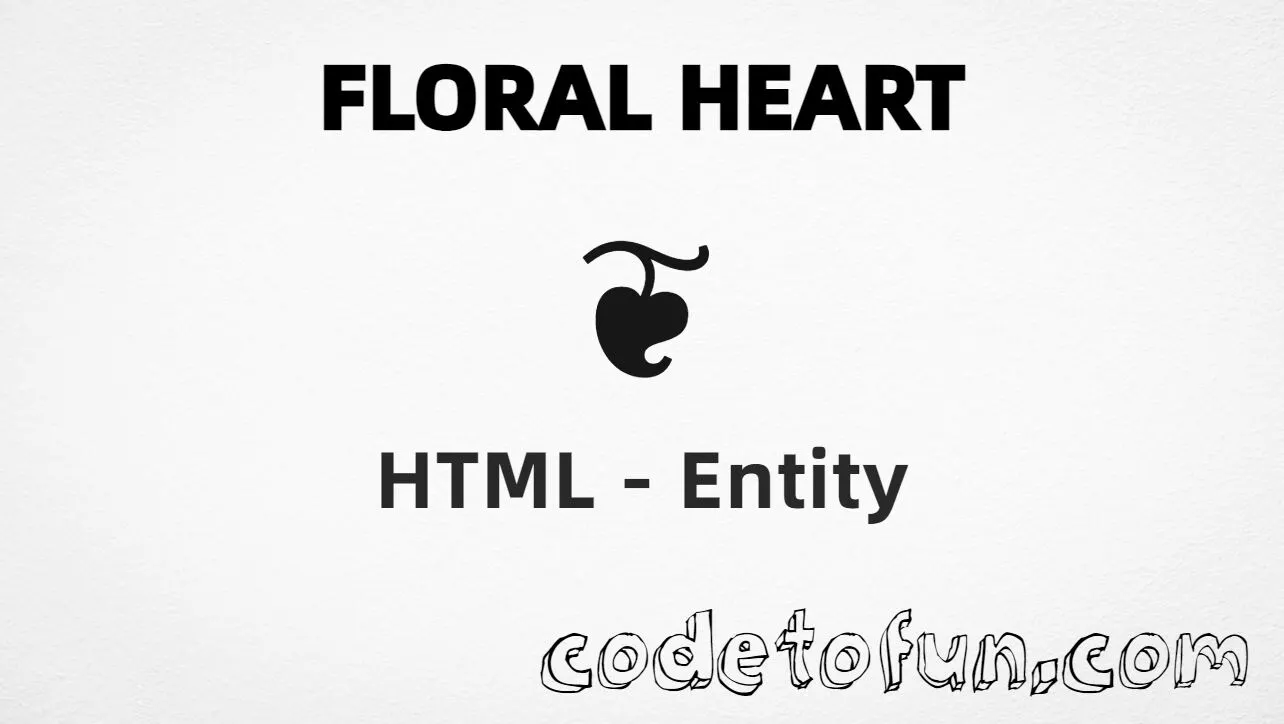
Floral heart (❦) is the Unicode character at U+2766 in Dingbats. Official name: FLORAL HEART. It is a decorative leaf/heart ornament used in elegant typography and cards (sometimes called an Aldus leaf).
Remember
Character     ❦
Unicode       U+2766
Hex entity    ❦
Decimal       ❦
CSS escape    \2766
Named entity  (none)
Not the same  ❤ (❤) · ♥ (♥) · ❧ (❧) · ⚜ (⚜)
Prefer ❦ or ❦ in HTML (no named form). You can also type ❦ in a UTF-8 document.
Built with Hex: ❦
Built with Decimal: ❦
Built with CSS: ❦
Typed: ❦
❦ Welcome ❦
How It Works
1. Hex:❦ inserts code point U+2766 → ❦.
2. Decimal: same code point as 10086 → ❦. Same visual as hex.
3. CSS: use \2766 in content (not an HTML entity). #point::after appends ❦.
4. Typed: paste ❦ in a UTF-8 document, or place it as a decorative flourish around a title.
Pitfalls & Tips
Common mistakes when working with Floral heart.
Name
No named entity
There is no HTML5 named entity for U+2766. Use ❦ or ❦. Do not invent &floralheart;.
♥
Not the card-suit heart
U+2665 (♥, ♥) is the playing-card heart. Floral heart is a Dingbats ornament.
❤
Not heavy black heart
U+2764 (❤) is a solid heart often used as an emoji-style icon — different from ❦.
❧
Not the rotated bullet
U+2767 (❧) is rotated floral heart bullet — related, but a different character.
CSS vs HTML
Do not mix escapes
\2766 belongs in CSS strings. ❦ / ❦ belong in HTML.
a11y
Add accessible text
Screen readers may not announce ❦ clearly. Prefer nearby prose when the ornament carries meaning.
Semicolon
End references
Always finish entities with ; — write ❦, not ❦.
Compatibility
Browser Support
Floral heart (U+2766) and its entity forms (❦, ❦, CSS \\2766) are supported in all mainstream browsers. Visible glyphs depend on Dingbats font coverage.
✓ Universal support
Floral Heart (❦)
Encode with hex, decimal, CSS escape, or type the character — same code point everywhere encoding is supported.
100%Browser coverage
Google ChromeSupported
Yes
Microsoft EdgeSupported
Yes
Mozilla FirefoxSupported
Yes
Apple SafariSupported
Yes
OperaSupported
Yes
Internet ExplorerAll versions
Yes
U+2766Full support
Bottom line: Prefer ❦ in HTML (no named form). Use ❦ when decimal form is required, and \\2766 only inside CSS content.
Remember
Key Takeaways
Unicode: floral heart is U+2766 (decimal 10086) — glyph ❦.
HTML: no named entity — use ❦ / ❦ / type ❦.
CSS: use \2766 inside content for generated text.
Meaning: ❦ ≠ suit ♥ ≠ heavy ❤ ≠ rotated ❧.
One line:U+2766 → ❦ / ❦ / CSS \2766 (no named form).
Frequently Asked Questions
Use ❦ (hex), ❦ (decimal), type ❦ directly in UTF-8, or the CSS escape \2766 in content. There is no named HTML entity for U+2766.
U+2766 (FLORAL HEART). Hex 2766, decimal 10086. It belongs to the Dingbats block (U+2700–U+27BF).
No. HTML5 does not define a named entity for U+2766. Prefer ❦ or ❦.
Use it as a decorative ornament in titles, cards, and elegant typography. Prefer ♥ (♥) for card-suit hearts, heavy black heart (❤) for a solid heart icon, and rotated floral heart bullet (❧) when that orientation is required.
HTML numeric entities (❦ or ❦) go in markup. The CSS escape \2766 goes in stylesheet strings (usually content on ::before/::after).
No. U+2766 is ❦ (floral heart). Black heart suit is U+2665 (♥, ♥). Heavy black heart is U+2764 (❤).
🤔
Did you know?
Floral heart is Unicode U+2766 (decimal 10086) — glyph ❦ (FLORAL HEART) in Dingbats. There is no HTML5 named entity; use ❦ or ❦. It is a decorative leaf/heart ornament (sometimes called an Aldus leaf). Do not confuse it with heavy black heart (❤), black heart suit (♥, ♥), rotated floral heart bullet (❧), or fleur-de-lis (⚜).