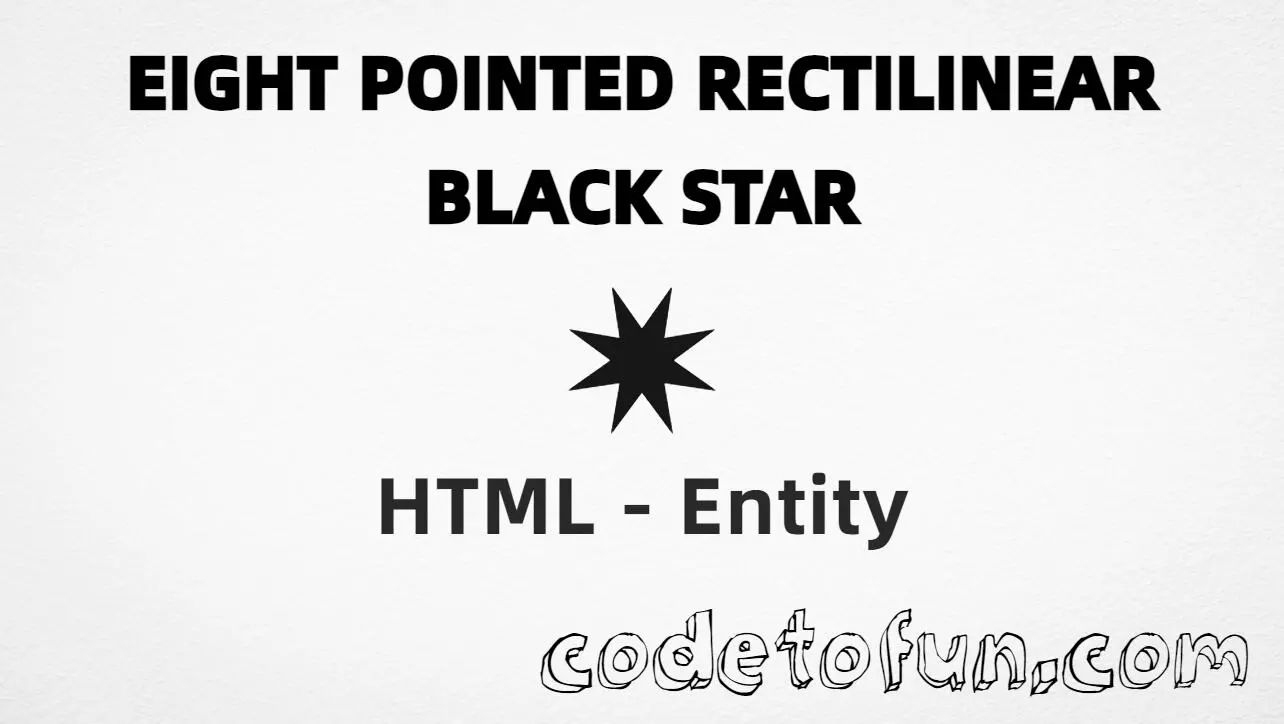
HTML Entity for Eight Pointed Rectilinear Black Star (✷)
Beginner
5 min read
Updated: Sep 2026
1 example
Unicode U+2737
Definition
What Is Eight Pointed Rectilinear Black Star?
Eight pointed rectilinear black star (✷) is the Unicode character at U+2737 in Dingbats. Official name: EIGHT POINTED RECTILINEAR BLACK STAR. It is a geometric eight-point star with straight rays — useful for ratings, awards, and star UI accents.
Remember
Character     ✷
Unicode       U+2737
Hex entity    ✷
Decimal       ✷
CSS escape    \2737
Named entity  (none)
Not the same  ✴ (black) · ✵ (pinwheel) · ✶ (6-point)
Prefer ✷ or ✷ in HTML (no named form). You can also type ✷ in a UTF-8 document.
Eight pointed rectilinear black star rendered alone, as a rating, and compared with related ornaments.
Glyph✷
Large glyph✷
Rating✷✷✷✷✷
Compared✷ ✴ ✵ ✶ ❁
With entitiesHex: ✷ | Decimal: ✷
Code
Complete HTML Example
One page that shows Eight Pointed Rectilinear Black Star with hex, decimal, CSS escape, and a typed character. Use View Output or open the live editor.
Hex + Decimal + CSS + Typed
Four ways to display ✷ in HTML and CSS.
html
<!DOCTYPE html>
<html lang="en">
<head>
<meta charset="UTF-8">
<title>Eight Pointed Rectilinear Black Star (U+2737) in HTML</title>
<style>
#point::after {
content: "\2737";
}
</style>
</head>
<body>
<p>Built with Hex: ✷</p>
<p>Built with Decimal: ✷</p>
<p id="point">Built with CSS: </p>
<p>Typed: ✷</p>
<p>Rating: ✷✷✷✷✷</p>
</body>
</html>
Built with Hex: ✷
Built with Decimal: ✷
Built with CSS: ✷
Typed: ✷
Rating: ✷✷✷✷✷
How It Works
1. Hex:✷ inserts code point U+2737 → ✷.
2. Decimal: same code point as 10039 → ✷. Same visual as hex.
3. CSS: use \2737 in content (not an HTML entity). #point::after appends ✷.
4. Typed: paste ✷ in a UTF-8 document, or build a rating row like ✷✷✷✷✷.
Pitfalls & Tips
Common mistakes when working with Eight Pointed Rectilinear Black Star.
Name
No named entity
There is no HTML5 named entity for U+2737. Use ✷ or ✷.
✴
Not a solid black star
U+2734 is a solid eight-point star. U+2737 is the rectilinear (straight-ray) form.
✵
Not a pinwheel star
U+2735 is a pinwheel-style star. This character has geometric, rectilinear rays.
CSS vs HTML
Do not mix escapes
\2737 belongs in CSS strings. ✷ / ✷ belong in HTML.
Fonts
Dingbats font coverage
Some fonts omit Dingbats stars. Prefer a font with solid Dingbats coverage.
a11y
Add accessible text
A lone ornamental glyph can be unclear to screen readers. Pair ratings with visible text (for example “4 of 5”) or mark decorative uses with aria-hidden="true".
Semicolon
End references
Always finish numeric entities with ; — write ✷, not ✷.
Compatibility
Browser Support
Eight pointed rectilinear black star (U+2737) and its entity forms (✷, ✷, CSS \\2737) are supported in all mainstream browsers. Visible glyphs depend on Dingbats font coverage.
✓ Universal support
Eight Pointed Rectilinear Black Star (✷)
Encode with hex, decimal, CSS escape, or type the character — same code point everywhere encoding is supported.
100%Browser coverage
Google ChromeSupported
Yes
Microsoft EdgeSupported
Yes
Mozilla FirefoxSupported
Yes
Apple SafariSupported
Yes
OperaSupported
Yes
Internet ExplorerAll versions
Yes
U+2737 / entitiesFull support
Bottom line: Prefer ✷ in HTML (no named form). Use ✷ when decimal form is required, and \\2737 only inside CSS content.
Remember
Key Takeaways
Unicode: eight pointed rectilinear black star is U+2737 (decimal 10039) — glyph ✷.
HTML: no named entity — use ✷ / ✷ / type ✷.
CSS: use \2737 inside content for generated text.
Shape: rectilinear star ≠ solid ✴ ≠ pinwheel ✵.
One line:U+2737 → ✷ / ✷ / CSS \2737.
Frequently Asked Questions
Use ✷ (hex), ✷ (decimal), type ✷ directly in UTF-8, or the CSS escape \2737 in content. There is no named HTML entity for U+2737.
U+2737 (EIGHT POINTED RECTILINEAR BLACK STAR). Hex 2737, decimal 10039. It belongs to the Dingbats block (U+2700–U+27BF).
No. Use numeric forms ✷ or ✷. Related stars such as U+2734 (black) and U+2735 (pinwheel) also have no named HTML entities.
Use it when you want a geometric, straight-ray eight-point star for ratings, awards, or UI accents. Prefer U+2734 for a solid black star, and U+2735 for a pinwheel style.
HTML entities (✷ or ✷) go in markup. The CSS escape \2737 goes in stylesheet strings (usually content on ::before/::after).
No. U+2737 is ✷ (eight-pointed rectilinear black star). U+2734 is ✴ (eight-pointed black star). U+2735 is ✵ (eight-pointed pinwheel star).
🤔
Did you know?
Eight pointed rectilinear black star is Unicode U+2737 (decimal 10039) — glyph ✷ (EIGHT POINTED RECTILINEAR BLACK STAR) in Dingbats. There is no HTML5 named entity; use ✷ or ✷. Nearby stars include U+2734 (✴, black), U+2735 (✵, pinwheel), and U+2736 (✶, six-pointed).