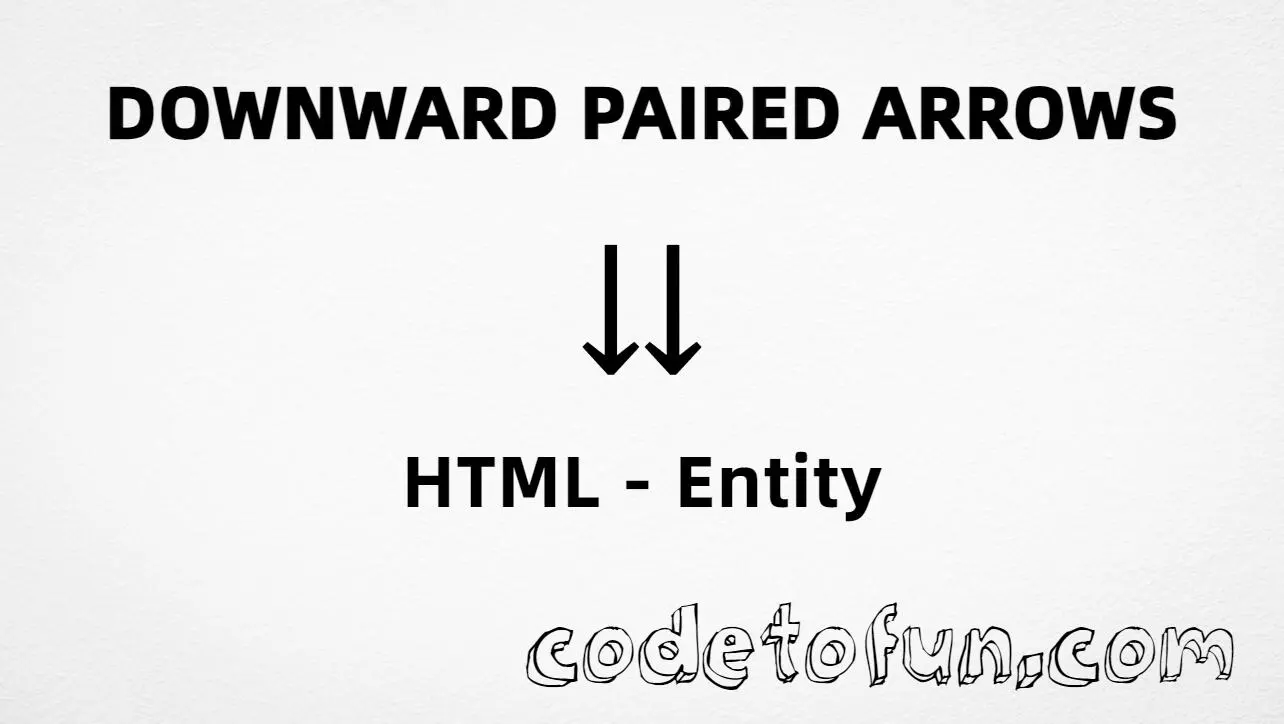
Downward paired arrows (⇊) is the Unicode character at U+21CA in the Arrows block. Official name: DOWNWARDS PAIRED ARROWS. It shows two parallel down arrows side by side — useful in logic flows, diagrams, and math.
Remember
Character     ⇊
Unicode       U+21CA
Named entity  ⇊
Hex entity    ⇊
Decimal       ⇊
CSS escape    \21CA
Not the same  ↓ (↓) · ⇓ (⇓) · ⇈ (⇈)
Prefer ⇊ in HTML markup (also aliased as ⇊). You can also type ⇊ in UTF-8, or use numeric forms when needed.
Built with Named: ⇊
Built with Hex: ⇊
Built with Decimal: ⇊
Built with CSS: ⇊
Typed: ⇊
Label: Both ⇊
How It Works
1. Named:⇊ is the preferred HTML5 name for U+21CA → ⇊.
2. Hex / decimal:⇊ and ⇊ insert the same code point.
3. CSS: use \21CA in content (not an HTML entity). #point::after appends ⇊.
4. Typed: paste ⇊ in a UTF-8 document, or pair it with a label like Both ⇊.
Pitfalls & Tips
Common mistakes when working with Downward Paired Arrows.
Count
Paired ≠ single
⇊ is two parallel down arrows. ↓ is one plain arrow. ⇓ is one double-lined arrow.
Alias
Same as ⇊
⇊ is an HTML5 alias for the same glyph as ⇊.
Family
Matching directions
Use ⇈, ⇇, and ⇉ for up, left, and right paired arrows.
CSS vs HTML
Do not mix escapes
\21CA belongs in CSS strings. ⇊ / ⇊ belong in HTML.
Fonts
Arrow font coverage
Some fonts omit paired-arrow glyphs. Prefer a font with solid Arrows-block coverage.
a11y
Add accessible text
A lone paired-arrow glyph can be unclear to screen readers. Pair it with visible text or an aria-label.
Semicolon
End references
Always finish entities with ; — write ⇊, not &ddarr.
Compatibility
Browser Support
Downward paired arrows (U+21CA) and its entity forms (⇊, ⇊, ⇊, CSS \\21CA) are supported in all mainstream browsers. Visible glyphs depend on Arrows-block font coverage.
✓ Universal support
Downward Paired Arrows (⇊)
Encode with named, hex, decimal, CSS escape, or type the character — same code point everywhere encoding is supported.
100%Browser coverage
Google ChromeSupported
Yes
Microsoft EdgeSupported
Yes
Mozilla FirefoxSupported
Yes
Apple SafariSupported
Yes
OperaSupported
Yes
Internet ExplorerAll versions
Yes
U+21CA / ⇊Full support
Bottom line: Prefer ⇊ in HTML. Use ⇊ / ⇊ when numeric form is required, and \\21CA only inside CSS content.
Use ⇊ (named), ⇊ (hex), ⇊ (decimal), type ⇊ directly in UTF-8, or the CSS escape \21CA in content. Prefer ⇊ in normal HTML.
U+21CA (DOWNWARDS PAIRED ARROWS). Hex 21CA, decimal 8650. It belongs to the Arrows block (U+2190–U+21FF).
Yes. Use ⇊ or the alias ⇊. Numeric forms ⇊ and ⇊ also work. Do not use ↓ (plain ↓) or ⇓ (double ⇓).
Use it for two parallel down arrows in logic flows, diagrams, and math. Prefer ↓ for a single plain down arrow, and ⇓ for a double-lined single shaft.
HTML entities (⇊, ⇊, or ⇊) go in markup. The CSS escape \21CA goes in stylesheet strings (usually content on ::before/::after).
No. ⇊ is ⇊ (U+21CA, two paired down arrows). ↓ is ↓ (U+2193). ⇓ is ⇓ (U+21D3, double-lined single arrow).
🤔
Did you know?
Downward paired arrows is Unicode U+21CA (decimal 8650) — glyph ⇊ (DOWNWARDS PAIRED ARROWS) in the Arrows block. HTML5 names it ⇊ (also ⇊). Matching directions use ⇈ (⇈), ⇇ (⇇), and ⇉ (⇉). Do not confuse with ↓ (↓) or ⇓ (⇓).