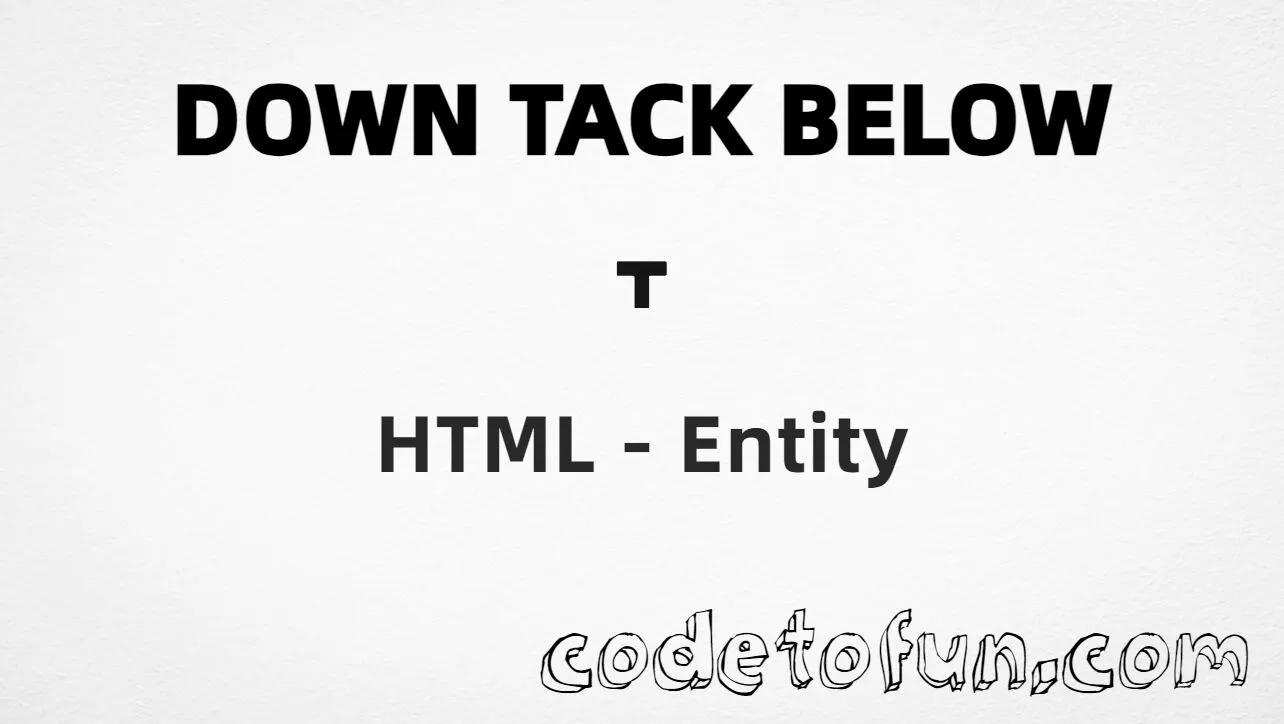
Down tack below is the Unicode character at U+031E in Combining Diacritical Marks. Official name: COMBINING DOWN TACK BELOW. It is a combining mark that attaches under the previous base letter — for example a̞ → a̞.
Remember
Mark          (combining ̞)
Unicode       U+031E
Hex entity    ̞
Decimal       ̞
CSS escape    \031E
Named entity  (none)
Not the same  ⊤ (⊤) · ̝
Prefer ̞ or ̞ immediately after the base letter (no named form). You can also type the combining mark after a letter in a UTF-8 document.
Built with Hex: a̞
Built with Decimal: a̞
Built with CSS: a̞
Typed: a̞  e̞  o̞
Standalone (different): ⊤
How It Works
1. Hex: write the base letter, then ̞ → a̞.
2. Decimal: same code point as 798 → ̞ after the base letter. Same result as hex.
3. CSS: use \031E in content after a letter in the string (not an HTML entity). #point::after appends a̞. Put the letter first so the escape is not absorbed into a longer hex sequence.
4. Typed: paste the combining mark after a, e, or o in a UTF-8 document.
Pitfalls & Tips
Common mistakes when working with Down Tack Below.
Order
Base letter first
Combining marks attach to the previous character. Write a̞, not ̞a.
⊤
Not ⊤
⊤ is the standalone down tack (U+22A4). U+031E is a combining diacritic under a letter.
CSS
Terminate the escape
Prefer "a\031E" (letter first). A hex digit right after \031E can extend the escape.
Name
No named entity
There is no HTML5 named entity for U+031E. Use ̞ or ̞.
Fonts
Diacritic font coverage
Some fonts omit rare combining marks. Prefer a font with solid IPA / diacritic coverage.
a11y
Add accessible text
A combining mark alone is invisible and unclear. Always show it with a base letter and helpful surrounding text.
Semicolon
End references
Always finish numeric entities with ; — write ̞, not ̞.
Compatibility
Browser Support
Combining down tack below (U+031E) and its entity forms (̞, ̞, CSS \\031E) are supported in all mainstream browsers. Visible rendering depends on combining-mark font coverage.
✓ Universal support
Down Tack Below (a̞)
Encode with hex, decimal, CSS escape, or type the combining mark after a letter — same code point everywhere encoding is supported.
100%Browser coverage
Google ChromeSupported
Yes
Microsoft EdgeSupported
Yes
Mozilla FirefoxSupported
Yes
Apple SafariSupported
Yes
OperaSupported
Yes
Internet ExplorerAll versions
Yes
U+031E / entitiesFull support
Bottom line: Prefer base + ̞ in HTML (no named form). Use ̞ when decimal form is required, and \\031E only inside CSS content after a letter.
Remember
Key Takeaways
Unicode: combining down tack below is U+031E (decimal 798).
HTML: no named entity — use base + ̞ / ̞.
CSS: use content: "a\031E" (letter before the escape).
One line: base + U+031E → a̞ / CSS "a\031E".
Frequently Asked Questions
Place ̞ (hex) or ̞ (decimal) after a base letter, type the combining mark in UTF-8 after a letter, or use CSS \031E in content after a letter. There is no named HTML entity for U+031E.
U+031E (COMBINING DOWN TACK BELOW). Hex 031E, decimal 798. It belongs to the Combining Diacritical Marks block (U+0300–U+036F).
No. Use numeric forms ̞ or ̞ after a base character, or type the combining mark in a UTF-8 document.
Use U+031E when you need a down-tack diacritic under a letter (phonetics/IPA). Use ⊤ (U+22A4) for the standalone down-tack / tautology symbol.
HTML entities (̞ or ̞) go in markup after a base letter. The CSS escape \031E goes in stylesheet strings (usually content on ::before/::after, after a letter in the string).
No. U+031E combines below the letter as a down tack. U+031D is combining up tack below. U+22A4 is a standalone down tack (⊤).
🤔
Did you know?
Down tack below is Unicode U+031E (decimal 798) — a combining mark (COMBINING DOWN TACK BELOW) in Combining Diacritical Marks. There is no HTML5 named entity; use ̞ or ̞ after a base letter (e.g. a̞ → a̞). Do not confuse with standalone down tack ⊤ (⊤).