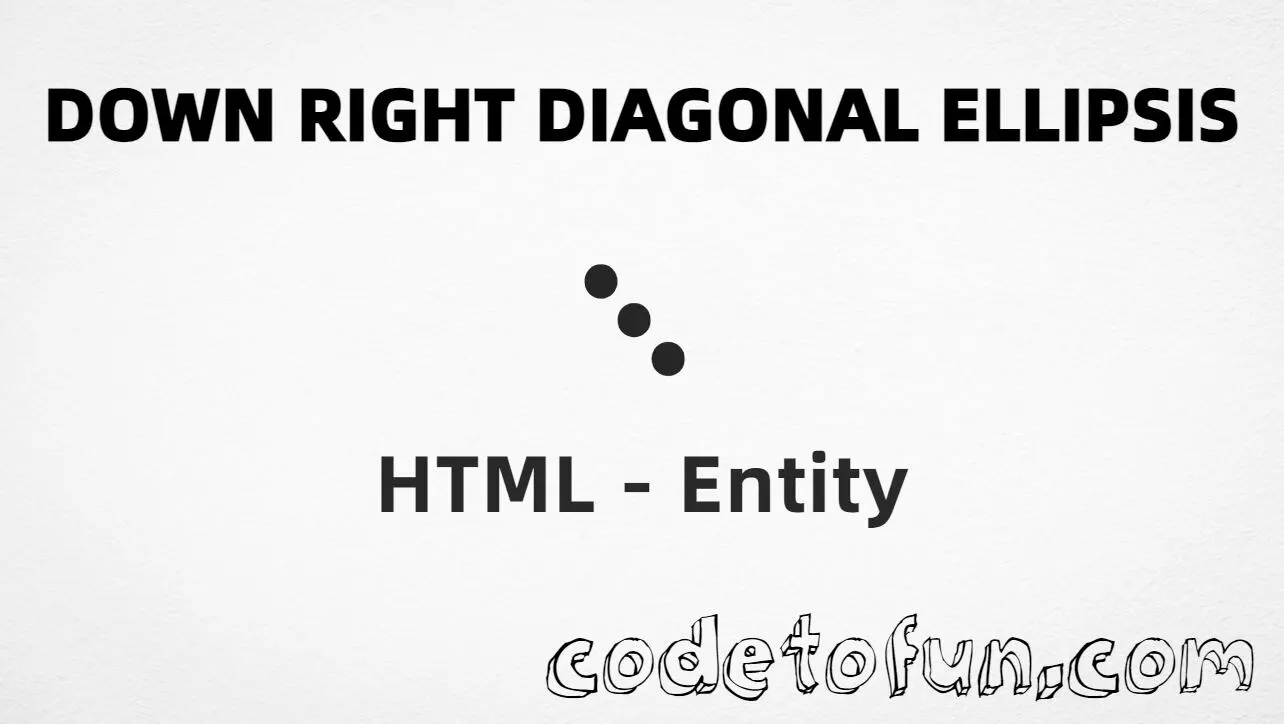
Down right diagonal ellipsis (⋱) is the Unicode character at U+22F1 in Mathematical Operators. Official name: DOWN RIGHT DIAGONAL ELLIPSIS. It is three dots running down-right — useful for matrix diagonals and math continuation.
Remember
Character     ⋱
Unicode       U+22F1
Named entity  ⋱
Hex entity    ⋱
Decimal       ⋱
CSS escape    \22F1
Not the same  ⋰ (⋰) · ⋯ (⋯) · … (…)
Prefer ⋱ in HTML markup. You can also type ⋱ in UTF-8, or use numeric forms when needed.
Built with Named: ⋱
Built with Hex: ⋱
Built with Decimal: ⋱
Built with CSS: ⋱
Typed: ⋱
Label: Diagonal ⋱
How It Works
1. Named:⋱ is the preferred HTML5 name for U+22F1 → ⋱.
2. Hex / decimal:⋱ and ⋱ insert the same code point.
3. CSS: use \22F1 in content (not an HTML entity). #point::after appends ⋱.
4. Typed: paste ⋱ in a UTF-8 document, or pair it with a label like Diagonal ⋱.
Pitfalls & Tips
Common mistakes when working with Down Right Diagonal Ellipsis.
Direction
Not ⋰
⋰ is up-right (U+22F0). ⋱ is down-right (U+22F1).
…
Not …
… is the ordinary text ellipsis (…). Use ⋱ for the math diagonal form.
⋯
Not ⋯
⋯ is midline horizontal dots (⋯). It is not diagonal.
CSS vs HTML
Do not mix escapes
\22F1 belongs in CSS strings. ⋱ / ⋱ belong in HTML.
Fonts
Math font coverage
Some fonts omit Mathematical Operators glyphs. Prefer a font with solid math coverage.
a11y
Add accessible text
A lone diagonal ellipsis can be unclear to screen readers. Pair it with visible text or an aria-label.
Semicolon
End references
Always finish entities with ; — write ⋱, not &dtdot.
Compatibility
Browser Support
Down right diagonal ellipsis (U+22F1) and its entity forms (⋱, ⋱, ⋱, CSS \\22F1) are supported in all mainstream browsers. Visible glyphs depend on Mathematical Operators font coverage.
✓ Universal support
Down Right Diagonal Ellipsis (⋱)
Encode with named, hex, decimal, CSS escape, or type the character — same code point everywhere encoding is supported.
100%Browser coverage
Google ChromeSupported
Yes
Microsoft EdgeSupported
Yes
Mozilla FirefoxSupported
Yes
Apple SafariSupported
Yes
OperaSupported
Yes
Internet ExplorerAll versions
Yes
U+22F1 / ⋱Full support
Bottom line: Prefer ⋱ in HTML. Use ⋱ / ⋱ when numeric form is required, and \\22F1 only inside CSS content.
Use ⋱ (named), ⋱ (hex), ⋱ (decimal), type ⋱ directly in UTF-8, or the CSS escape \22F1 in content. Prefer ⋱ in normal HTML.
U+22F1 (DOWN RIGHT DIAGONAL ELLIPSIS). Hex 22F1, decimal 8945. It belongs to the Mathematical Operators block (U+2200–U+22FF).
Yes. Use ⋱. Numeric forms ⋱ and ⋱ also work. The opposite diagonal uses ⋰ (U+22F0).
Use it in math or matrices when a diagonal pattern continues down-right. Prefer ⋰ for up-right diagonal, ⋯ for midline horizontal, and … for a plain text ellipsis.
HTML entities (⋱, ⋱, or ⋱) go in markup. The CSS escape \22F1 goes in stylesheet strings (usually content on ::before/::after).
No. ⋱ is ⋱ (U+22F1, down-right). ⋰ is ⋰ (U+22F0, up-right). … is … (U+2026), a horizontal text ellipsis.
🤔
Did you know?
Down right diagonal ellipsis is Unicode U+22F1 (decimal 8945) — glyph ⋱ (DOWN RIGHT DIAGONAL ELLIPSIS) in Mathematical Operators. HTML5 names it ⋱. The opposite diagonal is ⋰ (⋰). Midline horizontal is ⋯ (⋯). Vertical is ⋮ (⋮).