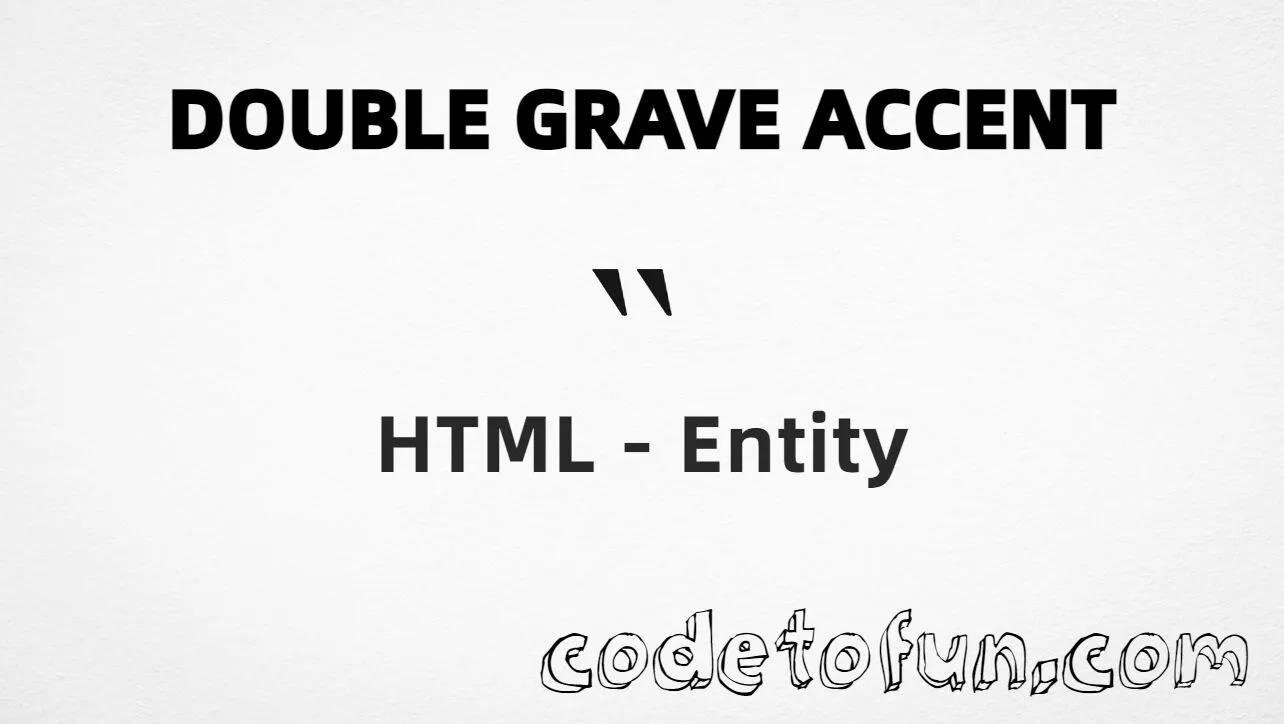
Double grave accent is the Unicode character at U+030F in the Combining Diacritical Marks block. Official name: COMBINING DOUBLE GRAVE ACCENT. It attaches above the previous base letter — for example ȍ → ȍ. Used in Serbo-Croatian, Slovene, and IPA (extra-low tone).
Remember
Mark          (combining ̏)
Unicode       U+030F
Hex entity    ̏
Decimal       ̏
CSS escape    \030F
Named entity  (none)
Prefer when   ȍ ȉ (precomposed) exist
Prefer ̏ or ̏ immediately after the base letter (no named form). Prefer precomposed letters like ȍ and ȉ when available.
Combining double grave rendered on base letters and precomposed forms.
Built with U+030Fȍ ȁ ȅ
Precomposedȍ ȉ ȅ ȕ
Large glyphȍ
Comparedȍ è ` ő ȍ
With entitiesHex: ȍ | Decimal: ȁ
Code
Complete HTML Example
One page that shows Double Grave Accent with hex, decimal, CSS escape, a typed combining form, and precomposed letters. Use View Output or open the live editor.
Built with Hex: ȍ
Built with Decimal: ȁ
Built with CSS: ȍ
Typed: ȍ  ȁ  ȅ
Precomposed (preferred): ȍ ȉ
How It Works
1. Hex: write the base letter, then ̏ → ȍ. Preferred when there is no named entity.
2. Decimal: same code point as 783 → ̏ after the base letter. Same result as hex.
3. CSS: use \030F in content after a letter in the string (not an HTML entity). #point::after appends ȍ.
4. Typed: paste the combining mark after a letter in a UTF-8 document.
5. Precomposed: prefer ȍȉ (and similar letters) when those characters exist.
Pitfalls & Tips
Common mistakes when working with Double Grave Accent.
Order
Base letter first
Write ȍ, not ̏o. Combining marks attach to the previous character.
Pre
Prefer precomposed when possible
Type ȍȉ instead of building with U+030F when those letters exist.
̀
Not single grave
U+0300 is combining grave (one mark). U+030F is double grave (two marks).
`
Not `
` is the spacing mark U+0060 (`). It does not combine with a letter the way U+030F does.
CSS vs HTML
Do not mix escapes
\030F belongs in CSS strings. ̏ / ̏ belong in HTML after a base letter.
Fonts
Diacritic font coverage
Some fonts omit U+030F. Prefer a font with Combining Diacritical Marks (and Latin Extended) coverage for display.
Compatibility
Browser Support
Combining double grave accent (U+030F) and its entity forms (̏, ̏, CSS \\030F) are supported in all mainstream browsers. Visible positioning depends on font diacritic coverage.
✓ Universal support
Double Grave Accent (U+030F)
Encode with hex, decimal, CSS escape, or type the combining mark after a letter — same code point everywhere encoding is supported.
100%Browser coverage
Google ChromeSupported
Yes
Microsoft EdgeSupported
Yes
Mozilla FirefoxSupported
Yes
Apple SafariSupported
Yes
OperaSupported
Yes
Internet ExplorerAll versions
Yes
U+030F / entitiesFull support
Bottom line: Prefer ̏ after a base letter (no named form), or precomposed letters like ȍ/ȉ when available. Use \\030F only inside CSS content.
Remember
Key Takeaways
Unicode: combining double grave is U+030F (decimal 783).
HTML: no named entity — use base + ̏ / ̏, or type ȍ/ȉ when available.
CSS: use a letter + \030F inside content.
Meaning: double combining grave — not single U+0300 or spacing `.
One line:U+030F → base + ̏ / ̏ / CSS \030F (or type ȍ/ȉ when available).
Frequently Asked Questions
Place ̏ (hex) or ̏ (decimal) after a base letter, type the combining mark in UTF-8 after a letter, or use CSS \030F in content after a letter. There is no named HTML entity for U+030F.
U+030F (COMBINING DOUBLE GRAVE ACCENT). Hex 030F, decimal 783. It belongs to the Combining Diacritical Marks block (U+0300–U+036F).
No. Use numeric forms ̏ or ̏ after a base character. The spacing grave ` uses ` (U+0060) — a different character.
Prefer precomposed letters such as ȍ and ȉ when they exist. Use combining U+030F when you need a letter with no precomposed form, or when building diacritics dynamically.
HTML entities (̏ or ̏) go in markup after a base letter. The CSS escape \030F goes in stylesheet strings (usually content on ::before/::after, after a letter in the string).
No. U+030F is combining double grave. U+0300 is combining grave (single). ` is the spacing grave accent U+0060 (`).
🤔
Did you know?
Double grave accent is Unicode U+030F (decimal 783) — a combining mark in the Combining Diacritical Marks block. There is no HTML5 named entity; use ̏ or ̏ after a base letter (e.g. ȍ → ȍ). Prefer precomposed letters like ȍȉ when they exist. Used in Serbo-Croatian, Slovene, and IPA (extra-low tone).