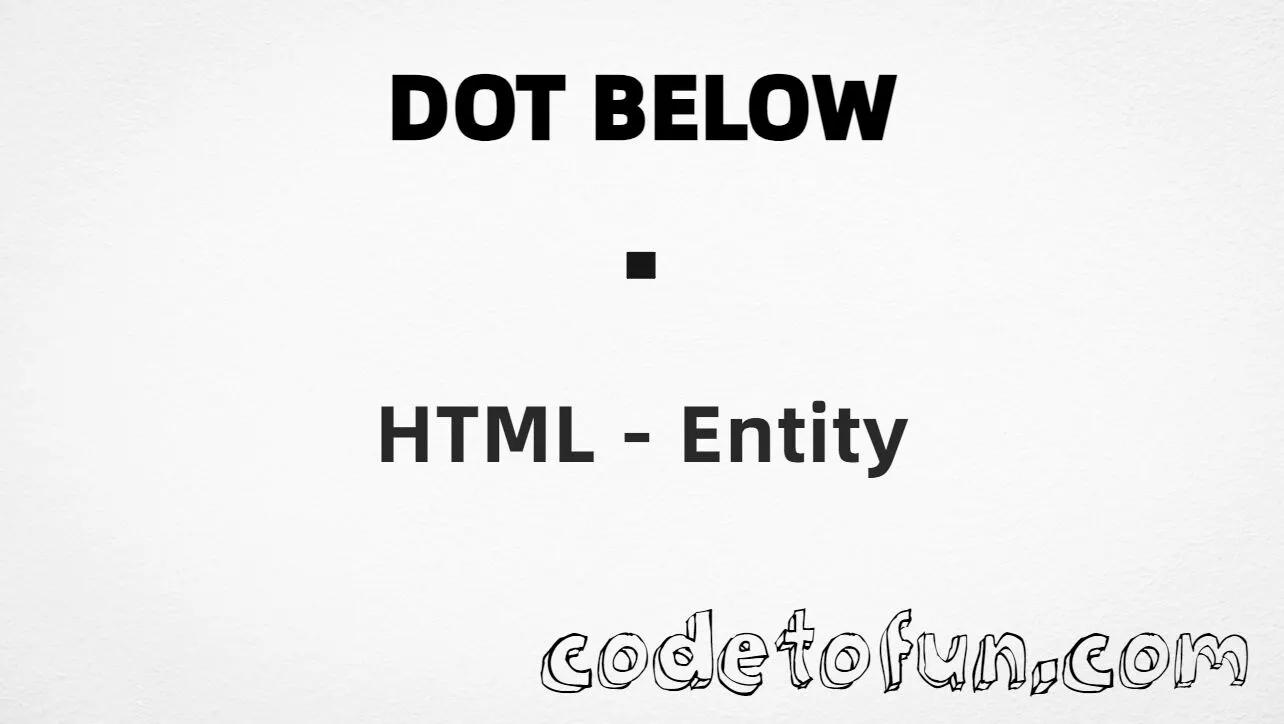
Dot below is the Unicode character at U+0323 in the Combining Diacritical Marks block. Official name: COMBINING DOT BELOW. It is a combining mark that attaches under the previous base letter — for example ạ → ạ.
Remember
Mark          (combining ̣)
Unicode       U+0323
Hex entity    ̣
Decimal       ̣
CSS escape    \0323
Named entity  (none)
Prefer when   ạ ẹ ọ (precomposed) exist
Prefer ̣ or ̣ immediately after the base letter (no named form). For Vietnamese, prefer precomposed letters like ạ, ẹ, ọ when available.
Combining dot below rendered on base letters and precomposed forms.
Built with U+0323ạ ẹ ọ
Precomposedạ ẹ ọ
Large glyphạ
Comparedạ ė O͘ ạ
With entitiesHex: ạ | Decimal: ạ
Code
Complete HTML Example
One page that shows Dot Below with hex, decimal, CSS escape, a typed combining form, and a precomposed alternative. Use View Output or open the live editor.
Built with Hex: ạ
Built with Decimal: ạ
Built with CSS: ạ
Typed: ạ  ẹ  ọ
Precomposed (preferred): ạ ẹ ọ
How It Works
1. Hex: write the base letter, then ̣ → ạ. Preferred when there is no named entity.
2. Decimal: same code point as 803 → ̣ after the base letter. Same result as hex.
3. CSS: use \0323 in content after a letter in the string (not an HTML entity). #point::after appends ạ.
4. Typed: paste the combining mark after a, e, or o in a UTF-8 document.
5. Precomposed: for Vietnamese, prefer ạẹọ when those characters exist.
Pitfalls & Tips
Common mistakes when working with Dot Below.
Order
Base letter first
Write ạ, not ̣a. Combining marks attach to the previous character.
Việt
Prefer precomposed when possible
For Vietnamese, type ạẹọ instead of building with U+0323 when those letters exist.
̇
Not dot above
U+0307 is combining dot above. U+0323 is below. U+0358 is above-right.
Name
No named entity
There is no &dotbelow;. Use ̣ or ̣.
CSS vs HTML
Do not mix escapes
\0323 belongs in CSS strings. ̣ / ̣ belong in HTML after a base letter.
Fonts
Diacritic font coverage
Some fonts omit U+0323. Prefer a font with Combining Diacritical Marks coverage for display.
Compatibility
Browser Support
Combining dot below (U+0323) and its entity forms (̣, ̣, CSS \\0323) are supported in all mainstream browsers. Visible positioning depends on font diacritic coverage.
✓ Universal support
Dot Below (U+0323)
Encode with hex, decimal, CSS escape, or type the combining mark after a letter — same code point everywhere encoding is supported.
100%Browser coverage
Google ChromeSupported
Yes
Microsoft EdgeSupported
Yes
Mozilla FirefoxSupported
Yes
Apple SafariSupported
Yes
OperaSupported
Yes
Internet ExplorerAll versions
Yes
U+0323 / entitiesFull support
Bottom line: Prefer ̣ after a base letter (no named form), or precomposed Vietnamese letters when available. Use \\0323 only inside CSS content.
Remember
Key Takeaways
Unicode: combining dot below is U+0323 (decimal 803).
HTML: no named entity — use base + ̣ / ̣, or type ạ when available.
CSS: use a letter + \0323 inside content.
Meaning: below combining mark — not U+0307 or U+0358.
One line:U+0323 → base + ̣ / ̣ / CSS \0323 (or type ạ when available).
Frequently Asked Questions
Place ̣ (hex) or ̣ (decimal) after a base letter, type the combining mark in UTF-8 after a letter, or use CSS \0323 in content after a letter. There is no named HTML entity for U+0323.
U+0323 (COMBINING DOT BELOW). Hex 0323, decimal 803. It belongs to the Combining Diacritical Marks block (U+0300–U+036F).
No. Use numeric forms ̣ or ̣ after a base character, or type the combining mark in a UTF-8 document.
Prefer precomposed Vietnamese letters (ạ ẹ ọ ụ …) for everyday text. Use combining U+0323 when you need a letter with no precomposed form, or when building diacritics dynamically.
HTML entities (̣ or ̣) go in markup after a base letter. The CSS escape \0323 goes in stylesheet strings (usually content on ::before/::after, after a letter in the string).
No. U+0323 combines below the letter. U+0307 is combining dot above (centered). U+0358 is combining dot above right.
🤔
Did you know?
Dot below is Unicode U+0323 (decimal 803) — a combining mark in the Combining Diacritical Marks block. There is no HTML5 named entity; use ̣ or ̣ after a base letter (e.g. ạ → ạ). For Vietnamese, prefer precomposed letters like ạẹọ when they exist.