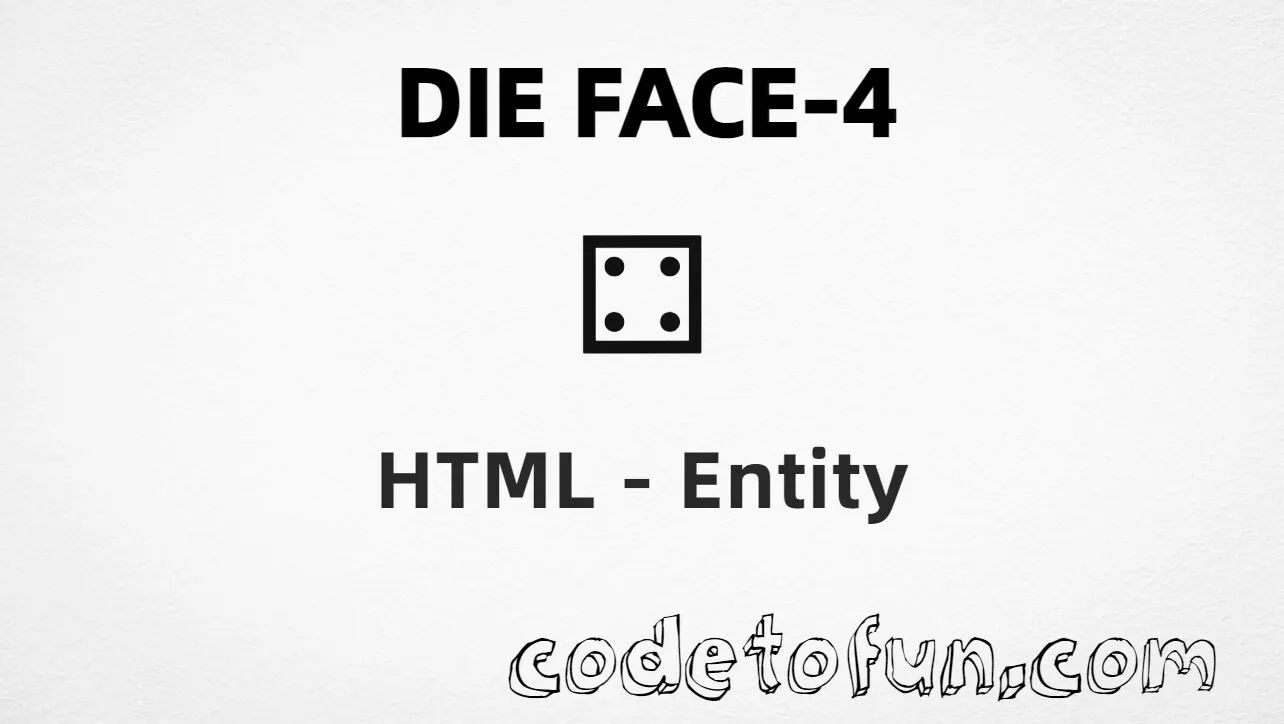
HTML Entity for Die Face 4 (⚃)

Beginner
5 min read
Updated: Sep 2026
1 example
Unicode U+2683

What Is Die Face 4?

Die face 4 (⚃) is the Unicode character at U+2683 in the Miscellaneous Symbols block. Official name: DIE FACE-4. It shows a six-sided die with four pips — useful for games, probability, and teaching.

Remember
Character     ⚃
Unicode       U+2683
Named entity  (none)
Hex entity    ⚃
Decimal       ⚃
CSS escape    \2683
Series        ⚀ ⚁ ⚂ ⚃ ⚄ ⚅

Prefer ⚃ or ⚃ in HTML markup (no named form). You can also type ⚃ in UTF-8 when the document encoding supports it.

Quick Reference

One table for every form you will actually use.

FormCodeWhere it goes
Named entityNone—
Direct character⚃HTML text (UTF-8)
Hex entity⚃HTML markup (preferred)
Decimal entity⚃HTML markup
CSS escape\2683Stylesheet content

When to Use Which

SituationUse
Show a die rolled 4⚃ or type ⚃
Die face 3⚂ / ⚂
Die face 5⚄ / ⚄
Accessible roll labelGlyph + text or aria-label (e.g. “rolled 4”)
Generated text via ::before / ::aftercontent: "\2683"

Live Preview

Die face 4 rendered in common game and teaching contexts.

Roll You rolled: ⚃
Large glyph ⚃
All faces ⚀ ⚁ ⚂ ⚃ ⚄ ⚅
Compared ⚂   ⚃   ⚄
With entities Hex: ⚃ | Decimal: ⚃

Complete HTML Example

One page that shows Die Face 4 with hex, decimal, CSS escape, a typed character, and the full face series. Use View Output or open the live editor.

Hex + Decimal + CSS + Typed + Series

Four ways to produce ⚃, plus faces 1–6 for context.

html
<!DOCTYPE html>
<html lang="en">
<head>
  <meta charset="UTF-8">
  <title>Die Face 4 (⚃) in HTML</title>
  <style>
    #point::after {
      content: "\2683";
    }
    .dice {
      font-size: 1.5rem;
      letter-spacing: 0.25em;
    }
  </style>
</head>
<body>
  <p>Die face 4 using Hex Code: &#x2683;</p>
  <p>Die face 4 using HTML Code: &#9859;</p>
  <p id="point">Die face 4 using CSS Entity: </p>
  <p>Typed directly: ⚃</p>
  <p class="dice" aria-label="Roll result: 4">You rolled: &#x2683;</p>
  <p class="dice">All faces: ⚀ ⚁ ⚂ ⚃ ⚄ ⚅</p>
</body>
</html>
Try It Yourself

How It Works

1. Hex: U+2683 → &#x2683; in HTML. Preferred when there is no named entity.

2. Decimal: same code point as 9859 → &#9859;. Same glyph as hex.

3. CSS: use \2683 in content (not an HTML entity). #point::after appends that ⚃ after the paragraph text.

4. Typed / roll: paste ⚃ in UTF-8. The roll line uses aria-label so screen readers hear “Roll result: 4”, not only an unlabeled symbol.

5. Series: faces 1–6 are consecutive Unicode points U+2680–U+2685 (glyphs ⚀ … ⚅).

Pitfalls & Tips

Common mistakes when working with Die Face 4.

Name

No named entity

There is no &dieface4; or similar. Use &#x2683; or &#9859;.

A11y

Say the number

A lone ⚃ may not announce clearly. Add nearby text or aria-label (e.g. “rolled 4”).

Emoji

Not game-die emoji

The emoji 🎲 is a different character (often U+1F3B2). Die face 4 is specifically U+2683.

CSS vs HTML

Do not mix escapes

\2683 belongs in CSS strings. &#x2683; / &#9859; belong in HTML.

Fonts

Symbol font coverage

Some fonts omit die faces. Prefer a font with Miscellaneous Symbols coverage for display.

Semicolon

End references

Always finish with ; — write &#x2683;, not &#x2683.

Browser Support

Die face 4 (U+2683) and its entity forms (&#x2683;, &#9859;, CSS \\2683) are supported in all mainstream browsers. Visible glyphs depend on symbol font coverage.

✓ Universal support

Die Face 4 (&#x2683;)

Encode with hex, decimal, CSS escape, or type the character — same code point everywhere encoding is supported.

100% Browser coverage
Google Chrome Supported
Yes
Microsoft Edge Supported
Yes
Mozilla Firefox Supported
Yes
Apple Safari Supported
Yes
Opera Supported
Yes
Internet Explorer All versions
Yes
U+2683 / entities Full support

Bottom line: Prefer &#x2683; in HTML (no named form). Use &#9859; when decimal form is required, and \\2683 only inside CSS content.

Key Takeaways

  • Unicode: die face 4 is U+2683 (decimal 9859) — glyph ⚃.
  • HTML: no named entity — use &#x2683; / &#9859; / type ⚃.
  • CSS: use \2683 inside content for generated text.
  • Series: faces 1–6 are U+2680–U+2685 (⚀ … ⚅).

One line: U+2683 → &#x2683; / &#9859; / CSS \2683 / type ⚃ (no named entity).

Frequently Asked Questions

Use &#x2683; (hex), &#9859; (decimal), type ⚃ directly in UTF-8, or the CSS escape \2683 in content. There is no named HTML entity for U+2683.
U+2683 (DIE FACE-4). Hex 2683, decimal 9859. It belongs to the Miscellaneous Symbols block (U+2600–U+26FF).
No. Use numeric forms &#9859; or &#x2683;, or type the character in a UTF-8 document.
Use it for dice games, board-game UIs, probability demos, and education when you need a standard six-sided die showing four pips.
HTML entities (&#9859; or &#x2683;) go in markup. The CSS escape \2683 goes in stylesheet strings (usually content on ::before/::after).
Faces 1–6 are U+2680 through U+2685. For face 3 use &#x2682; (U+2682); for face 5 use &#x2684; (U+2684).

Did you know?

Die face 4 is Unicode U+2683 (decimal 9859) — glyph ⚃ in the Miscellaneous Symbols block. There is no HTML5 named entity; use &#x2683; or &#9859;. Faces 1–6 are consecutive: U+2680–U+2685.
Next: Die Face 5

Learn the HTML entity for die face 5 (U+2684).

Die Face 5 tutorial →

About the author

Mari Selvan M P
Mari Selvan M P 🔗

Developer, cloud engineer, and technical writer

  • Experience 12 years building web and cloud systems
  • Focus Full Stack Development, AWS, and Developer Education

I write practical tutorials so students and working developers can learn by doing—from databases and APIs to deployment on AWS.

8 people found this page helpful

