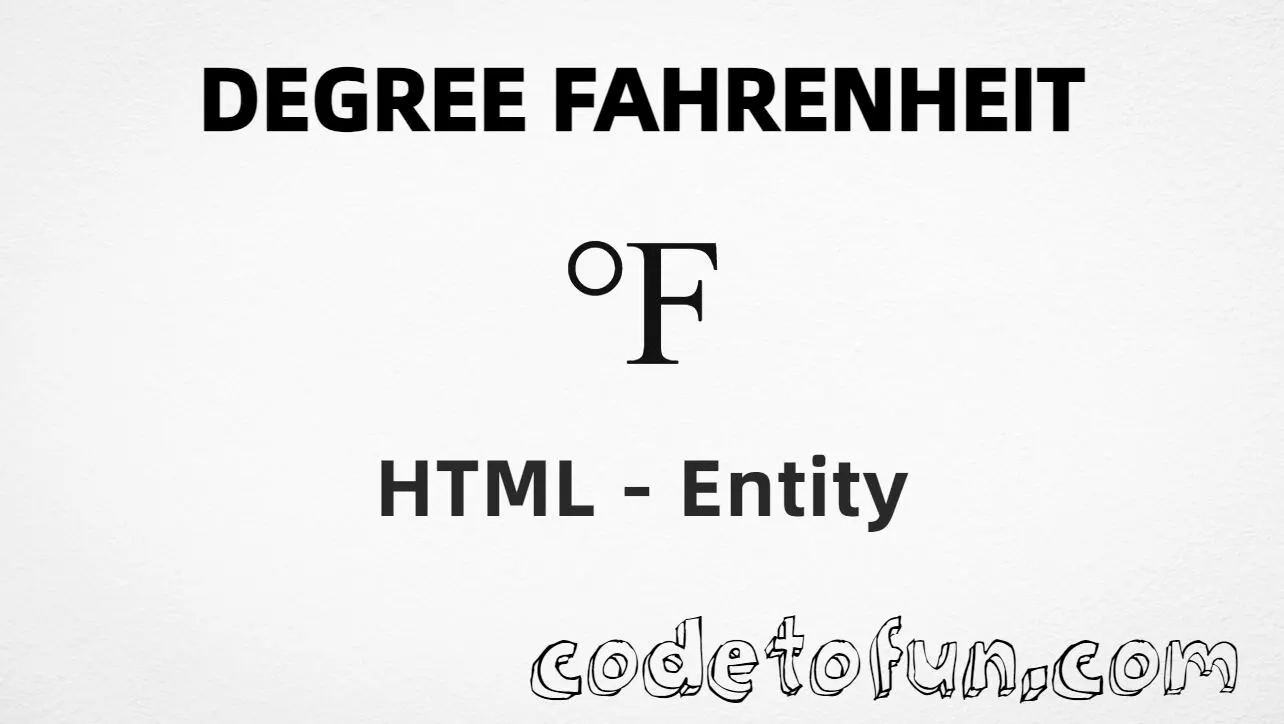
Degree Fahrenheit (℉) is the Unicode character at U+2109 in the Letterlike Symbols block. Official name: DEGREE FAHRENHEIT. It is a single symbol for Fahrenheit temperature — not the same as degree sign + letter F.
Remember
Character     ℉
Unicode       U+2109
Hex entity    ℉
Decimal       ℉
CSS escape    \2109
Named entity  (none for U+2109)
Alternative   °F  (°F)
Prefer typing ℉ or using ℉ / ℉ for the single symbol. For everyday copy, °F is a common, compatible alternative.
Degree Fahrenheit rendered in common temperature contexts.
WeatherToday: 72℉
Large glyph℉
Compared℉ °F ℃
ScienceWater freezes at 32℉
With entitiesHex: ℉ | Decimal: ℉ | Alt: °F
Code
Complete HTML Example
One page that shows Degree Fahrenheit with hex, decimal, CSS escape, typed character, and the °F alternative. Use View Output or open the live editor.
Hex + Decimal + CSS + Typed + Alternative
Ways to show Fahrenheit in a single document.
html
<!DOCTYPE html>
<html lang="en">
<head>
<meta charset="UTF-8">
<title>Degree Fahrenheit (℉) in HTML</title>
<style>
#point::after {
content: "\2109";
}
</style>
</head>
<body>
<p>Fahrenheit using Hex Code: ℉</p>
<p>Fahrenheit using HTML Code: ℉</p>
<p id="point">Fahrenheit using CSS Entity: </p>
<p>Typed directly: ℉</p>
<p>Alternative: 72 °F</p>
</body>
</html>
Fahrenheit using Hex Code: ℉
Fahrenheit using HTML Code: ℉
Fahrenheit using CSS Entity: ℉
Typed directly: ℉
Alternative: 72 °F
How It Works
1. Hex:U+2109 → ℉ in HTML → ℉.
2. Decimal: same code point as 8457 → ℉. Same result as hex.
3. CSS: use \2109 in content (not an HTML entity). #point::after appends that ℉ after the paragraph text.
4. Typed: in a UTF-8 page you can paste ℉ directly.
5. Alternative:°F is degree sign (U+00B0) plus the letter F — two characters, often better for fonts and accessibility.
Pitfalls & Tips
Common mistakes when working with Degree Fahrenheit.
Named?
No &fahrenheit;
HTML5 has no named entity for U+2109. Use numeric forms, or °F as an alternative.
°F
Symbol vs composition
℉ is one character. °F is two. Prefer °F when font or a11y support for U+2109 is uncertain.
℃
Not Celsius
℃ is degree Celsius (U+2103). Do not mix the two symbols.
CSS vs HTML
Do not mix escapes
\2109 belongs in CSS strings. ℉ / ℉ belong in HTML.
Fonts
Letterlike coverage
Some fonts omit U+2109 and show a box. Fall back to °F if needed.
Semicolon
End references
Always finish with ; — write ℉, not ℉.
Compatibility
Browser Support
Degree Fahrenheit (U+2109) and its numeric entity forms (℉, ℉, CSS \\2109) are supported in all mainstream browsers. Visible glyphs depend on Letterlike Symbols font coverage.
✓ Universal support
Degree Fahrenheit (℉)
Encode with hex, decimal, CSS escape, or type the character — same code point everywhere encoding is supported.
100%Browser coverage
Google ChromeSupported
Yes
Microsoft EdgeSupported
Yes
Mozilla FirefoxSupported
Yes
Apple SafariSupported
Yes
OperaSupported
Yes
Internet ExplorerAll versions
Yes
U+2109 / entitiesFull support
Bottom line: Use ℉ or ℉ for the single Fahrenheit symbol, and \\2109 only inside CSS content. Prefer °F when you need maximum font and accessibility compatibility.
Remember
Key Takeaways
Unicode: degree Fahrenheit is U+2109 (decimal 8457) — glyph ℉.
HTML: type ℉, or use ℉ / ℉ (no named entity).
CSS: use \2109 inside content for generated text.
Alternative:°F is often safer for fonts and screen readers than U+2109.
One line:U+2109 → ℉ / ℉ / CSS \2109 / type ℉ (or °F).
Frequently Asked Questions
Use ℉ (hex), ℉ (decimal), type ℉ directly in UTF-8, or the CSS escape \2109 in content. There is no named HTML entity for U+2109. Alternatively use °F (two characters).
U+2109 (DEGREE FAHRENHEIT). Hex 2109, decimal 8457. It belongs to the Letterlike Symbols block (U+2100–U+214F).
No. Use numeric references like ℉ or ℉, or type ℉. For a composed form, use °F (degree sign U+00B0 + F).
Use U+2109 when you need the single letterlike Fahrenheit symbol. Prefer °F for everyday weather and UI copy — it is often more compatible and clearer for assistive tech.
HTML entities (℉ or ℉) go in markup. The CSS escape \2109 goes in stylesheet strings (usually content on ::before/::after).
℉ (U+2109) is degree Fahrenheit. ℃ (U+2103) is degree Celsius. They are different Letterlike Symbols.
🤔
Did you know?
Degree Fahrenheit is Unicode U+2109 (decimal 8457) — glyph ℉ in the Letterlike Symbols block. HTML5 has no named entity for it. Many sites prefer °F (degree sign + letter F) for wider font support and clearer screen-reader spelling.