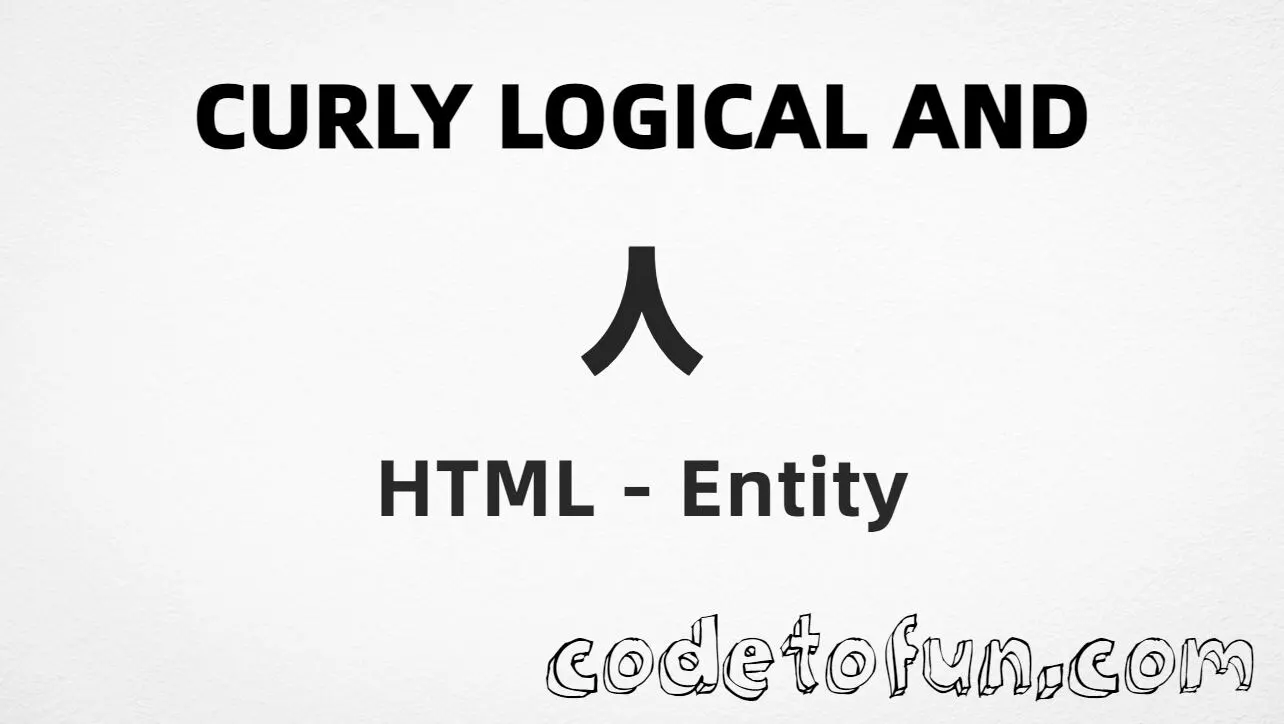
Curly logical AND (⋏) is the Unicode character at U+22CF in the Mathematical Operators block. It is also called curly wedge — a spacing logic / lattice operator, not the everyday Boolean AND (∧).
Remember
Character     ⋏
Unicode       U+22CF
Hex entity    ⋏
Decimal       ⋏
Named entity  ⋏ / ⋏
CSS escape    \22CF
Not the same  ∧ U+2227 · ⋎ U+22CE · ⋀ U+22C0
Prefer ⋏ or a typed ⋏ in hand-written HTML; use numeric forms when generating markup.
Curly logical AND rendered in common logic contexts.
Inline logicP⋏Q
Large glyph⋏
Compared⋏ ∧ ⋎ ⋀
Monospacea ⋏ b
With entitiesNamed: ⋏ | Hex: ⋏ | Decimal: ⋏
Code
Complete HTML Example
One page that shows Curly Logical AND with the named entity, hex entity, decimal entity, CSS escape, and a typed character. Use View Output or open the live editor.
Named + Hex + Decimal + CSS + Typed
Five ways to produce ⋏ in a single document.
html
<!DOCTYPE html>
<html lang="en">
<head>
<meta charset="UTF-8">
<title>Curly Logical AND (⋏) in HTML</title>
<style>
#point::after {
content: "\22CF";
}
</style>
</head>
<body>
<p>Curly AND using Named Entity: ⋏</p>
<p>Curly AND using Hex Code: ⋏</p>
<p>Curly AND using HTML Code: ⋏</p>
<p id="point">Curly AND using CSS Entity: </p>
<p>Typed directly: ⋏</p>
</body>
</html>
Curly AND using Named Entity: ⋏
Curly AND using Hex Code: ⋏
Curly AND using HTML Code: ⋏
Curly AND using CSS Entity: ⋏
Typed directly: ⋏
How It Works
1. Named:⋏ (alias ⋏) is the HTML named reference for U+22CF → ⋏.
2. Hex:U+22CF → ⋏ in HTML. Same glyph as the named form.
3. Decimal: same code point as 8911 → ⋏. Same result as hex.
4. CSS: use \22CF in content (not an HTML entity). #point::after appends that ⋏ after the paragraph text.
5. Typed: in a UTF-8 page you can paste ⋏ directly. All five lines show the same glyph.
Pitfalls & Tips
Common mistakes when working with Curly Logical AND.
Named
Prefer ⋏
⋏ and ⋏ both map to U+22CF. Do not use ∧ — that is ordinary logical AND.
∧
Not ordinary AND
∧ (∧ / ∧) is the common wedge AND. ⋏ is the curly form.
⋎
Not curly OR
⋎ is curly logical OR (curly vee). Use it for the dual operator, not as AND.
CSS vs HTML
Do not mix escapes
\22CF belongs in CSS. ⋏ / ⋏ / ⋏ belong in HTML.
Fonts
Math font coverage
Some fonts omit U+22CF. Prefer a font with Mathematical Operators coverage for display.
Semicolon
End references
Always finish with ; — write ⋏ and ⋏, not bare forms.
Compatibility
Browser Support
Curly logical AND (U+22CF) and its entity forms (⋏, ⋏, ⋏, CSS \\22CF) are supported in all mainstream browsers. Visible glyphs depend on font coverage.
✓ Universal support
Curly Logical AND (⋏)
Encode with named, hex, decimal, CSS escape, or type the character — same glyph everywhere encoding is supported.
100%Browser coverage
Google ChromeSupported
Yes
Microsoft EdgeSupported
Yes
Mozilla FirefoxSupported
Yes
Apple SafariSupported
Yes
OperaSupported
Yes
Internet ExplorerAll versions
Yes
U+22CF / entitiesFull support
Bottom line: Prefer ⋏ or typed ⋏ in HTML. Use \\22CF only inside CSS content. Do not confuse with ∧ (U+2227).
Remember
Key Takeaways
Unicode: curly logical AND is U+22CF (decimal 8911) — glyph ⋏.
HTML: use ⋏, ⋏, ⋏, or type ⋏.
CSS: use \22CF inside content for generated text.
Watch out:⋏ ≠ ∧ ≠ ⋎ (curly AND ≠ AND ≠ curly OR).
One line:U+22CF → ⋏ / ⋏ / CSS \22CF / type ⋏.
Frequently Asked Questions
Use ⋏ (hex), ⋏ (decimal), ⋏ or ⋏ (named), or the CSS escape \22CF in content. You can also paste ⋏ directly in UTF-8.
U+22CF (hex 22CF, decimal 8911). It belongs to the Mathematical Operators block and is also called curly wedge.
Yes. ⋏ and ⋏ are the HTML named references. Numeric forms ⋏ and ⋏ also work.
Use it in logic, lattice theory, or math docs that need the curly-wedge AND operator. For ordinary Boolean AND, prefer ∧ (U+2227 / ∧).
HTML entities (⋏, ⋏, or ⋏) go in markup. The CSS escape \22CF goes in stylesheet strings (usually content on ::before/::after).
⋏ (U+22CF / ⋏) is curly logical AND. ∧ (U+2227 / ∧) is the common logical AND (wedge). ⋎ (U+22CE) is curly logical OR — the dual operator.
🤔
Did you know?
Curly logical AND (curly wedge) is Unicode U+22CF (decimal 8911) — glyph ⋏ in the Mathematical Operators block. HTML named references include ⋏ and ⋏. It is a spacing logic / lattice operator. It is not logical AND ∧ (U+2227 / ∧) and not curly logical OR ⋎ (U+22CE).