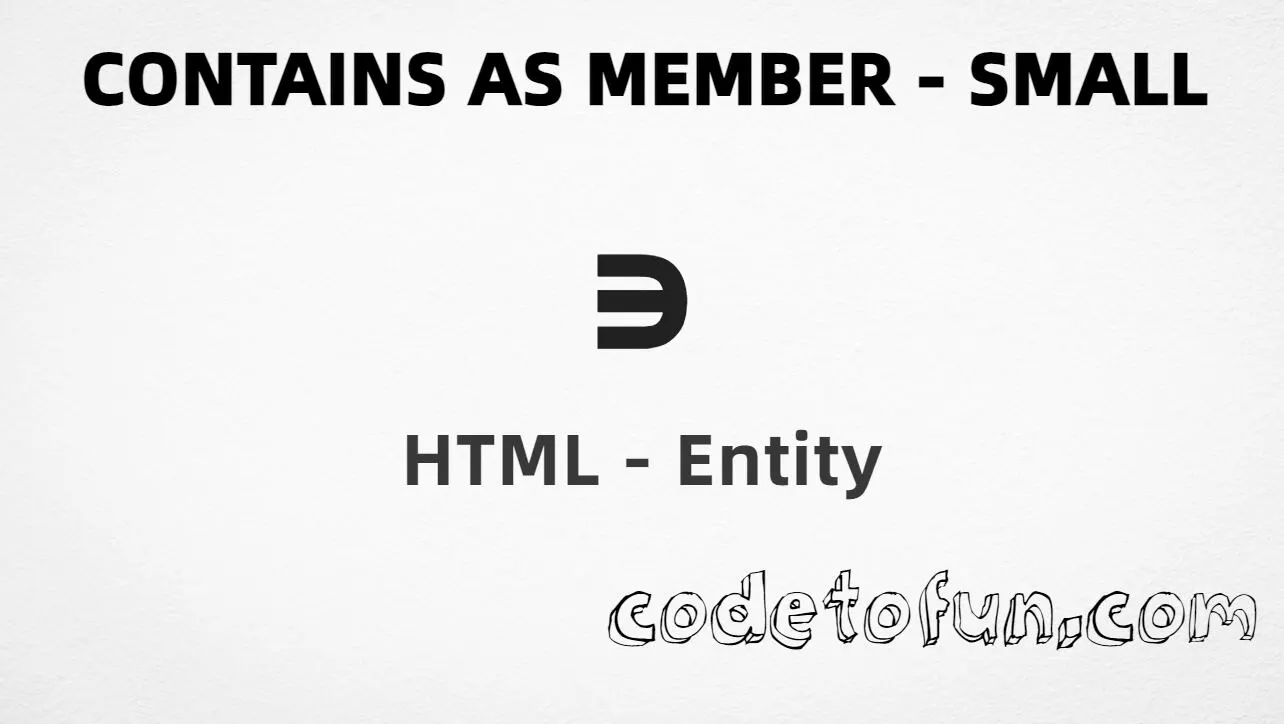
Small contains as member (∍) is the Unicode character at U+220D in the Mathematical Operators block. It is a smaller variant of contains as member (∋, U+220B) — same membership idea (set on the left), different glyph size.
Remember
Character     ∍
Unicode       U+220D
Hex entity    ∍
Decimal       ∍
CSS escape    \220D
Named entity  (none for U+220D)
Not the same  ∋ U+220B · ∈ U+2208
Prefer typing ∍ in UTF-8 HTML when your editor supports it; use ∍ or ∍ when you need an explicit entity. For standard set theory, prefer ∋ / ∋ unless you specifically need the small form.
Small contains using Hex Code: ∍
Small contains using HTML Code: ∍
Small contains using CSS Entity: ∍
Typed directly: ∍
How It Works
1. Hex:U+220D → ∍ in HTML → ∍.
2. Decimal: same code point as 8717 → ∍. Same result as hex.
3. CSS: use \220D in content (not an HTML entity). #point::after appends that ∍ after the paragraph text.
4. Typed: in a UTF-8 page you can paste ∍ directly. All four lines show the same glyph.
Pitfalls & Tips
Common mistakes when working with Small Contains As Member.
Named?
No named entity for U+220D
Use numeric forms. ∋ is for full-size ∋ (U+220B), not this small variant.
Size
Small ≠ full
∍ and ∋ look related but are different code points. Do not swap them if a font or PDF requires a specific form.
∈
Not element of
∈ puts the element first. ∍ puts the set first (small contains).
CSS vs HTML
Do not mix escapes
\220D belongs in CSS strings. ∍ / ∍ belong in HTML.
Fonts
Coverage varies
Some fonts omit U+220D or render it almost like ∋. Test with a font that covers Mathematical Operators.
Semicolon
End references
Always finish with ; — write ∍, not ∍.
Compatibility
Browser Support
Small contains as member (U+220D) and its numeric entity forms (∍, ∍, CSS \\220D) are supported in all mainstream browsers. Visible glyphs depend on font coverage.
✓ Universal support
Contains As Member Small (∍)
Encode with hex, decimal, CSS escape, or type the character — same code point everywhere encoding is supported.
100%Browser coverage
Google ChromeSupported
Yes
Microsoft EdgeSupported
Yes
Mozilla FirefoxSupported
Yes
Apple SafariSupported
Yes
OperaSupported
Yes
Internet ExplorerAll versions
Yes
U+220D / entitiesFull support
Bottom line: Use ∍ or ∍ when you need the small glyph, and \\220D only inside CSS content. Prefer ∋ / ∋ for standard contains-as-member.
Remember
Key Takeaways
Unicode: small contains as member is U+220D (decimal 8717) — glyph ∍.
HTML: type ∍, or use ∍ / ∍ (no named entity).
CSS: use \220D inside content for generated text.
Watch out:∍ ≠ ∋ ≠ ∈ (small ≠ full ≠ element of).
One line:U+220D → ∍ / ∍ / CSS \220D / type ∍.
Frequently Asked Questions
Use ∍ (hex), ∍ (decimal), type ∍ directly in UTF-8, or the CSS escape \220D in content. There is no named HTML entity for U+220D.
U+220D (hex 220D, decimal 8717). It belongs to the Mathematical Operators block and is a smaller variant of ∋ (U+220B).
No. Use numeric references like ∍ or ∍, or type the character ∍ in a UTF-8 document. Note: ∋ is for the full-size ∋ (U+220B), not U+220D.
Use it when a document specifically needs the small contains-as-member glyph. For everyday set theory, prefer ∋ (U+220B / ∋) or element of ∈ (U+2208).
HTML entities (∍ or ∍) go in markup. The CSS escape \220D goes in stylesheet strings (usually content on ::before/::after).
∍ (U+220D) is small contains as member. ∋ (U+220B / ∋) is the standard full-size contains as member. ∈ (U+2208) is element of (flipped writing order).
🤔
Did you know?
Small contains as member is Unicode U+220D (decimal 8717) — glyph ∍ in the Mathematical Operators block. It is a smaller variant of contains as member ∋ (U+220B). HTML5 has no named entity. Prefer U+220B / ∋ for standard set-theory text unless you specifically need the small form.