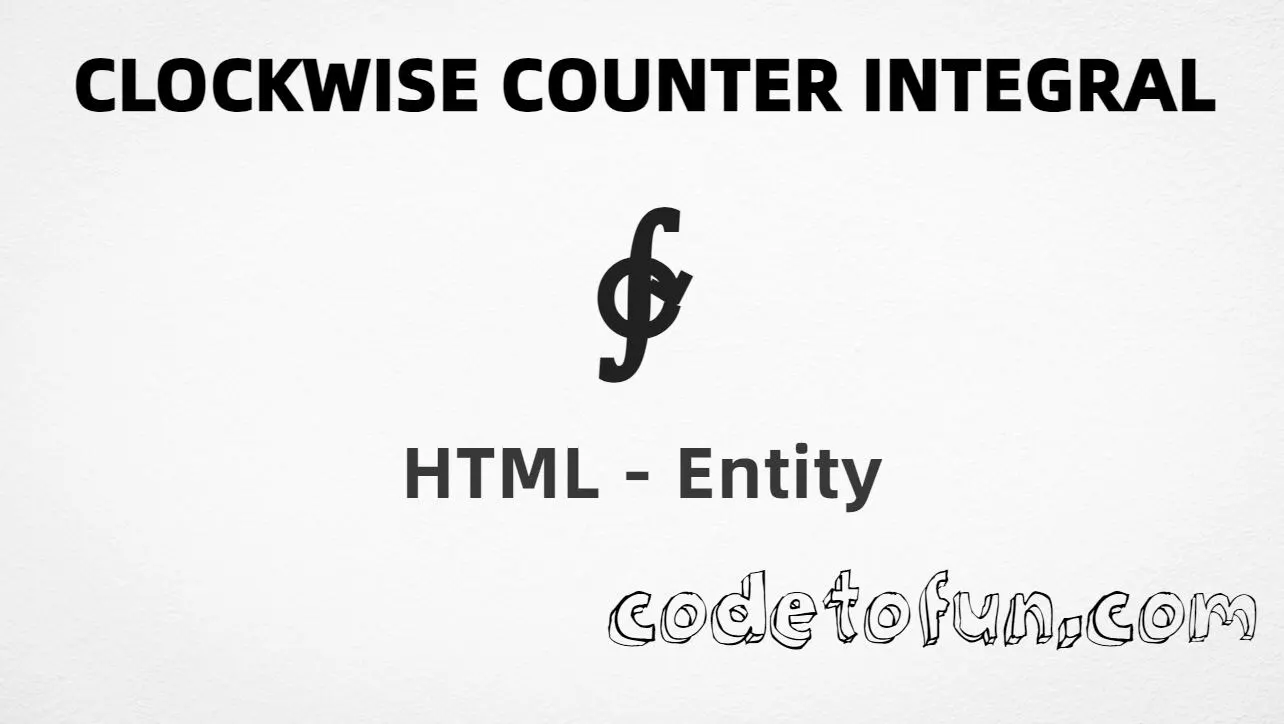
Clockwise Contour Integral (∲) is the Unicode character at U+2232 in the Mathematical Operators block (official name: CLOCKWISE CONTOUR INTEGRAL). It is the contour-integral symbol with a clockwise orientation, used in calculus and physics notation.
Remember
Character     ∲
Unicode       U+2232
Hex entity    ∲
Decimal       ∲
Named entity  ∲ / ∲
CSS escape    \2232
All of these produce the same glyph: ∲. Prefer ∲ or a typed ∲ in hand-written HTML; use numeric forms when generating markup.
Clockwise contour integral rendered in common writing contexts.
Inline math∲f(z) dz
Large glyph∲
Compared∲ ∮ ∳
Monospaceop: ∲ cw contour
With entitiesNamed: ∲ | Hex: ∲ | Decimal: ∲
Code
Complete HTML Example
One page that shows Clockwise Contour Integral with the named entity, hex entity, decimal entity, CSS escape, and a typed character. Use View Output or open the live editor.
Named + Hex + Decimal + CSS + Typed
Five ways to produce ∲ in a single document.
html
<!DOCTYPE html>
<html lang="en">
<head>
<meta charset="UTF-8">
<title>Clockwise Contour Integral (∲) in HTML</title>
<style>
#point::after {
content: "\2232";
}
</style>
</head>
<body>
<p>Clockwise Contour Integral using Named Entity: ∲</p>
<p>Clockwise Contour Integral using Hex Code: ∲</p>
<p>Clockwise Contour Integral using HTML Code: ∲</p>
<p id="point">Clockwise Contour Integral using CSS Entity: </p>
<p>Typed directly: ∲</p>
</body>
</html>
Clockwise Contour Integral using Named Entity: ∲
Clockwise Contour Integral using Hex Code: ∲
Clockwise Contour Integral using HTML Code: ∲
Clockwise Contour Integral using CSS Entity: ∲
Typed directly: ∲
How It Works
1. Named:∲ (alias ∲) is the HTML5 named reference for U+2232 → ∲.
2. Hex:U+2232 → ∲ in HTML. Same glyph as the named form.
3. Decimal: same code point as 8754 → ∲. Same result as hex.
4. CSS: use \2232 in content (not an HTML entity). #point::after appends that ∲ after the paragraph text.
5. Typed ∲: fine in UTF-8 pages. All five lines show the same glyph.
Pitfalls & Tips
Common mistakes when working with Clockwise Contour Integral entities.
Named
Use ∲
∲ and ∲ both work. Always end with ;.
CSS vs HTML
Do not mix escapes
\2232 belongs in CSS. ∲ / ∲ / ∲ belong in HTML.
∲ vs ∮
Different characters
∲ is U+2232. Plain contour ∮ is U+222E (∮).
Slug
URL says “counter”
This page’s path is /clockwise-counter-integral, but the character is the clockwise contour integral (U+2232), not anticlockwise.
A11y
Name the operator
Pair ∲ with prose or an accessible name (e.g. “clockwise contour integral”) so screen readers get the meaning.
Semicolon
End references
Always finish with ; — write ∲ and ∲, not bare forms.
Compatibility
Browser Support
Clockwise Contour Integral (U+2232) and its entity forms (∲, ∲, ∲, ∲, CSS \\2232) are supported in all mainstream browsers.
✓ Universal support
Clockwise Contour Integral (∲)
Type ∲, or encode with named, hex, decimal, or CSS escape — same glyph everywhere encoding is supported.
100%Browser coverage
Google ChromeSupported
Yes
Microsoft EdgeSupported
Yes
Mozilla FirefoxSupported
Yes
Apple SafariSupported
Yes
OperaSupported
Yes
Internet ExplorerAll versions
Yes
U+2232 / entitiesFull support
Bottom line: Prefer ∲ or a typed ∲ for clockwise contour integrals. Use decimal when generating markup, and \\2232 only inside CSS content.
Remember
Key Takeaways
Unicode: clockwise contour integral is U+2232 (decimal 8754).
Use ∲ (hex), ∲ (decimal), ∲ (named), or the CSS escape \2232 in the content property. All render ∲. You can also paste ∲ directly when your file is UTF-8.
U+2232 (hex 2232, decimal 8754). Unicode names it CLOCKWISE CONTOUR INTEGRAL. It belongs to the Mathematical Operators block.
Yes. ∲ and ∲ are HTML5 named references for ∲. Numeric forms ∲ and ∲ also work.
Use it in math, physics, or engineering pages when you need a clockwise contour integral symbol. For complex layouts, MathML or a math library may be clearer than a lone glyph.
HTML entities (∲, ∲, or ∲) go in markup. The CSS escape \2232 goes in stylesheet strings (usually content on ::before/::after).
∮ (U+222E / ∮) is the plain contour integral. ∲ (U+2232 / ∲) adds a clockwise sense. ∳ (U+2233) is the anticlockwise contour integral. Do not mix them up.
🤔
Did you know?
Clockwise contour integral is Unicode U+2232 (decimal 8754) — official name CLOCKWISE CONTOUR INTEGRAL in the Mathematical Operators block. HTML named references are ∲ and ∲. It is not the plain contour integral ∮ (U+222E / ∮).