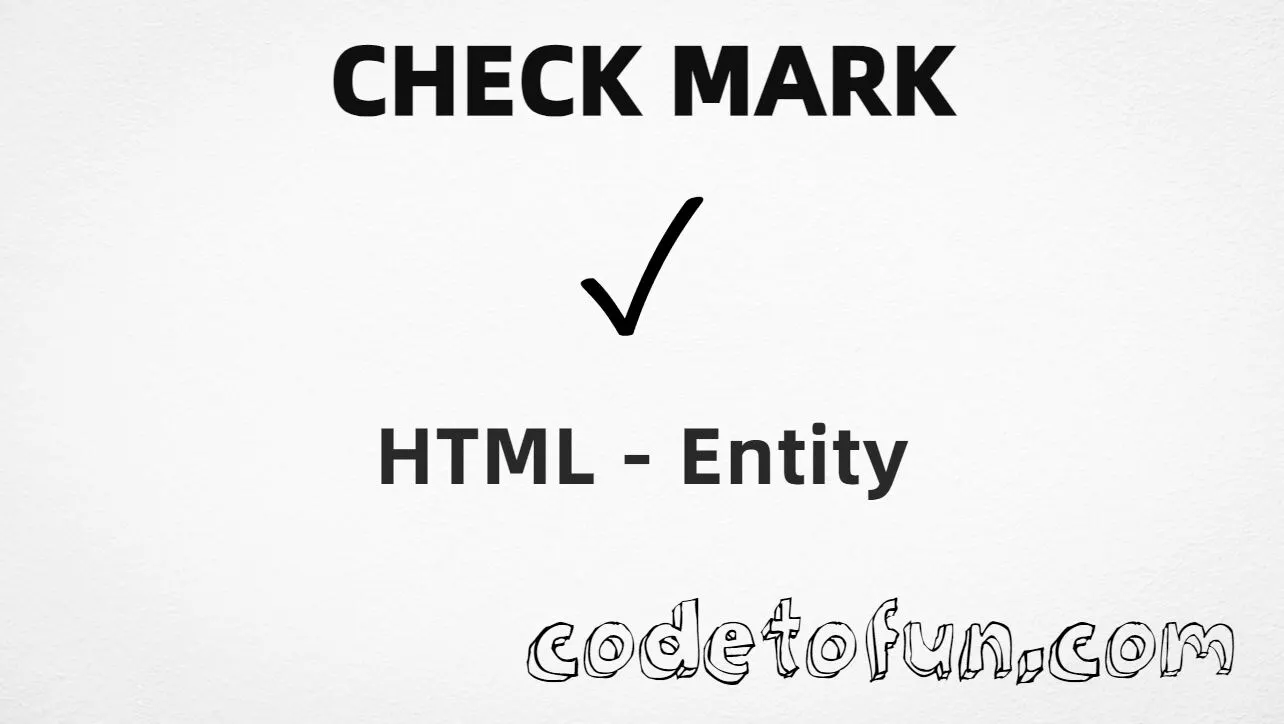
Check Mark (✓) is the Unicode character at U+2713 in the Dingbats block (official name: CHECK MARK). It is the familiar “tick” used for completed tasks, correct answers, and approval UI.
Remember
Character     ✓
Unicode       U+2713
Hex entity    ✓
Decimal       ✓
Named entity  ✓ / ✓
CSS escape    \2713
All of these produce the same glyph: ✓. Prefer ✓ or a typed ✓ in hand-written HTML; use numeric forms when generating markup.
Reference
Quick Reference
One table for every form you will actually use.
Form
Code
Where it goes
Direct character
✓
HTML text (UTF-8)
Named entity
✓ or ✓
HTML markup
Hex entity
✓
HTML markup
Decimal entity
✓
HTML markup
CSS escape
\2713
Stylesheet content
When to use which
Situation
Use
Hand-written HTML
✓ or type ✓
Generated / numeric-only markup
✓ or ✓
Generated text via ::before / ::after
content: "\2713"
Bolder “heavy” tick
Use ✔ (U+2714), not ✓
Checked ballot box
Use ☑ (U+2611)
See it
Live Preview
Check Mark rendered in common writing contexts.
Inline text✓ Task complete
Large glyph✓
Compared✓ ✔ ☑
Monospacestatus: ✓ passed
With entitiesNamed: ✓ | Hex: ✓ | Decimal: ✓
Code
Complete HTML Example
One page that shows Check Mark with the named entity, hex entity, decimal entity, CSS escape, and a typed character. Use View Output or open the live editor.
Named + Hex + Decimal + CSS + Typed
Five ways to produce ✓ in a single document.
html
<!DOCTYPE html>
<html lang="en">
<head>
<meta charset="UTF-8">
<title>Check Mark (✓) in HTML</title>
<style>
#point::after {
content: "\2713";
}
</style>
</head>
<body>
<p>Check Mark using Named Entity: ✓</p>
<p>Check Mark using Hex Code: ✓</p>
<p>Check Mark using HTML Code: ✓</p>
<p id="point">Check Mark using CSS Entity: </p>
<p>Typed directly: ✓</p>
</body>
</html>
Use ✓ (hex), ✓ (decimal), ✓ or ✓ (named), or the CSS escape \2713 in the content property. All render ✓. You can also paste ✓ directly when your file is UTF-8.
U+2713 (hex 2713, decimal 10003). Unicode names it CHECK MARK. It belongs to the Dingbats block.
Yes. Both ✓ and ✓ map to U+2713. Prefer ✓ in hand-written HTML; numeric forms are useful in generated markup.
✓ (U+2713) is the standard check mark. ✔ (U+2714) is HEAVY CHECK MARK — a bolder, related glyph with a different code point.
HTML entities (✓, ✓, ✓, or ✓) go in markup. The CSS escape \2713 is used in stylesheets (usually in the content property of ::before/::after). Both render ✓.
Use it for completed tasks, correct answers, approval UI, and feature lists. For accessible “done” states, pair the glyph with clear text or an aria-label so meaning does not rely on the symbol alone.
🤔
Did you know?
Check mark is Unicode U+2713 (decimal 10003) — official name CHECK MARK in the Dingbats block. HTML named references are ✓ and ✓. It is not the heavy check mark (U+2714 ✔).