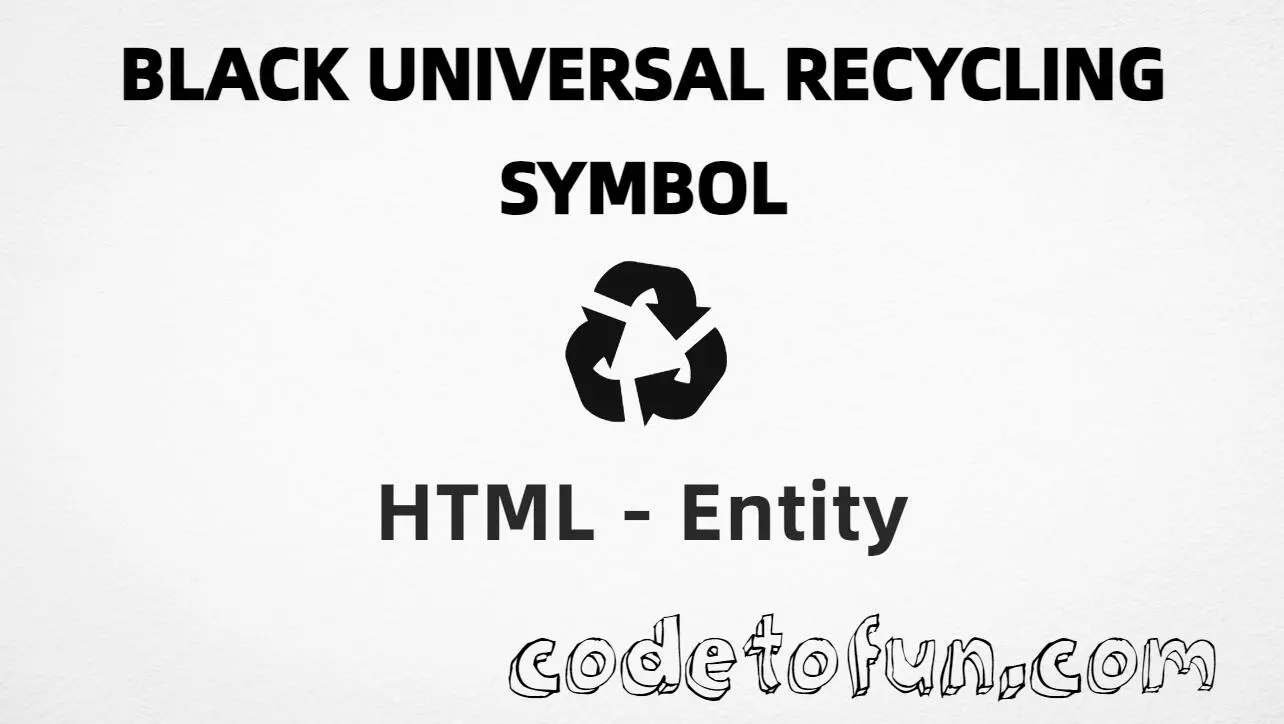
HTML Entity for Black Universal Recycling Symbol (♻)
Beginner
5 min read
Updated: Sep 2026
1 example
Unicode U+267B
Definition
What Is Black Universal Recycling Symbol?
Black universal recycling symbol (♻) is Unicode U+267B in the Miscellaneous Symbols block. It is the filled Möbius-loop recycling glyph — useful for eco cues and sustainability labels. HTML has no standard named entity — use numeric or CSS forms (or type the character in UTF-8).
Remember
Character     ♻
Unicode       U+267B
Hex entity    ♻
Decimal       ♻
Named entity  (none)
CSS escape    \267B
Not the same  ♲ U+2672 (universal recycling symbol)
All of these produce the same glyph: ♻. Prefer typing ♻ in UTF-8 when you can; use ♻ / ♻ or CSS for generated content.
Black universal recycling symbol using Hex Code: ♻
Black universal recycling symbol using HTML Code: ♻
Black universal recycling symbol using CSS Entity: ♻
Typed directly: ♻
How It Works
1. Hex:U+267B → ♻ in HTML. The browser turns it into ♻.
2. Decimal: same code point as 9851 → ♻. Same result as hex.
3. CSS: use \267B in content (not an HTML entity). #point::after appends that ♻ after the paragraph text.
4. Typed ♻: fine in UTF-8 source. All four lines show the same glyph.
Pitfalls & Tips
Common mistakes when working with black universal recycling symbol (♻).
Named
No &name; form
U+267B has no standard named entity — use ♻ or ♻.
Some platforms draw U+267B as a colorful emoji. Expect text vs emoji style differences across OS and fonts.
a11y
Say “recycle”
Screen readers may not announce “recycling.” Pair the glyph with visible or visually hidden text such as Recycle.
CSS vs HTML
Do not mix escapes
\267B belongs in CSS. ♻ / ♻ belong in HTML.
Semicolon
End references
Always finish with ; — write ♻, not ♻.
Compatibility
Browser Support
Black universal recycling symbol (U+267B) and its entity forms (♻, ♻, CSS \\267B) are supported in all mainstream browsers. Glyph quality depends on font support for Miscellaneous Symbols (and emoji fonts where applicable).
✓ Universal support
Black Universal Recycling Symbol (♻)
Type ♻, or encode with hex, decimal, or CSS escape — same code point everywhere encoding is supported.
100%Browser coverage
Google ChromeSupported
Yes
Microsoft EdgeSupported
Yes
Mozilla FirefoxSupported
Yes
Apple SafariSupported
Yes
OperaSupported
Yes
Internet ExplorerAll versions
Yes
U+267B / entitiesFull support
Bottom line: Prefer a typed ♻ or ♻ for markers. Use decimal when generating markup, and \\267B only inside CSS content.
Remember
Key Takeaways
Unicode: black universal recycling symbol is U+267B (decimal 9851).
HTML: use ♻ or ♻ (no named entity).
CSS: use \267B inside content for generated icons.
Watch out: ♻ ≠ ♲ (U+267B ≠ U+2672).
One line:U+267B → ♻ / ♻ / CSS \267B.
Frequently Asked Questions
Use ♻ (hex), ♻ (decimal), or the CSS escape \267B in the content property. All render ♻. You can also paste ♻ directly if your file is UTF-8. There is no standard named entity.
U+267B (hex 267B, decimal 9851). Unicode names it BLACK UNIVERSAL RECYCLING SYMBOL. It belongs to the Miscellaneous Symbols block.
No. HTML5 / WHATWG does not define a named character reference for U+267B. Prefer ♻, ♻, or a typed ♻ in UTF-8.
♻ (U+267B) is black universal recycling symbol. ♲ (U+2672) is universal recycling symbol. They are different code points.
HTML entities (♻ or ♻) go in markup. The CSS escape \267B is used in stylesheets (usually in the content property of ::before/::after). Both render ♻.
Use ♻ for sustainability cues, eco branding, and recycling program labels. Prefer clear text or ARIA labels when the meaning must be obvious to screen readers.
🤔
Did you know?
Black universal recycling symbol is Unicode U+267B (decimal 9851) in the Miscellaneous Symbols block — official name BLACK UNIVERSAL RECYCLING SYMBOL. There is no standard named HTML entity. It is not universal recycling symbol (U+2672 ♲).