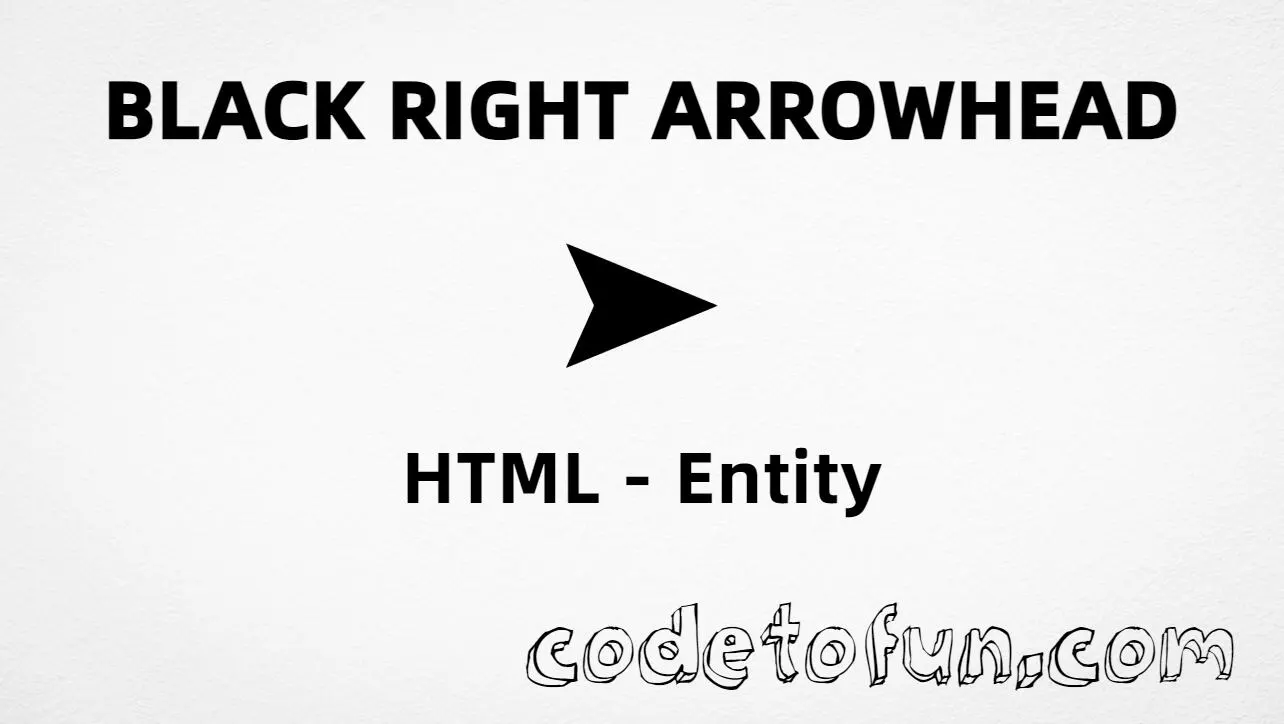
Black right arrowhead (➤) is Unicode U+27A4 in the Dingbats block. It is a compact filled arrowhead pointing right — useful for tight UI pointers. HTML has no standard named entity — use numeric or CSS forms (or type the character in UTF-8).
Remember
Character     ➤
Unicode       U+27A4
Hex entity    ➤
Decimal       ➤
Named entity  (none)
CSS escape    \27A4
Not the same  ➡ U+27A1 · ➵ U+27B5
All of these produce the same glyph: ➤. Prefer typing ➤ in UTF-8 when you can; use ➤ / ➤ or CSS for generated content.
Screen readers may not announce a clear direction. Pair the glyph with visible or visually hidden text.
Fonts
Check Dingbats coverage
Some UI fonts omit U+27A4. Prefer fonts with solid Dingbats / arrow support.
CSS vs HTML
Do not mix escapes
\27A4 belongs in CSS. ➤ / ➤ belong in HTML.
Semicolon
End references
Always finish with ; — write ➤, not ➤.
Compatibility
Browser Support
Black right arrowhead (U+27A4) and its entity forms (➤, ➤, CSS \\27A4) are supported in all mainstream browsers. Glyph quality depends on font support for Dingbats.
✓ Universal support
Black Right Arrowhead (➤)
Type ➤, or encode with hex, decimal, or CSS escape — same glyph everywhere encoding is supported.
100%Browser coverage
Google ChromeSupported
Yes
Microsoft EdgeSupported
Yes
Mozilla FirefoxSupported
Yes
Apple SafariSupported
Yes
OperaSupported
Yes
Internet ExplorerAll versions
Yes
U+27A4 / entitiesFull support
Bottom line: Prefer a typed ➤ or ➤ for markers. Use decimal when generating markup, and \\27A4 only inside CSS content.
Remember
Key Takeaways
Unicode: black right arrowhead is U+27A4 (decimal 10148).
HTML: use ➤ or ➤ (no named entity).
CSS: use \27A4 inside content for generated icons.
One line:U+27A4 → ➤ / ➤ / CSS \27A4.
Frequently Asked Questions
Use ➤ (hex), ➤ (decimal), or the CSS escape \27A4 in the content property. All render ➤. You can also paste ➤ directly if your file is UTF-8. There is no standard named entity.
U+27A4 (hex 27A4, decimal 10148). Unicode names it BLACK RIGHTWARDS ARROWHEAD. It belongs to the Dingbats block.
No. HTML5 / WHATWG does not define a named character reference for U+27A4. Prefer ➤, ➤, or a typed ➤ in UTF-8.
➤ (U+27A4) is a compact black rightwards arrowhead. ➡ (U+27A1) is black rightwards arrow. ➵ (U+27B5) is black-feathered rightwards arrow. They are different code points.
HTML entities (➤ or ➤) go in markup. The CSS escape \27A4 is used in stylesheets (usually in the content property of ::before/::after). Both render ➤.
Use ➤ for compact navigation pointers, UI markers, and next/forward cues where a short arrowhead fits better than a full arrow. Prefer plain text or ARIA labels when the direction must be clear to screen readers.
🤔
Did you know?
Black right arrowhead is Unicode U+27A4 (decimal 10148) in the Dingbats block — official name BLACK RIGHTWARDS ARROWHEAD. There is no standard named HTML entity. It is not black right arrow (U+27A1 ➡) or black feathered right arrow (U+27B5 ➵).