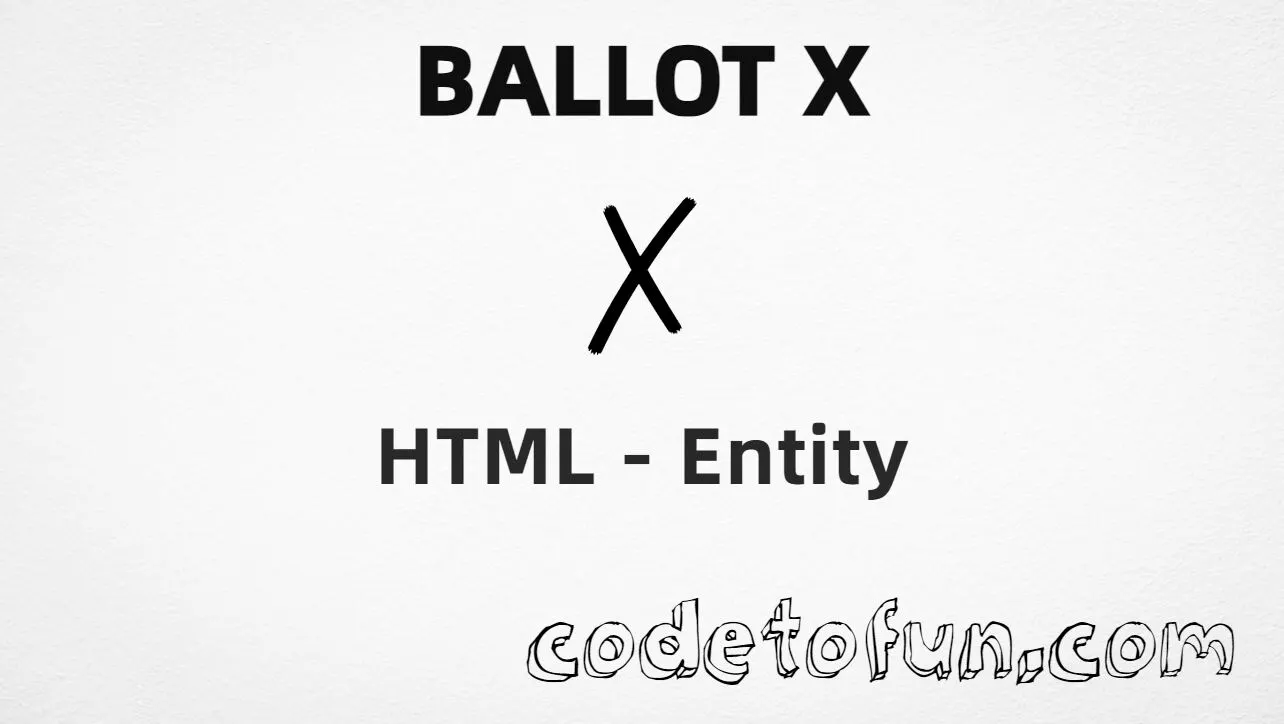
Ballot X (✗) is Unicode U+2717 in the Dingbats block. It is a standalone cross used for “wrong,” “no,” or rejection in quizzes and UI. HTML provides the named entity ✗.
Remember
Character     ✗
Unicode       U+2717
Hex entity    ✗
Decimal       ✗
Named entity  ✗
CSS escape    \2717
Not the same  ☒ U+2612 · × U+00D7 · ✘ U+2718
All of these produce the same glyph: ✗. Prefer ✗ in hand-written HTML; type ✗ in UTF-8 when you can; use numeric or CSS forms for generated content.
One page that shows ✗ with hex, decimal, named entity, CSS escape, and a typed character. Use View Output or open the live editor.
Hex + Decimal + Named + CSS + Typed
Five ways to produce ✗ in a single document.
html
<!DOCTYPE html>
<html lang="en">
<head>
<meta charset="UTF-8">
<title>Ballot X (✗) in HTML</title>
<style>
#point::after {
content: "\2717";
}
</style>
</head>
<body>
<p>Ballot X using Hex Code: ✗</p>
<p>Ballot X using HTML Code: ✗</p>
<p>Ballot X using Named Entity: ✗</p>
<p id="point">Ballot X using CSS Entity: </p>
<p>Typed directly: ✗</p>
</body>
</html>
Use × (×) for math. ✗ is a Dingbat, not the times sign.
✘
Heavy variant exists
✘ (U+2718) is a heavier ballot X — pick one style per UI.
a11y
Add plain-language labels
Screen readers may not say “incorrect.” Pair ✗ with visible text when meaning matters.
CSS vs HTML
Do not mix escapes
\2717 belongs in CSS. ✗ / ✗ belong in HTML.
Semicolon
End references
Always finish with ; — write ✗, not &cross.
Compatibility
Browser Support
Ballot X (U+2717) and its entity forms (✗, ✗, ✗, CSS \\2717) are supported in all mainstream browsers. Glyph quality depends on font support for Dingbats.
✓ Universal support
Ballot X (✗)
Type ✗, or encode with named, hex, decimal, or CSS escape — same glyph everywhere encoding is supported.
100%Browser coverage
Google ChromeSupported
Yes
Microsoft EdgeSupported
Yes
Mozilla FirefoxSupported
Yes
Apple SafariSupported
Yes
OperaSupported
Yes
Internet ExplorerAll versions
Yes
U+2717 / entitiesFull support
Bottom line: Prefer ✗ or a typed ✗ for quiz marks. Use numeric forms when generating markup, and \\2717 only inside CSS content.
Remember
Key Takeaways
Unicode: ballot X is U+2717 (decimal 10007).
HTML: prefer ✗ (or ✗ / ✗).
CSS: use \2717 inside content for generated icons.
Use ✗ (hex), ✗ (decimal), ✗ (named), or the CSS escape \2717 in the content property. All render ✗. You can also paste ✗ directly if your file is UTF-8.
U+2717 (hex 2717, decimal 10007). Unicode names it BALLOT X. It belongs to the Dingbats block.
Yes. ✗ maps to U+2717. Prefer it in hand-written HTML; numeric forms are useful in generated markup.
✗ is a standalone cross (U+2717). ☒ is ballot box with X (U+2612) — a box glyph. Do not substitute them.
No. × is U+00D7 (multiplication sign, often ×). ✗ is the ballot X dingbat — different character and meaning.
HTML entities (✗, ✗, or ✗) go in markup. The CSS escape \2717 is used in stylesheets (usually in the content property of ::before/::after). Both render ✗.
🤔
Did you know?
Ballot X is Unicode U+2717 (decimal 10007) in the Dingbats block — official name BALLOT X. HTML’s named reference is ✗. It is not the same as ballot box with X (☒, U+2612) or multiplication sign (×, U+00D7).