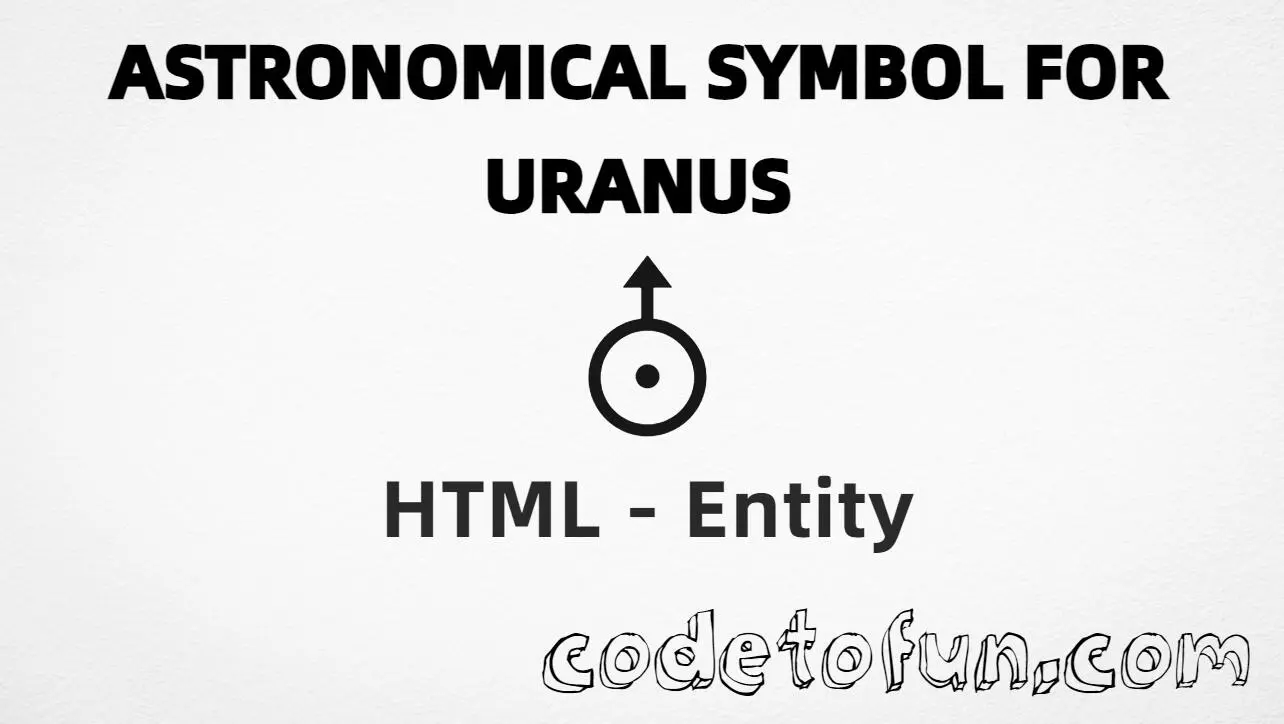
The astronomical symbol for Uranus (⛢) is Unicode U+26E2 in the Miscellaneous Symbols block. It is the modern-style planet mark used in astronomy charts, legends, and many astrology UIs. HTML has no standard named entity — use numeric or CSS forms (or type the character in UTF-8).
Remember
Character     ⛢
Unicode       U+26E2
Hex entity    ⛢
Decimal       ⛢
Named entity  (none)
CSS escape    \26E2
Not the same  ♅ (U+2645, older Uranus)
All of these produce the same glyph: ⛢. Prefer typing ⛢ in UTF-8 when you can; use ⛢ / ⛢ or CSS for generated content.
Uranus using Hex Code: ⛢
Uranus using HTML Code: ⛢
Uranus using CSS Entity: ⛢
Typed directly: ⛢
How It Works
1. Hex:U+26E2 → ⛢ in HTML. The browser turns it into ⛢.
2. Decimal: same code point as 9954 → ⛢. Same result as hex.
3. CSS: use \26E2 in content (not an HTML entity). #point::after appends that ⛢ after the paragraph text.
4. Typed ⛢: fine in UTF-8 source. All four lines show the same glyph.
Pitfalls & Tips
Common mistakes when working with the Uranus astronomical symbol (⛢).
Named
No &name; form
U+26E2 has no standard named entity — use ⛢ or ⛢.
U+2645
Do not mix Uranus glyphs
♅ (U+2645) is a different Uranus mark. Pick one convention per chart.
Fonts
Check symbol coverage
Some UI fonts omit a polished U+26E2. Prefer fonts with solid Miscellaneous Symbols coverage.
CSS vs HTML
Do not mix escapes
\26E2 belongs in CSS. ⛢ / ⛢ belong in HTML.
a11y
Add plain-language labels
Screen readers may not speak “Uranus.” Pair the glyph with visible text or an accessible name.
Semicolon
End references
Always finish with ; — write ⛢, not ⛢.
Compatibility
Browser Support
The Uranus astronomical symbol (U+26E2) and its entity forms (⛢, ⛢, CSS \\26E2) are supported in all mainstream browsers. Glyph quality depends on font support for Miscellaneous Symbols.
✓ Universal support
Uranus (⛢)
Type ⛢, or encode with hex, decimal, or CSS escape — same glyph everywhere encoding is supported.
100%Browser coverage
Google ChromeSupported
Yes
Microsoft EdgeSupported
Yes
Mozilla FirefoxSupported
Yes
Apple SafariSupported
Yes
OperaSupported
Yes
Internet ExplorerAll versions
Yes
U+26E2 / entitiesFull support
Bottom line: Prefer a typed ⛢ or ⛢ for planet legends. Use decimal when generating markup, and \\26E2 only inside CSS content.
Remember
Key Takeaways
Unicode: Uranus astronomical symbol is U+26E2 (decimal 9954).
HTML: use ⛢ or ⛢ (no named entity).
CSS: use \26E2 inside content for generated icons.
Watch out: ⛢ ≠ ♅ (U+2645).
One line:U+26E2 → ⛢ / ⛢ / CSS \26E2.
Frequently Asked Questions
Use ⛢ (hex), ⛢ (decimal), or the CSS escape \26E2 in the content property. All render ⛢. You can also paste ⛢ directly if your file is UTF-8. There is no standard named entity.
U+26E2 (hex 26E2, decimal 9954). Unicode names it ASTRONOMICAL SYMBOL FOR URANUS. It belongs to the Miscellaneous Symbols block.
No. HTML5 / WHATWG does not define a named character reference for U+26E2. Prefer ⛢, ⛢, or a typed ⛢ in UTF-8.
No. U+26E2 is the modern astronomical symbol for Uranus. U+2645 (♅) is an older astrological Uranus sign — a different character. Pick one convention per project.
HTML entities (⛢ or ⛢) go in markup. The CSS escape \26E2 is used in stylesheets (usually in the content property of ::before/::after). Both render ⛢.
In astronomy charts, planet legends, educational pages, and astrology UIs that need a compact Uranus glyph. Prefer consistent encoding (hex, decimal, or UTF-8) across the site.
🤔
Did you know?
Uranus’s astronomical symbol is Unicode U+26E2 (decimal 9954) in the Miscellaneous Symbols block — official name ASTRONOMICAL SYMBOL FOR URANUS. There is no standard named HTML entity. An older astrological mark is U+2645 (♅); that is a different code point.