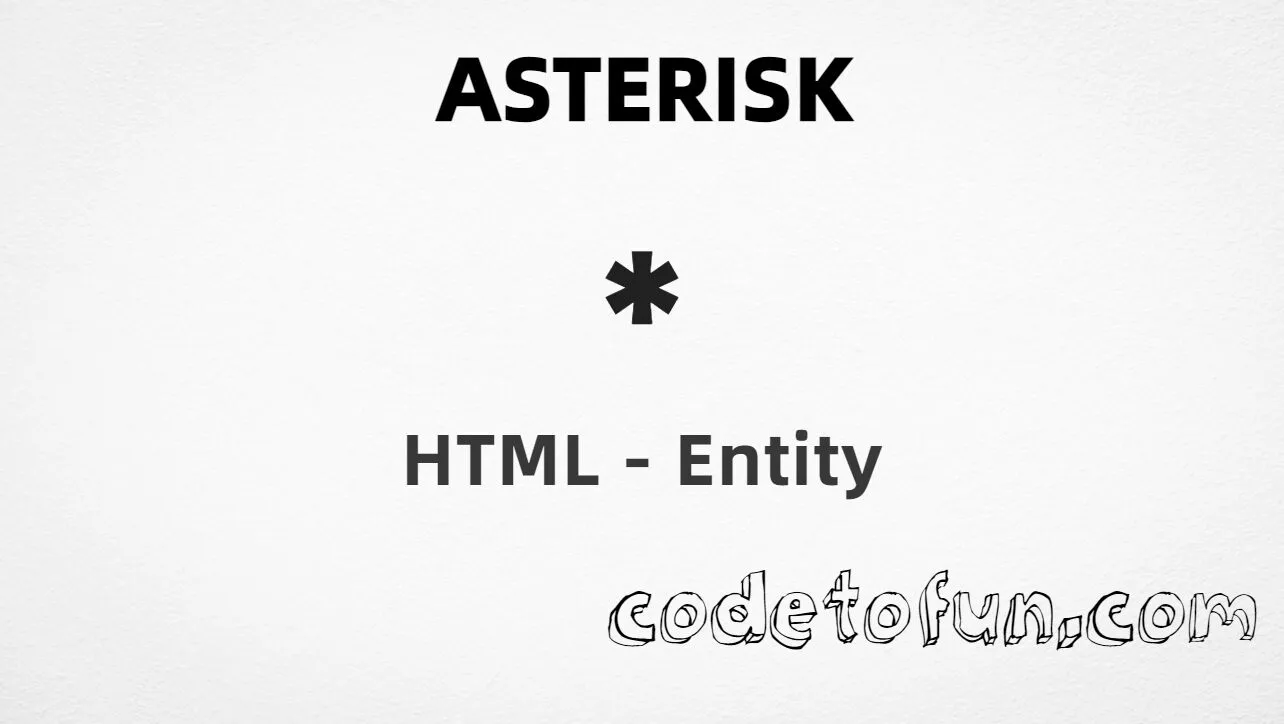
Asterisk operator (∗) is Unicode U+2217 in the Mathematical Operators block. It is the centered mathematical asterisk — not the same code point as the keyboard ASCII star * (U+002A). HTML provides the named entity ∗.
Remember
Character     ∗
Unicode       U+2217
Hex entity    ∗
Decimal       ∗
Named entity  ∗
CSS escape    \2217
Not the same  * U+002A (*)
All of these produce the same glyph: ∗. Prefer ∗ in hand-written HTML; type ∗ in UTF-8 when you can; use numeric or CSS forms for generated content.
Do not use U+2217 where a literal keyboard * is required (passwords, wildcards, source).
CSS vs HTML
Do not mix escapes
\2217 belongs in CSS. ∗ / ∗ belong in HTML.
Fonts
Glyphs can look alike
Some fonts draw ∗ and * almost the same — check code points, not appearance alone.
Consistency
Pick one style
Do not mix U+002A and U+2217 randomly in one formula without a reason.
Semicolon
End references
Always finish with ; — write ∗, not &lowast.
Compatibility
Browser Support
Asterisk operator (U+2217) and its entity forms (∗, ∗, ∗, CSS \\2217) are supported in all mainstream browsers. Glyph availability depends on font support for Mathematical Operators.
✓ Universal support
Asterisk Operator (∗)
Type ∗, or encode with named, hex, decimal, or CSS escape — same glyph everywhere encoding is supported.
100%Browser coverage
Google ChromeSupported
Yes
Microsoft EdgeSupported
Yes
Mozilla FirefoxSupported
Yes
Apple SafariSupported
Yes
OperaSupported
Yes
Internet ExplorerAll versions
Yes
U+2217 / entitiesFull support
Bottom line: Prefer ∗ or a typed ∗ for math text. Use * / * for ASCII stars, and \\2217 only inside CSS content.
Remember
Key Takeaways
Unicode: asterisk operator is U+2217 (decimal 8727).
Use ∗ (hex), ∗ (decimal), ∗ (named), or the CSS escape \2217 in the content property. All render ∗ (U+2217). You can also paste ∗ directly if your file is UTF-8.
U+2217 (hex 2217, decimal 8727). Unicode names it ASTERISK OPERATOR. It belongs to the Mathematical Operators block (U+2200–U+22FF).
No. ∗ is U+2217 (∗). * is U+002A (*), the ASCII keyboard asterisk. They may look alike but are different code points.
Use ∗ (U+2217) when you want the mathematical operator glyph. Use * (U+002A) for keyboard-style stars, passwords, wildcards, and source code that must match ASCII.
HTML entities (∗, ∗, or ∗) go in markup. The CSS escape \2217 is used in stylesheets (usually in the content property of ::before/::after). Both render ∗.
Yes. ∗ maps to U+2217. Prefer it in hand-written HTML; numeric forms are useful in generated markup.
🤔
Did you know?
Asterisk operator is Unicode U+2217 (decimal 8727) in the Mathematical Operators block. HTML provides ∗ for ∗. It is not the keyboard ASCII asterisk * (U+002A / *) — they may look similar but are different characters.