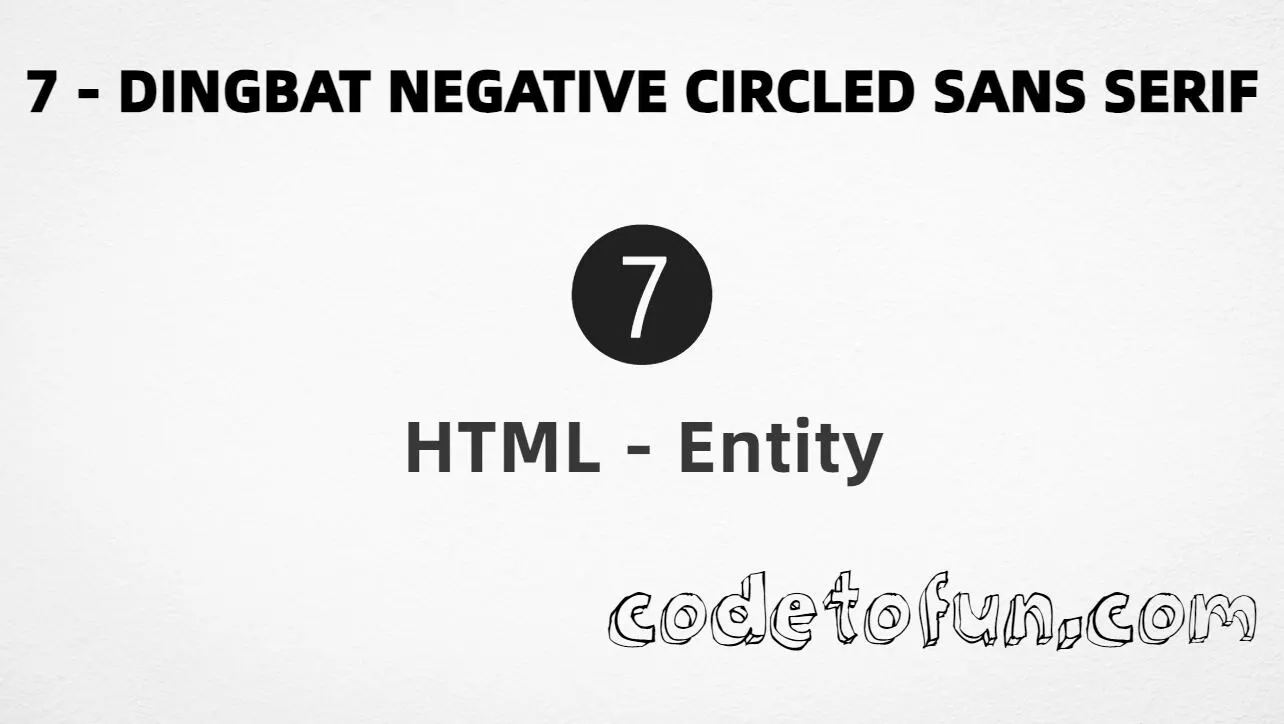
HTML Entity for Negative Circled Sans-Serif Digit Seven (➐)
Beginner
6 min read
Updated: Sep 2026
1 example
Unicode U+2790
Definition
What Is the Negative Circled Sans-Serif Digit Seven Entity?
Negative Circled Sans-Serif Digit Seven (➐) is the Unicode character at U+2790 in the Dingbats block. It looks like a sans-serif digit 7 on a filled circle and is common for high-contrast step markers.
Remember
Character     ➐
Unicode       U+2790
Hex entity    ➐
Decimal       ➐
CSS escape    \2790
Named entity  (none)
All of these produce the same glyph: ➐. Prefer this character when you need a filled sans-serif circled look; type plain 7 when you only need a normal digit.
Reference
Quick Reference
One table for every form you will actually use.
Form
Code
Where it goes
Direct character
➐
HTML text (UTF-8)
Hex entity
➐
HTML markup
Decimal entity
➐
HTML markup
CSS escape
\2790
Stylesheet content
Named entity
—
Not defined in HTML5
When to use which
Situation
Use
Need the filled sans-serif circled glyph ➐
Type ➐, or ➐ / ➐
Generated text via ::before / ::after
content: "\2790"
Filled circled seven (non-sans)
Use ❼ (U+277C)
Plain digit seven (not circled)
Type 7 (U+0037)
Looking for &negcircledsans7; or similar
Does not exist — use numeric form
See it
Live Preview
Negative Circled Sans-Serif Digit Seven rendered in common UI contexts.
Inline text➐ Download receipt
Large glyph➐
Step list➎ Review ➏ Confirm ➐ Done
Monospacestep ➐ → receipt
With entitiesHex: ➐ | Decimal: ➐
Code
Complete HTML Example
One page that shows Negative Circled Sans-Serif Digit Seven with the hex entity, decimal entity, CSS escape, and a typed character. Use View Output or open the live editor.
Neg. Circled Sans-Serif Seven using Hex Code: ➐
Neg. Circled Sans-Serif Seven using HTML Code: ➐
Neg. Circled Sans-Serif Seven using CSS Entity: ➐
Typed directly: ➐
How It Works
1. Hex:U+2790 → ➐ in HTML. The browser turns it into ➐.
2. Decimal: same code point as 10128 → ➐. Same result as hex.
3. CSS: use \2790 in content (not an HTML entity). #point::after appends that ➐ after the paragraph text.
4. Typed ➐: fine in UTF-8 pages. All four lines show the same dingbat digit.
Pitfalls & Tips
Common mistakes when working with Negative Circled Sans-Serif Digit Seven entities.
Named?
No named entity
HTML5 does not define &negcircledsans7; or similar. Use numeric forms.
CSS vs HTML
Do not mix escapes
\2790 belongs in CSS. ➐ / ➐ belong in HTML.
➐ vs ❼ vs 7
Different characters
➐ is U+2790; filled circled ❼ is U+277C; digit 7 is U+0037.
Fonts
Check the glyph
Dingbat support varies by font. If ➐ is missing, use a fallback font or CSS badge instead.
Semicolon
End references
Always finish with ; — write ➐, not ➐.
Related
Open circled form
➆ (open circled sans-serif) is a different Unicode character — not the same as ➐.
Compatibility
Browser Support
Negative Circled Sans-Serif Digit Seven (U+2790) and its numeric entity forms (➐, ➐, CSS \\2790) are supported in all mainstream browsers. Glyph shape depends on the font.
✓ Universal support
Neg. Circled Sans-Serif 7 (➐)
Encode with hex, decimal, or CSS escape — or paste ➐ in UTF-8 HTML.
100%Browser coverage
Google ChromeSupported
Yes
Microsoft EdgeSupported
Yes
Mozilla FirefoxSupported
Yes
Apple SafariSupported
Yes
OperaSupported
Yes
Internet ExplorerAll versions
Yes
U+2790 / entitiesFull support
Bottom line: Use ➐ or ➐ for the Unicode glyph, and \\2790 only inside CSS content. Prefer typed 7 for ordinary numbers.
Remember
Key Takeaways
Unicode: Negative Circled Sans-Serif Digit Seven is U+2790 (decimal 10128).
HTML: use ➐ or ➐ when you need an entity.
CSS: use \2790 inside content for generated text.
Default: use ➐ for filled sans-serif step badges; type 7 for ordinary numbers.
One line:U+2790 → ➐ / ➐ / CSS \2790, or paste ➐.
Frequently Asked Questions
Use ➐ (hex), ➐ (decimal), or the CSS escape \2790 in the content property. All render ➐. You can also paste ➐ directly when your file is UTF-8.
U+2790 (hex 2790, decimal 10128). It belongs to the Dingbats Unicode block.
No. HTML5 does not define a named entity for ➐. Use numeric references like ➐ or ➐.
Use it for filled sans-serif step markers, rankings, and high-contrast numbered badges. For plain counts or data, prefer typing digit 7 (U+0037).
No. Digit seven is U+0037. Negative circled seven is U+277C (❼). Negative circled sans-serif seven is U+2790 (➐) — a different character.
HTML entities (➐ or ➐) go in markup. The CSS escape \2790 is used in stylesheets (usually in the content property of ::before/::after). Both render ➐.
🤔
Did you know?
Negative circled sans-serif digit seven is Unicode U+2790 (decimal 10128). HTML5 has no named entity for it — use ➐ or ➐. It is a different character from plain digit seven (U+0037) and from filled circled ❼ (U+277C).