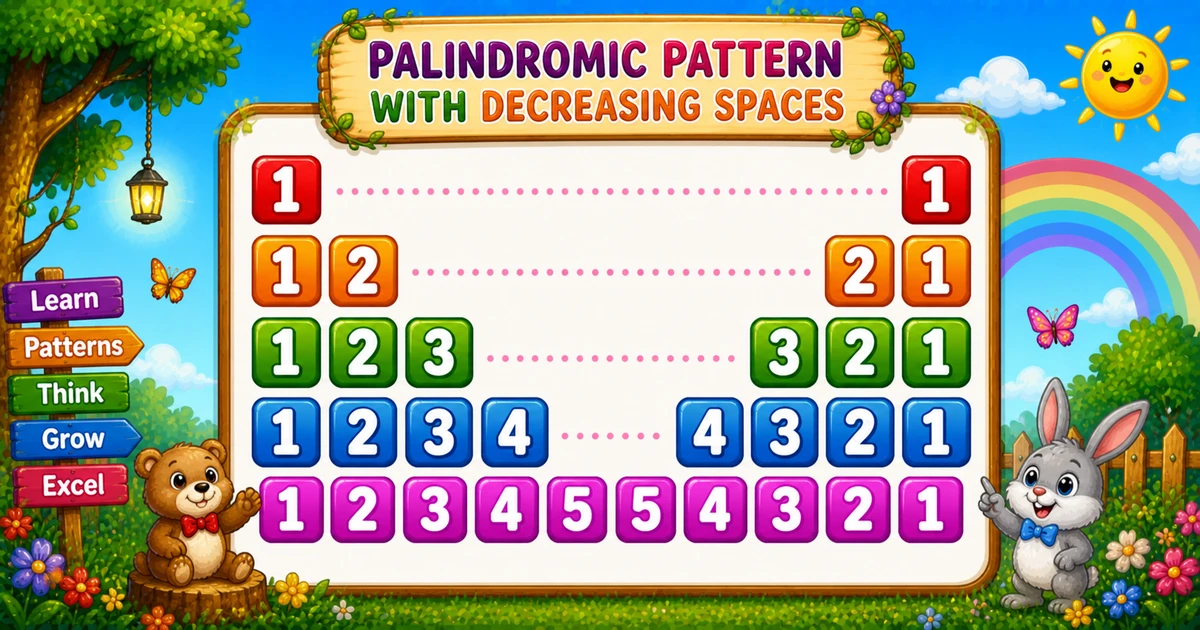
A spaced mirror prints left digits 1..i and right digits i..1 inside two fixed-width loops. Unused columns become spaces, so the gap shrinks until the last row joins with no gap.
Remember
Rule: for i from 1 to rows
      left  — digit if j <= i, else space  (j = 1..rows)
      right — space if k > i, else digit k (k = rows..1)

1        1
12      21
123    321
1234  4321
1234554321     ← rows = 5
Two coordinated halves share the same width. Follows the 0-centered mirror in Program 28; next is Program 30.
Approach
How to Solve It
Start with fixed rows = 5, then generalize with scanf — optionally demo a smaller count for tracing.
Method
Idea
Best for
Fixed-width + spaces
Left 1..i / spaces; right spaces / i..1
Learning, interviews, exams
Ternary print
Same loops; (cond) ? printf("%d", …) : printf(" ")
Compact code after you know if/else
Pseudocode
Pseudocode
for i from 1 to rows:
    for j from 1 to rows:
        if j <= i: print j
        else: print space
    for k from rows down to 1:
        if k > i: print space
        else: print k
    print newline
Cheat sheet
Goal
Pattern
Walk each row
for (i = 1; i <= rows; i++)
Left half width
for (j = 1; j <= rows; j++)
Left digit or space
if (j <= i) printf("%d", j); else printf(" ");
Right half width
for (k = rows; k >= 1; k--)
Right space or digit
if (k > i) printf(" "); else printf("%d", k);
End the row
printf("\n");
Printing Numbers vs Starting a New Line
API
Effect
Use for
printf("%d", j) / printf(" ")
Stays on the same line
Digits and alignment spaces
printf("\n")
Ends the current line
After both halves
Print the whole mirror without a newline, then end the row once.
Try it
Live Preview
Change the row count and the spaced mirror updates instantly — capped at 9 so every value stays a single character.
Whole numbers from 1 to 9. Tap a chip or type a value — the preview redraws as you go.
Live result5 rows · 50 cells
1        1
12      21
123    321
1234  4321
1234554321
Trace
Worked Walkthrough — rows = 4
Trace each outer-loop value of i and list the left half, right half, and full printed row (spaces shown as · below for clarity).
i
Left (j = 1..4)
Right (k = 4..1)
Printed row
1
1···
···1
1 1
2
12··
··21
12 21
3
123·
·321
123 321
4
1234
4321
12344321
Each row prints 2 × rows characters. For n rows that is 2n² cells — why time is O(n²).
Code
C Programs
Three complete programs: fixed rows, scanf input with ternary prints, and a small demo. Use View Output to reveal sample results.
Example 1 — Fixed rows = 5
Hard-coded row count — if/else in both fixed-width halves.
C
#include <stdio.h>

int main(void)
{
    int i, j, k;

    for (i = 1; i <= 5; i++)
    {
        for (j = 1; j <= 5; j++)
        {
            if (j <= i)
                printf("%d", j);
            else
                printf(" ");
        }

        for (k = 5; k >= 1; k--)
        {
            if (k > i)
                printf(" ");
            else
                printf("%d", k);
        }

        printf("\n");
    }

    return 0;
}
Output
1        1
12      21
123    321
1234  4321
1234554321
How It Works
1. Outer loop grows i.i runs from 1 to 5 — one mirrored row per pass.
2. Left half.j always runs 1..5; print the digit when j <= i, otherwise a space.
3. Right half.k runs 5..1; print a space when k > i, otherwise digit k.
4. Newline.printf("\n") ends the row after both halves.
When i = 1 you get 1 1; when i = 5 both halves fill — 1234554321.
Example 2 — User Input Version
Read rows with scanf and clamp to 1–9. Ternary operators compact the digit-or-space choice.
C
#include <stdio.h>

int main(void)
{
    int rows;
    int i, j, k;

    printf("Enter rows (1-9): ");
    scanf("%d", &rows);
    if (rows < 1) rows = 1;
    if (rows > 9) rows = 9;

    for (i = 1; i <= rows; i++)
    {
        for (j = 1; j <= rows; j++)
            (j <= i) ? printf("%d", j) : printf(" ");

        for (k = rows; k >= 1; k--)
            (k > i) ? printf(" ") : printf("%d", k);

        printf("\n");
    }

    return 0;
}
Output (when user enters 4)
Enter rows (1-9): 4
1      1
12    21
123  321
12344321
How It Works
1. Prompt and clamp. Read rows, then force it into 1..9 so single-digit columns stay valid.
2. Same two-half core. Only the hard-coded 5 becomes rows; ternaries replace if/else.
3. Safer input tip. Unchecked scanf leaves rows uninitialized on bad input. Prefer:
Safer input
if (scanf("%d", &rows) != 1 || rows < 1 || rows > 9)
{
    printf("Enter a whole number from 1 to 9.\n");
    return 1;
}
Example 3 — Compact rows = 3
Same if/else logic with a smaller row count for quick paper tracing.
C
#include <stdio.h>

int main(void)
{
    int rows = 3;
    int i, j, k;

    for (i = 1; i <= rows; i++)
    {
        for (j = 1; j <= rows; j++)
        {
            if (j <= i)
                printf("%d", j);
            else
                printf(" ");
        }

        for (k = rows; k >= 1; k--)
        {
            if (k > i)
                printf(" ");
            else
                printf("%d", k);
        }

        printf("\n");
    }

    return 0;
}
Output
1    1
12  21
123321
How It Works
1. Same structure. Only rows changes from 5 to 3 — both fixed-width halves stay identical.
2. Trace on paper. For i = 2: left prints 12, right prints 21 → 12 21.
3. Scale up next. Once the small demo is clear, use Examples 1–2 for the classic five-row mirror.
Edge Cases & Pitfalls
Check these before calling the solution done.
no spaces
Missing middle gap
If you skip the space branches, the right half shifts left every row and the mirror collapses. Always fill unused columns.
short loops
Variable-width halves
Looping only to i (not rows) drops the padding spaces. Both inner loops must run the full width.
\n inside
Broken rows
If printf("\n") sits inside either inner loop, each character lands on its own line. Call the newline only after both halves.
rows > 9
Multi-digit values
printf("%d", 10) prints two characters and columns drift. Clamp demos to 1–9.
rows = 1
Smallest mirror
Output is 11 — both halves print a single 1 with no gap. A good sanity check.
scanf
Check the return value
If scanf fails, rows may be uninitialized — always test scanf(...) == 1.
Analysis
Time and Space Complexity
Program
Time
Extra space
Fixed / input (Examples 1–2)
O(rows²)
O(1)
Small demo (Example 3)
O(rows²)
O(1)
Each of n rows prints 2n characters → 2n² cells total. Extra memory stays constant aside from loop counters.
Remember
Key Takeaways
Rule: left prints 1..i (else space); right prints i..1 (else space).
Fixed width: both inner loops always run to rows so columns stay aligned.
Break the row: call printf("\n") only after both halves.
Complexity:O(n²) time from 2n² cells; O(1) extra space.
One line: for each i, print a width-rows left half (1..i / spaces), then a width-rows right half (spaces / i..1), then printf("\n").
Frequently Asked Questions
Spaces keep the left and right halves aligned so the pattern looks symmetric. Without them, the right half shifts left each row.
The right loop runs k from rows down to 1. When k > i it prints a space; otherwise it prints k — building i..1 on the right.
Both inner loops always run rows times. Extra positions are filled with spaces so columns stay aligned.
Program 27 prints a tight palindrome with no alignment spaces. Program 29 uses fixed-width loops and spaces for a symmetric spaced mirror.
When i equals rows, both halves fill all columns — 12345 on the left and 54321 on the right meet with no space between.
Replace 5 with rows in both inner loop bounds — see Example 2.
O(n²) for n rows because each row runs two inner loops of width n.
Check scanf's return value and reject values outside 1..9 so single-digit columns stay aligned.
🤔
Did you know?
This pattern prints an increasing left half (1..i), then a mirrored right half (i..1). Fixed-width loops fill unused columns with spaces so both halves stay aligned until the final row joins with no gap.