C Binary Number Triangle Pattern (Starting with 1)
Beginner
5 min read
Updated: Sep 2026
3 programs
Live preview
Definition
What Is This Pattern?
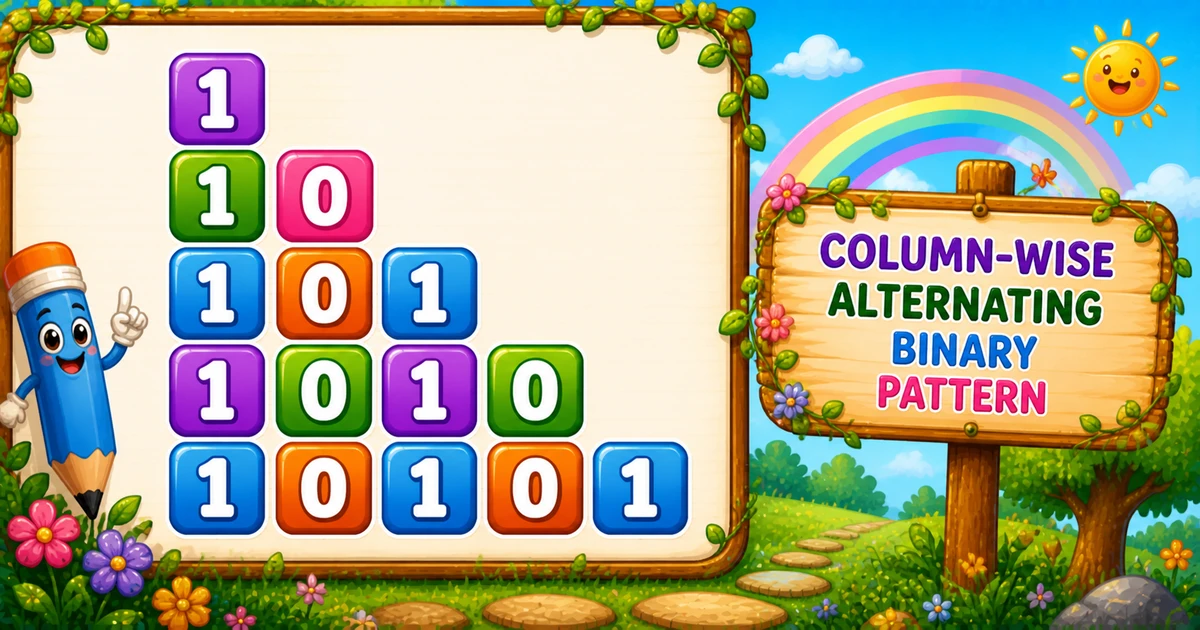
An ascending binary number triangle grows each row by one digit while printing 0 and 1 via j % 2 as the inner loop counts up — so every row starts with 1.
Remember
Rule: for i = 1..n, for j = 1..i print (j % 2)

1
10
101
1010
10101   ← 5 rows
In C you solve it with ascending outer and inner loops that print j % 2 with printf("%d", j % 2), then printf("\n") ends the row. Program 15 is the twin with a descending inner loop (1, 01, 101…).
Approach
How to Solve It
Outer loop grows from 1 to rows. Inner loop counts up and prints j % 2. End each row with printf("\n").
Method
Idea
Best for
j % 2
Ascending inner loop; remainder is the binary digit
Learning, interviews, exams
1 - (j % 2)
Same loops; every digit inverted
Quick flip variant
Pseudocode
Pseudocode
for i from 1 to rows:
    for j from 1 to i:
        print (j % 2) (no newline)
    print newline
Cheat sheet
Goal
Pattern
Grow each row
for (i = 1; i <= rows; i++)
Print binary digit
for (j = 1; j <= i; j++) printf("%d", j % 2);
End the row
printf("\n");
Flip every digit
printf("%d", 1 - (j % 2));
Descending twin (Program 15)
for (j = i; j >= 1; j--) printf("%d", j % 2);
Printing Numbers vs Starting a New Line
API
Effect
Use for
printf("%d", j % 2)
Stays on the same line
Each binary digit
printf("\n")
Ends the current line
After the inner loop
Print all digits without a newline, then end the row once.
Try it
Live Preview
Change the row count and the binary triangle updates instantly — including the total digit count.
Whole numbers from 1 to 15. Tap a chip or type a value — the preview redraws as you go.
Live result5 rows · 15 digits
1
10
101
1010
10101
Trace
Worked Walkthrough — rows = 4
Trace each outer-loop value of i, the ascending j sequence, and j % 2.
i
Inner j
j % 2
Printed row
1
1
1
1
2
1, 2
1, 0
10
3
1, 2, 3
1, 0, 1
101
4
1, 2, 3, 4
1, 0, 1, 0
1010
Total digits are 1+2+3+4 = 10 — the triangular number n(n+1)/2.
Code
C Programs
Three complete programs: fixed height, flipped digits, and scanf input. Use View Output for sample results.
Example 1 — Fixed rows = 5
Outer loop grows the length; ascending inner loop prints j % 2.
C
#include <stdio.h>

int main(void)
{
    int rows = 5;
    int i, j;

    for (i = 1; i <= rows; i++)
    {
        for (j = 1; j <= i; j++)
            printf("%d", j % 2);

        printf("\n");
    }

    return 0;
}
Output
1
10
101
1010
10101
How It Works
1. Grow.for (i = 1; i <= rows; i++) makes each row one digit longer.
2. Modulo digit. When i = 2, j is 1 then 2 → 1 then 0 → 10.
3. Newline.printf("\n") after the inner loop starts the next longer binary row.
Example 2 — Flip with 1 - (j % 2)
Same loops; invert every digit so the first row starts with 0.
C
#include <stdio.h>

int main(void)
{
    int rows = 5;
    int i, j;

    for (i = 1; i <= rows; i++)
    {
        for (j = 1; j <= i; j++)
            printf("%d", 1 - (j % 2));

        printf("\n");
    }

    return 0;
}
Output
0
01
010
0101
01010
How It Works
1. Invert. Where j % 2 was 1, you print 0, and vice versa.
2. Same shape. Row lengths still grow 1..5 — only the bit polarity flips.
Example 3 — User Input
Read the row count with scanf and reject non-positive values.
C
#include <stdio.h>

int main(void)
{
    int rows;
    int i, j;

    printf("Enter the number of rows: ");
    if (scanf("%d", &rows) != 1 || rows < 1)
    {
        printf("Please enter a positive integer.\n");
        return 1;
    }

    for (i = 1; i <= rows; i++)
    {
        for (j = 1; j <= i; j++)
            printf("%d", j % 2);

        printf("\n");
    }

    return 0;
}
Output (when user enters 4)
Enter the number of rows: 4
1
10
101
1010
How It Works
1. Validate rows. Require scanf success and rows >= 1.
2. Same nested loops. Four rows start at 1 and end at 1010.
Edge Cases & Pitfalls
Check these before calling the solution done.
forgot %
printf("%d", j) instead of j % 2
That prints 1, 2, 3… instead of binary digits. Always take modulo 2.
wrong direction
for (j = i; j >= 1; j--)
That is Program 15 (1, 01, 101…). Keep counting up for this lesson’s sample.
\n inside
printf("\n") inside the inner loop
That puts each digit on its own line. Print digits without a newline; call printf("\n") only after the row finishes.
rows = 1
Single digit
Output is just 1 — a good sanity check.
rows ≤ 0
Empty output
The outer loop never runs. Validate and prompt again for clearer UX.
flip vs base
Mixing Example 1 and 2
1 - (j % 2) is intentional inversion. Do not mix both formulas in the same program unless asked.
Analysis
Time and Space Complexity
Program
Time
Extra space
Nested loops (Examples 1–3)
O(n²)
O(1)
There are n rows printing 1+2+…+n digits, so total work is n(n+1)/2.
Remember
Key Takeaways
Rule: for i = 1..n, print j % 2 for j from 1 up to i.
Starts with 1: counting up from j = 1 makes every row begin with an odd remainder.
printf vs newline: digits stay on the line; printf("\n") advances after each row.
Next step: Program 17 builds a left-shifted odd number triangle.
One line: for each length from 1 to n, print j % 2 counting up with printf, then printf("\n").
Frequently Asked Questions
Modulo 2 returns the remainder after dividing by 2. Any integer is either even (remainder 0) or odd (remainder 1).
On row 2, the inner loop prints j = 1 then j = 2. That becomes 1 % 2 = 1 then 2 % 2 = 0, so the row is 10.
printf("%d", j % 2) stays on the same line. printf("\n") ends the current line. Binary digits use printf; the row break uses printf("\n") after the inner loop.
Row 3 prints j = 1, 2, 3 and j % 2 becomes 1, 0, 1 — concatenated as 101.
Program 16 counts the inner loop up (j = 1 to i) producing 1, 10, 101, 1010, 10101. Program 15 counts down (j = i to 1) producing 1, 01, 101, 0101, 10101.
Yes. Print 1 - (j % 2) instead of j % 2 to flip every digit — first row becomes 0 instead of 1.
Yes. Toggle a variable between 0 and 1 on each print, but modulo is the simplest approach for this pattern.
O(n²) where n is the number of rows. Total digit prints equal n+(n-1)+…+1 = n(n+1)/2.
Check scanf's return value: if (scanf("%d", &rows) != 1) handle bad input. Unchecked scanf leaves rows uninitialized on failure.
The outer loop never runs, so nothing is printed. Validate and prompt again if you want a clear user message.
🤔
Did you know?
Each row prints alternating 0 and 1 using j % 2. The inner loop counts up from 1 to i, so every row starts with 1 — still O(n²) total prints.