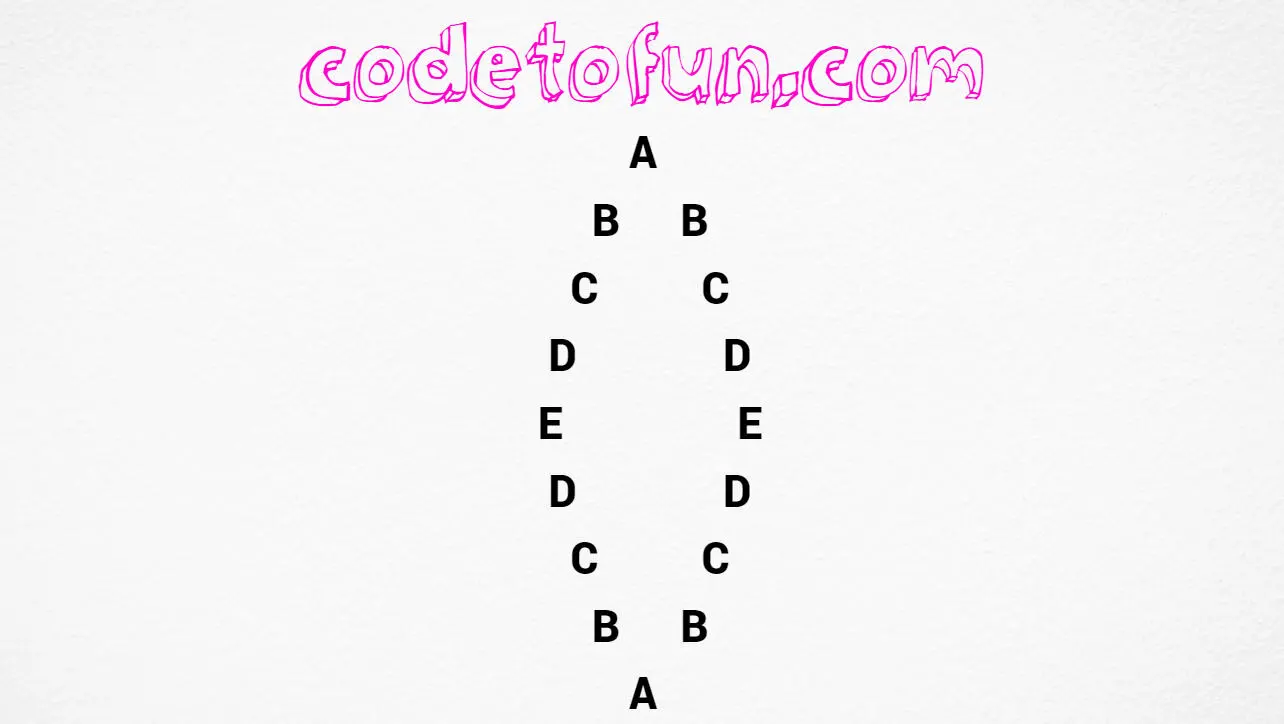
A diamond-shaped alphabet pattern prints only the outline of a diamond: tip A at the top, letters that open to a wide waist, then close back to tip A.
Remember
Rule: upper i = 0..n, then lower i = n-1..0
      On each row, print alpha[col] where i == col

    A
   B B
  C   C
 D     D
E       E
 D     D
  C   C
   B B
    A         ← A–E (9 rows, width 9)
Build it by stacking Program 33 (upper inverted V) and mirroring back from n - 1 so the waist prints once. Geometry matches the hollow diamond in Star Pattern 9, with letters instead of *.
Approach
How to Solve It
Print one hollow alphabet row with two inner loops, then call that idea twice — ascending, then descending past the waist.
Method
Idea
Best for
Dual outer loops
Upper 0..n, lower n-1..0, same j/k bodies
Learning, interviews, clearest stack of P33
Helper + PrintRow
One PrintRow(i) called from both halves
Less duplication once the geometry clicks
Pseudocode
Pseudocode
n = endLetter - 'A'
printHollowRow(i, n):
    for j from n down to 0:
        print alpha[j] if i == j else " "
    for k from 1 to n:
        print alpha[k] if i == k else " "
    print newline

for i from 0 to n:          // upper half
    printHollowRow(i, n)
for i from n - 1 down to 0: // lower half (skip waist)
    printHollowRow(i, n)
Change the end letter and the diamond updates instantly — including row and outline-letter counts.
One letter from A to Z. You get 2 * n + 1 rows where n = end - 'A'.
Live resultA–E · 9 rows · 16 letters
    A
   B B
  C   C
 D     D
E       E
 D     D
  C   C
   B B
    A
Trace
Worked Walkthrough — A–D (n = 3)
Trace each outer value of i. Letters land where j == i or k == i. Spaces show as ·.
Half
i
Printed row
Letters
Upper
0 (A)
···A···
1
Upper
1 (B)
··B·B··
2
Upper
2 (C)
·C···C·
2
Upper (waist)
3 (D)
D·····D
2
Lower
2 (C)
·C···C·
2
Lower
1 (B)
··B·B··
2
Lower
0 (A)
···A···
1
Lines: 4 + 3 = 7 = 2×3 + 1. Outline letters: 12 = 4×3. Width of every line: 7.
Code
C# Programs
Three complete programs: fixed A–E, end-letter input, and a reusable row helper. Use View Output to reveal sample results.
Example 1 — Fixed A–E
Upper i = 0..4, lower i = 3..0, same j/k bodies.
C#
using System;

class Program
{
    static void Main()
    {
        char[] alpha = "ABCDEFGHIJKLMNOPQRSTUVWXYZ".ToCharArray();

        // Upper half: A through E
        for (int i = 0; i <= 4; i++)
        {
            for (int j = 4; j >= 0; j--)
            {
                if (i == j)
                    Console.Write(alpha[j]);
                else
                    Console.Write(" ");
            }
            for (int k = 1; k <= 4; k++)
            {
                if (i == k)
                    Console.Write(alpha[k]);
                else
                    Console.Write(" ");
            }
            Console.WriteLine();
        }

        // Lower half: skip duplicate waist
        for (int i = 3; i >= 0; i--)
        {
            for (int j = 4; j >= 0; j--)
            {
                if (i == j)
                    Console.Write(alpha[j]);
                else
                    Console.Write(" ");
            }
            for (int k = 1; k <= 4; k++)
            {
                if (i == k)
                    Console.Write(alpha[k]);
                else
                    Console.Write(" ");
            }
            Console.WriteLine();
        }
    }
}
Output
    A
   B B
  C   C
 D     D
E       E
 D     D
  C   C
   B B
    A
How It Works
1. Alphabet table.alpha[0] is A, alpha[4] is E.
2. Upper half grows outward.i runs from 0 to 4. Left j and right k print a letter only when they equal i.
3. Lower half mirrors without a second waist.i runs from 3 down to 0 with the same inner logic.
4. Break the line.Console.WriteLine() after both inner loops starts the next outline row.
Example 2 — End Letter Input
Read the end letter and scale both phases with n = end - 'A'. Prefer validating a single A–Z character in real apps.
C#
using System;

class Program
{
    static void Main()
    {
        Console.Write("Enter end letter (like E): ");
        string line = Console.ReadLine();
        char end = char.ToUpperInvariant(line.Trim()[0]);

        int n = end - 'A';
        char[] alpha = "ABCDEFGHIJKLMNOPQRSTUVWXYZ".ToCharArray();

        for (int i = 0; i <= n; i++)
        {
            for (int j = n; j >= 0; j--)
                Console.Write(i == j ? alpha[j] : ' ');
            for (int k = 1; k <= n; k++)
                Console.Write(i == k ? alpha[k] : ' ');
            Console.WriteLine();
        }

        for (int i = n - 1; i >= 0; i--)
        {
            for (int j = n; j >= 0; j--)
                Console.Write(i == j ? alpha[j] : ' ');
            for (int k = 1; k <= n; k++)
                Console.Write(i == k ? alpha[k] : ' ');
            Console.WriteLine();
        }
    }
}
Output (when user enters C)
Enter end letter (like E): C
  A
 B B
C   C
 B B
  A
How It Works
1. Prompt and normalize. Read a line, trim it, and take the first character as uppercase.
2. Scale both phases. For end = C, n = 2 — 5 rows of width 5.
3. Safer input tip. Bare [0] throws on empty input. Prefer:
Safer input
string line = (Console.ReadLine() ?? "").Trim();
if (line.Length != 1 || !char.IsLetter(line[0]))
{
    Console.WriteLine("Enter a single letter A–Z.");
    return;
}
char end = char.ToUpperInvariant(line[0]);
if (end < 'A' || end > 'Z')
{
    Console.WriteLine("Enter a single letter A–Z.");
    return;
}
Example 3 — Helper Method
Extract one row printer so the diamond reads as “upper, then lower.”
C#
using System;

class Program
{
    static void PrintCell(char[] alpha, int row, int col)
    {
        Console.Write(row == col ? alpha[col] : ' ');
    }

    static void PrintRow(char[] alpha, int n, int i)
    {
        for (int j = n; j >= 0; j--)
            PrintCell(alpha, i, j);
        for (int k = 1; k <= n; k++)
            PrintCell(alpha, i, k);
        Console.WriteLine();
    }

    static void Main()
    {
        int n = 4;
        char[] alpha = "ABCDEFGHIJKLMNOPQRSTUVWXYZ".ToCharArray();

        for (int i = 0; i <= n; i++)
            PrintRow(alpha, n, i);

        for (int i = n - 1; i >= 0; i--)
            PrintRow(alpha, n, i);
    }
}
Output
    A
   B B
  C   C
 D     D
E       E
 D     D
  C   C
   B B
    A
How It Works
1. One row recipe.PrintRow owns the j/k diagonal logic and the row break.
2. Call it twice. Upper half walks i up; lower half walks i down from n - 1.
3. Same shape, less copy-paste. Learn the expanded loops first (Example 1), then refactor when the geometry feels familiar.
Edge Cases & Pitfalls
Check these before calling the solution done.
Lower starts at n
Double waist
If the second outer loop starts at i = n, the widest line prints twice. Use n - 1.
k = 0
Duplicate tip A
Right loop must start at k = 1. Starting at 0 prints two As on the tip rows.
WriteLine inside
Broken outline
If WriteLine sits inside j or k, the outline collapses into a column. Call it only after both inner loops.
end = A
Single tip
Upper prints one line; lower never runs. Output is just A — a good sanity check.
Proportional font
Looks skewed in the IDE
Spaces and letters need a monospace font. Proportional fonts make diagonals look uneven.
Bad input
Validate one letter
Empty lines and multi-character input break naive [0] indexing — require a single A–Z character.
Analysis
Time and Space Complexity
Program
Time
Extra space
Dual loops (Examples 1–2)
O(n²)
O(1) beyond the alphabet array
Helper method (Example 3)
O(n²)
O(1) beyond the alphabet array
Lines printed = 2n + 1. Each line walks about 2n + 1 positions across the two inner loops, so work is still quadratic in n. Outline letters grow as 4n for n ≥ 1 (and 1 when n = 0).
Remember
Key Takeaways
Compose halves: upper 0..n then lower n-1..0 — Program 33 with one seam fix.
Diagonal rule: letter only when i == j or i == k; everything else is a space.
Break the row: call WriteLine only after both inner loops.
Complexity:O(n²) time; O(1) extra space beyond the alphabet table.
One line: print hollow alphabet rows for i = 0..n, then again for i = n-1..0, starring only the diagonals.
Frequently Asked Questions
The first outer loop grows i from 0 through n (A through the end letter) using the inverted-V inner loops. The second outer loop shrinks i from n-1 through 0 with the same inner loops, mirroring the top without repeating the widest row.
Because the widest row is already printed at the end of the first part. Starting the second part at n again would duplicate that waist line.
Yes. Program 34 is Program 33 printed for A..end and then mirrored back for (end-1)..A using the same inner loops.
Console.Write stays on the same line. Console.WriteLine ends the current line. Letters and spaces use Write; the row break uses WriteLine after both inner loops.
For n = end - 'A', total rows are (n+1) + n = 2n+1. For A..E, n is 4 and you get 9 rows.
Width is also 2n+1: n+1 columns from the left block and n columns from the right block.
O(n²) because there are Theta(n) rows and each row scans Theta(n) positions across both blocks.
Read a line, trim it, require a single A–Z character (or ToUpperInvariant), and reject empty or multi-character input.
🤔
Did you know?
Two phases with identical inner loops. Phase 1 prints A..E using two diagonal scans (left: E..A, right: B..E). Phase 2 prints D..A to mirror the top without repeating the widest E row. For n = end - 'A', total rows and width are both 2n + 1.