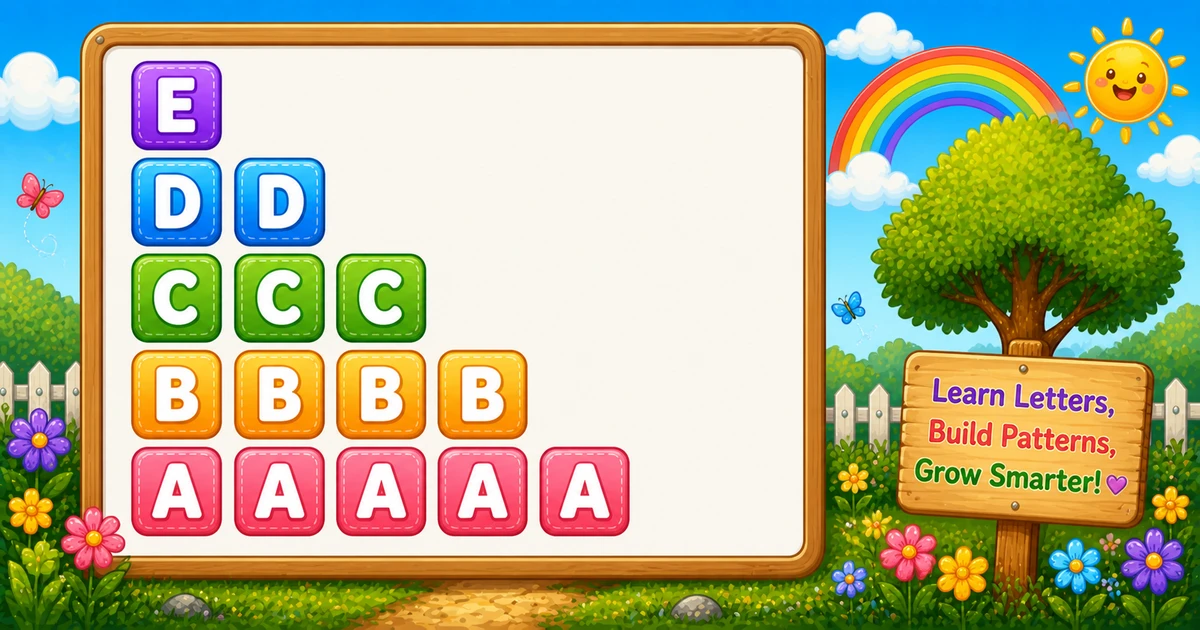
A reverse repeating alphabet triangle grows by one repeated letter on each new line while letters count downward from the top of the alphabet range.
Remember
Rule: for letter i from top down to 'A',
      print i with growing width 1, 2, 3, …

E
DD
CCC
BBBB
AAAAA     ← 5 rows (top = 'E')
It is the reverse of Program 9: same growing widths, but letters step E → A instead of A → E. Print the outer letter inside the inner loop so each row stays uniform. Flip the widths in Program 11 to get the inverted twin.
Approach
How to Solve It
Two ways to emit the same shape — start with nested char loops, then optionally shorten with new string.
Method
Idea
Best for
Nested char loops
Outer = letter; inner = growing width; print outer letter
Learning, interviews, exams
new string(ch, repeat)
Build a whole repeated-letter row in one call
Shorter demos once loops click
Pseudocode
Pseudocode
for i from top down to 'A':
    for j from top down to i:
        print i (no newline)
    print newline
Change the height and the reverse repeating triangle updates instantly — including the letter total.
Whole numbers from 1 to 26 (A–Z). Tap a chip or type a value — the preview redraws as you go.
Live result5 rows · 15 letters
E
DD
CCC
BBBB
AAAAA
Trace
Worked Walkthrough — 'E' down to 'A'
Trace each outer-loop value of i and count how many times the inner loop runs.
i
Inner j range
Printed row
Repeats
'E'
'E'..'E'
E
1
'D'
'E'..'D'
DD
2
'C'
'E'..'C'
CCC
3
'B'
'E'..'B'
BBBB
4
'A'
'E'..'A'
AAAAA
5
Total letter prints: 1 + 2 + 3 + 4 + 5 = 15 = 5×6/2. That triangular sum is why time is O(n²).
Code
C# Programs
Three complete programs: fixed letters, console input, and a new string shortcut. Use View Output to reveal sample results.
Example 1 — Fixed 'E' down to 'A'
Hard-coded range — outer letter counts down; inner loop grows and prints that letter.
C#
using System;

class Program
{
    static void Main()
    {
        for (char i = 'E'; i >= 'A'; i--)
        {
            for (char j = 'E'; j >= i; j--)
            {
                Console.Write(i);
            }
            Console.WriteLine();
        }
    }
}
Output
E
DD
CCC
BBBB
AAAAA
How It Works
1. Outer loop picks the letter.i runs from 'E' down to 'A'.
2. Inner loop sets the width.j runs from 'E' down to i — once for E, twice for D, and so on.
3. Print the outer letter.Console.Write(i) keeps the whole row the same character.
4. Break the line.Console.WriteLine() after the inner loop starts the next row.
Example 2 — User Input Version
Compute top = 'A' + rows - 1, then grow repeat from 1 as letters count down. Prefer int.TryParse in real apps.
C#
using System;

class Program
{
    static void Main()
    {
        Console.Write("Enter the number of rows: ");
        int rows = Convert.ToInt32(Console.ReadLine());

        char top = (char)('A' + rows - 1);
        int repeat = 1;

        for (char ch = top; ch >= 'A'; ch--)
        {
            for (int k = 1; k <= repeat; k++)
            {
                Console.Write(ch);
            }
            Console.WriteLine();
            repeat++;
        }
    }
}
Output (when user enters 4)
Enter the number of rows: 4
D
CC
BBB
AAAA
How It Works
1. Prompt and read. Ask for a row count, then convert the line to an int.
2. Compute the top letter. For rows = 4, top is 'D' — first row is D.
3. Grow the repeat count. Start at repeat = 1 and increment after each row so widths become 1, 2, 3, 4.
4. Safer input tip.Convert.ToInt32 throws on letters. Prefer:
Safer input
if (!int.TryParse(Console.ReadLine(), out int rows) || rows < 1 || rows > 26)
{
    Console.WriteLine("Enter a whole number from 1 to 26.");
    return;
}
Example 3 — new string(ch, repeat)
Build each repeated-letter row in one call — same shape, no explicit character loop.
C#
using System;

class Program
{
    static void Main()
    {
        int rows = 5;
        char top = (char)('A' + rows - 1);
        int repeat = 1;

        for (char ch = top; ch >= 'A'; ch--)
        {
            Console.WriteLine(new string(ch, repeat));
            repeat++;
        }
    }
}
Output
E
DD
CCC
BBBB
AAAAA
How It Works
1. Same countdown. Still walk ch from top down to 'A'.
2. Build the row.new string(ch, repeat) creates a string of length repeat filled with ch.
3. Learn loops first. Use Examples 1–2 when you need to show nested bounds; treat this as a polish shortcut afterward.
Edge Cases & Pitfalls
Check these before calling the solution done.
Write(j)
Stepping letters on a row
If you print j instead of i, letters change across the row. Print the outer letter to keep each row uniform.
i++
Forward triangle by mistake
Counting letters upward reprints Program 9. Keep i-- from the top letter down to 'A'.
WriteLine inside
Column of letters
If WriteLine is inside the inner loop, each letter lands on its own line. Use Write for letters; WriteLine only after the inner loop.
rows > 26
Past Z
'A' + rows - 1 leaves A–Z when rows > 26. Clamp or reject in interactive programs.
rows = 1
Single A
Output is just A — top and tip coincide. A good sanity check.
Bad input
Use TryParse
Convert.ToInt32 throws on letters — prefer int.TryParse and require 1–26.
Analysis
Time and Space Complexity
Program
Time
Extra space
Nested loops (Examples 1–2)
O(rows²)
O(1)
new string (Example 3)
O(rows²)
O(rows) per temporary row string
Total letters = 1 + 2 + … + n = n(n + 1)/2 — still quadratic in n. Same totals as Program 11; only the print order of widths differs.
Remember
Key Takeaways
Rule: countdown letter i; print i with growing width 1, 2, 3, …
Reverse of Program 9: same growing widths — letters step down instead of up.
Break the row: call WriteLine only after the inner loop.
Complexity:O(n²) time from the triangular letter count; O(1) extra space for nested loops.
One line: for i from the top letter down to 'A', print i for every j from top down to i, then WriteLine.
Frequently Asked Questions
Program 9 uses A, BB, CCC, ... (letters increase). Program 10 uses E, DD, CCC, ... (letters decrease) with the same growing repeat counts.
On the 4th row the outer-loop letter is B, and the inner loop runs four times, printing B each time.
j only controls how many times the loop runs. Printing i keeps the row the same letter; printing j would change letters across the row.
With for (char j = top; j >= i; j--), when i is near the top the range is short; as i moves toward A the range lengthens, so repeat counts grow 1, 2, 3, …
Console.Write stays on the same line. Console.WriteLine ends the current line. Letters use Write; the row break uses WriteLine after the inner loop.
O(n²) where n is the number of rows. Total Console.Write calls equal 1+2+…+n = n(n+1)/2.
Yes. Console.WriteLine(new string(ch, repeat)) prints a full repeated-letter row in one call. Nested loops are better for learning; the string constructor is a handy shortcut later.
Prefer int.TryParse(Console.ReadLine(), out rows) and clamp rows between 1 and 26 so bad input does not throw FormatException or walk past A.
🤔
Did you know?
This pattern is the reverse of Program 9: row widths still grow 1, 2, 3, …, but letters run backward (E, then D, then C, …). Print the outer loop letter inside the inner loop so each row stays uniform.